 1 / 9



- Thickened Stainless Steel
- ABS Plastic
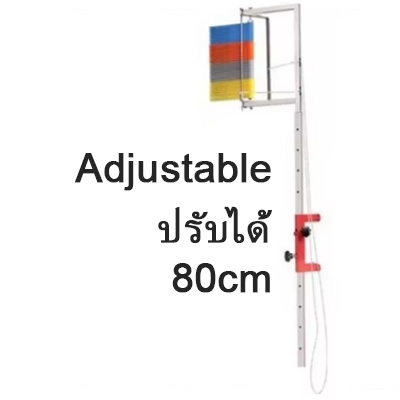
- Height Adjustment: 80cm
- Multi Colour
- Rope Reset
Wall Mounted Vertec Vertical Jump Tester (Multi Colour, Adjustable 80cm)
Height adjustment is done easily, via hand-twist bolt.
The poles are made from thickened stainless steel for stability.
This particular model uses a rope to reset the vanes after each jump.
This wall mounted Vertec is a drilled, permanent installation rather than a stand, and can adjust within a fixed range after installation.
- Installation needs a hammer drill and a solid wall. Four expansion bolts into strong concrete, with enough clear height above the mounting point for upward adjustment, and set at a height that will suit your cohorts of jumpers. Level the pole before marking the holes.
- The rope reset is assembled on site. Two rollers feed through the frame, then rope is threaded through each roller and through the vane resetter bar, and knotted two or three times so the combined knot sits inside the resetter. One rope resets the vanes and the other moves the resetter out of the way.
- Calibration differs from the free standing models, because the mounting height is unique to each installation. Set the frame to 0cm and measure from the ground to 1cm below the 1cm vane: that is your installation height. A reading is then calculated as: installation height plus frame adjustment plus vanes struck. It is good to install it at a round numbered height from the ground. For example, before you fit any bolts, set the frame to the 0cm adjustment and lift it until the 1cm vane is 171cm off the ground, which gives you an installation height of 170cm. A jump then reads as vane touched plus 170cm plus the frame adjustment, so a jumper who strikes the 17cm vane with the frame set at 20cm has touched 207cm.
- One installation may not suit both children and adults. The frame adjusts through 80cm plus 40cm of vanes, while the stand based models have an adjustment range of roughly 1.9m to 2.5m between their lowest and highest settings, plus 40cm of vanes, so the span from a young child's standing reach to a tall adult's jump touch can be wider than the 120cm of range. There are two ways around it. Install a second unit at a second height, or take standing reach against a wall with chalk and a tape, and then use the Vertec for the jump measurements only. The second needs no extra hardware, because the vanes then have to cover the jump touches alone, instead of jumps and standing reach.
- Suggested Process: Step 1: Measure standing reach against a wall. Step 2: Only measure the jump heights on the wall mounted Vertec. Or alternatively: Have 2 wall mounted Vertecs set up at differing heights.
- The vane rod moves to either side, depending on which side the jumpers will stand. Important: Do not hit the vanes towards the resetter rod, but away from it.
Which Vertec to choose
This is the one for a room where floor space is the problem, or wanting to have a permanent set-up. It bolts to a wall, weighs 7kg and gives 80cm of adjustment plus 40cm of vanes, so it becomes a permanent testing station rather than something you carry out to a field. Reset is by rope rather than a pole. The mounting height depends on how tall the intended users are and how high they jump. To judge it, have them do test jumps against the wall with chalk and see the highest reading you realistically need to support. The wall itself has to take expansion bolts if you use the ones supplied, so concrete or brick.
What is involved in installing it?
It is a permanent installation, bolted to a solid wall rather than set on a stand. You need a hammer drill and four expansion bolts into strong concrete or brick, with clear height above the mounting point for upward adjustment. Level the pole before marking the holes. The rope reset is assembled on site: two rollers feed through the frame, and rope threads through each roller and the vane resetter bar, knotted so the knot sits inside the resetter.
How high should I mount it?
Mount it at a height that suits the tallest reach your jumpers realistically need, and at a round number if you can. Before drilling, have your intended users do test jumps against the wall with chalk and note the highest mark. Then set the frame to 0cm and lift it until the 1cm vane sits 1cm above a round figure, such as 171cm, which gives an installation height of 170cm.
How is a jump height calculated on the wall mounted model?
Add three numbers: the installation height, the frame adjustment and the vane struck. The installation height is measured once, with the frame at 0cm, from the ground to 1cm below the 1cm vane. With an installation height of 170cm and the frame set at 20cm, a jumper who strikes the 17cm vane has touched 207cm. This differs from the free standing models, because the mounting height is unique to each installation.
Can one wall mounted Vertec cover both children and adults?
Often not. The frame adjusts through 80cm plus 40cm of vanes, and the span from a young child's standing reach to a tall adult's jump touch can be wider than that. The stand models have a larger adjustment range, roughly 1.9m to 2.5m between their lowest and highest settings. The simplest fix is to measure standing reach against a wall with chalk and a tape, then use the Vertec for jump heights only. Otherwise, install a second unit at a different height.
Which side should jumpers stand on?
Either side, because the vane rod moves across to suit where your jumpers will stand. The important rule is direction: always hit the vanes away from the resetter rod, never towards it. Check the rod position when you install the unit, and tell each group which way to strike before they start, so nobody hits the vanes the wrong way during a session.

| Adjustable Height | 80cm |
| Weight | 7kg |
| Colour | Red, Silver, Multi Colour |
| What's Included | Vertical Jump (Wall Mounted), Reset Rope |
| Email Support | 7 Days per Week |
 Specification Sheet (PDF) English or ThaiSet-up Manual (PDF) English or Thai