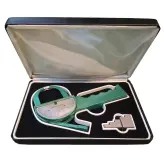



- Dynamometer Device + Metal Frame with Grips + 2x Attachments (2x AA Batteries not included) + Protective Carry Case
- Maximum Force: 50kg
Digital Handheld Muscle Strength Dynamometer
The assessor must have the strength to keep the device steady while the athlete applies force against it, meaning that a strong or large assessor could test larger muscles, while a smaller assessor would find it most useful for small muscles (tricep, bicep, deltoid, neck, wrist etc), for younger or lighter athletes, or for comparing left and right sides.
The device can provide readings in kgf, N, or lbf. It can be used in Live mode or Peak mode (Live: reading constantly updates, Peak: only the greatest force is shown until pressing Zero). It has a Save mode, to save data values to memory (only works in Live mode), to read back later.
The device uses a solid metal frame with gripping handles, so that the assessor can use 2 hands to keep the device steady, to support higher force readings.
Instructions
- Instruct the athlete on how to apply force against the device, with the correct muscle and positioning.
- Turn on the device, and set to Peak mode if that is your preferred mode.
- Take a braced stance, with grip on both handles of the device, then position the device so that the athlete can apply force straight down the bolt of the device.
- After a couple of seconds, allow the athlete to cease applying force.
- Record the reading, then press Zero so the device is ready for the next usage.
The manual is clear that the examiner affects the reading as much as the device does.
- Peak mode against live mode. Peak holds the highest force measured until you zero it. Live shows only the current value. Live values can be saved to memory one at a time; peak values cannot be saved, but they can easily be read off the screen. Saved readings are reviewed in a separate read mode, scrolled with the arrow buttons, and deleted individually.
- The examiner has to hold the device still, and the force must run straight down the bolt of the device rather than diagonally. A moving examiner would make the reading inaccurate.
- Two attachments, an arc and a circle, screw onto the end bolt and lock by spinning a disc against them. The attachments are for pushing only, although the device itself can read both positive and negative force.
- Two displays are fitted, so it can be read from either side.
- Units and power. Switches between kgf, newtons and pounds force. It takes two AA batteries. The manual illustrates test positions for the quadriceps, hamstring and hip flexor.
Who this suits
Handheld strength testing up to 50kg, with the metal frame and handles to allow for a tester to hold a solid brace position against the device. In practice, peak mode is the mode to use in most cases: you can concentrate on holding the device in place and on the person being tested, and read the peak value once the test is complete. Live mode means watching the screen as the values change, which takes your attention off the person being tested.
What is the difference between peak and live mode?
Peak holds the highest force measured until you zero it, and live shows only the current dynamically changing value. Live values can be saved to memory one at a time, if you press Save during the test. Peak values cannot be saved to memory, but can easily be read off the screen after the test is complete. Saved readings are reviewed in a separate read mode, scrolled with the arrow buttons and deleted individually. In practice, peak mode is the mode to use in most cases: you can concentrate on holding the device in place and on the person being tested, and read the peak value once the test is complete.
What affects the accuracy of a reading?
The examiner, mainly. The manual is explicit that the examiner has to be strong enough to hold the device still, and that the force must run straight down the bolt of the device rather than diagonally. A moving examiner makes the reading inaccurate. The two attachments, an arc and a circle, screw onto the end bolt and lock by spinning a disc against them, and they are for pushing only.
Is this a hand-held dynamometer or a grip dynamometer?
It is a hand-held dynamometer. The tester holds it steady while the athlete pushes against it, so it reads the force of a chosen muscle group, up to 50 kgf; the manual shows test positions for the quadriceps, hamstring and hip flexor. A grip dynamometer is a different device that the athlete squeezes, and it measures grip strength only. Our grip strength norms chart covers that test.

| What's Included | Dynamometer Device, Metal Frame with Grips, 2x Attachments, (2x AA Batteries not included) + Protective Carry Case |
| Colour | Black + Silver |
| Maximum Force | 50 kgf (490 N, 110 lbf) |
| Resolution | 0.01 kgf, 0.01 N, 0.1 lbf |
| Accuracy | ±0.5% |
| Units | kgf, N, lbf |
| Modes | Peak and Live mode (Save function for live mode only) |
| Memory | 99 readings |
| Display | Two 4 digit LCDs, readable from either side, blue backlight |
| Power | 2x AA batteries |
| Auto Power Off | 10 minutes |
| Protection Class | IP55 |
| Operating Conditions | 0 to 40°C, humidity below 80% |
| Weight | 705g (main unit) |
| Email Support | 7 Days per Week |
 Specification Sheet (PDF) English or ThaiSet-up Guide (PDF) English or ThaiInternal Calibration Certificate - FM 204M / FM 207M