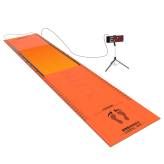



- 1 Starting Speaker and Signal Box with Remote, 2 Timing Gates, 2 Reflectors
- Aluminum Carry Case
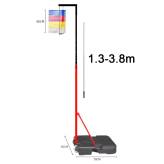
- Height Adjustment: 0.6-1.6m
- Lithium Batteries
- 0.001s Accuracy to 1 Minute
- 0.01s Accuracy to 10 Minutes
- 100 Minutes Maximum Time
- 200m Signal Range
Multi Purpose Laser Timing Gates (2 or More Gates)
There is a Camera Mode for research purposes (to minimize errors such as false readings from arms/legs crossing the laser), and a variety of modes for other purposes (short distance, long distance, shuttle run etc).
This specific listing is for 2 finishing gates with aluminum carry case (1 signal box and remote, 1 speaker, 2 timing gates, 2 reflectors, 5 tripod stands,).
If wanting more than 2 timing gates, you must select that option in the dropdowns.
For multi-lane race set-up, the signal box and speaker are set up at the starting line, with the timing gates and 1 reflector at the finishing line. The remote has buttons for 'On Your Mark', 'Set', '(Gun Fires)'. Upon each athlete passing their timing gate, the timer will pause, to 0.001s accuracy.
Accuracy is 0.001s up to 60s. From 60s to 10 minutes, the accuracy is 0.01s, and from 10 minutes to 100 minutes, the accuracy is 0.1s. Times can be tracked up to 100 minutes.
The tripod stands can be adjusted in height between 60cm and 160cm tall. The signal distance between start gate and timing gate is up to 200m.
Each powered device includes an internal rechargeable premium lithium battery (recharge via USB).
A variety of modes are possible:
- Normal mode for 50-400m, with firing gun sound effect start.
- Starting point trigger mode - the time starts upon passing the first gate.
- Video camera mode - you record the finishing line and timer, then replay it to check the times. Most reliable mode for research purposes, by removing the possibility of false readings when the arms/legs pass the laser.
- Multi lap mode for 800m-1500m+ - the timers will not record times until the final lap.
- Cumulative time mode - recording the total time of multiple passes through the gate, updating after each pass.
- Lap timing mode - displaying the time of only the most recent lap.
Advantages
- Can be changed to Camera Mode for higher reliability for research, being particularly important for shorter distances.
- Laser Modes acceptable for distances of 20m and up, or less stringent testing purposes.
- Convenient wireless usage.
- Relatively simple set-up.
- Clear readings displayed.
- Multiple mode options.
Limitations
Limitation 1: False triggers from swinging arms or legs are possible in single-laser measurement systems, or single-photocell systems. Thus, single-laser systems have a greater Typical Error than video camera systems. This can effect times by 0.05-0.06 seconds, which is most significant over distances below 20 meters. Thus video camera is able to detect smaller real changes in performance.Solution: Laser modes are most effective for distances of 20m and above eg. 20m-1500m, where 0.05-0.06s is less significant. But to fully remove false triggers, the system should be changed to Video Camera mode. (Change to video mode with gun sound start, set up a timer at the finish line, set up a high speed camera in line with the timer and finish line. Finish the race, then review the video, recording the times displayed at the point that the sacrum or torso passes the finish line.)
Overall: "For sprints longer than 20 m or with a flying start, validity of single beam photocells has been proven excellent (Altmann et al., 2018; Bastida Castillo et al., 2017)."
"Although the Video Camera timing system does not provide immediate feedback, its excellent validity and reliability allows for the most reliable measurements of an athlete's sprint time, especially in distances less than 30′."
What needs charging before I can get started, and how to run the start sequence.
- What charges and what does not. The timer displays charge by USB, showing a red light while charging and green when done, and take about three hours to full. They show a battery percentage in the second after being switched on. The speaker charges by USB to USB-C, with the charging light turning off when it is finished. The signal box needs no charging at all: it draws power from the speaker. The remote takes a 9V battery and is not rechargeable.
- The speaker has to be in AUX mode to receive audio from the signal box. The signal box then shows a green light.
- Remote buttons. A is On Your Mark, B is Set, and C fires the gun.
- It works without the remote, as a single lane, using multiple timers and reflectors, with the first gate starting the clock for all other gates.
- Antennas. One screws into each timer display after a yellow protective cap is removed.
- Changing modes. Changing between modes is not self-explanatory when looking at the display, but is relatively straight forward when you refer to the manual. The manual gives instructions for holding the buttons down in the correct way to change mode, and a description of each mode. After changing mode, it will be locked in even when turning off the device, until you change mode again.
Who this suits
This is the set for timing sprints and agility properly rather than with a stopwatch. It works best when you have a testing and data collection plan that you want to complete, for example: if you wanted to test the 40 yard dash of each team mate with a 10 yard rolling start, or if you wanted to break down the 100m sprint of each athlete into 20m sections. It can be ordered as two or more gates. It has 200m of signal range, which can cover a whole 400m athletics track, and resolution to 0.001 seconds over the first minute, which means you can test a sprint or a shuttle and read the splits. The displays and smaller parts can be stored in an aluminium case, with tripod stands and speaker stored separately. How many gates you need depends on what you want to measure. For example, four gates can time four runners racing at once. Or one runner can pass through two to eight gates in sequence. For example, five gates for one runner could sit on the 10m, 20m, 30m, 40m and 50m lines, or on the 20m, 40m, 60m, 80m and 100m lines, or at 100m, 200m, 300m, 350m and 400m, and each layout gives different insights from the same gates.
What needs charging before a session?
The timer displays and the speaker. The displays charge by USB, showing a red light while charging and green when done, and take about three hours to full, with a battery percentage shown in the second after they are switched on. The speaker charges by USB to USB-C and its charging light goes out when it is finished. The signal box draws power from the speaker, and the remote takes a 9V battery that is not rechargeable.
Can I use the timing gates without the remote?
Yes, as a single lane, using multiple timers and reflectors, with the first gate starting the clock for all the other gates. The remote is what gives you the start sequence: A is On Your Mark, B is Set and C fires the gun. For that to be heard, the speaker has to be switched to AUX mode so it connects to the signal box, which then shows a green light to confirm.
How do I change the timing mode?
By holding the buttons down in the sequence the manual sets out. The display does not make this obvious on its own, so keep the manual to hand when wanting to change mode, because it gives the button instructions and a description of what each mode does. Once a mode is set it stays set, including after the device is switched off, until you change it again.
How many gates do I need?
That depends on what you want to measure rather than on the sport. Four gates can time four runners racing at once. One runner can instead pass through two to eight gates in sequence, so five gates could sit on the 10, 20, 30, 40 and 50m lines, or at 100, 200, 300, 350 and 400m. Each layout gives different insights from the same set of gates.
How accurate are they, and how far apart can the gates sit?
Resolution is 0.001 seconds over the first minute, and the signal range is 200m, which covers a whole 400m athletics track. That is what makes splits worth reading: a hand timed sprint carries about two tenths of a second of reaction error, which is enough to hide a real improvement over 40 yards or to make one appear.
How does the set pack away?
The displays and the smaller parts store in an aluminium case, and the tripod stands and the speaker are stored separately. Each antenna screws into its own timer display after the yellow protective cap has been removed. The remote runs on a 9V battery, so it is worth keeping a spare battery with the case for a testing day away from the club.

| Adjustable Height | 0.6-1.6m |
| Signal Range | 200m |
| Accuracy | 0.001s to 1 Minute, 0.01s to 10 Minutes, 0.1s to 100 Minutes |
| Maximum Time | 100 Minutes |
| Signal Range | 200m |
| Colour | Black |
| What's Included | Starting Speaker and Signal Box with Remote, 2 Timing Gates, 2 Reflectors, 5 Tripod Stands, Aluminum Carry Case |
| Email Support | 7 Days per Week |
 Specification Sheet (PDF) English or ThaiManual (PDF) English or Thai