
Jump Testing
Five ways to measure a jump. Four are Vertec style vertical jump testers, where the athlete swipes the highest coloured vane they can reach at the top of the jump: a 3.6m model with pole reset, a 3.8m model on a weighted base, a wall mounted version adjustable to 80cm, and a 3.6m electronic model that reads the height straight off an infrared display. The fifth measures standing long jump on a 3.6m electronic mat. Prices run from 11,900 to 19,900 baht.


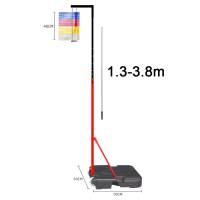
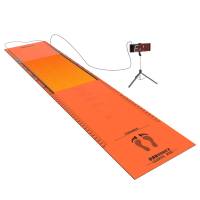

How the four vertical jump testers differ
All four measure the same thing, the difference between standing reach and the highest point of a jump. They differ in how they are mounted, how high they reach, and how the result is read.
- 3.6m, pole reset, 12,900 baht. Free standing on a three footed base, adjustable from 1.7 to 3.6m, 16kg, in thickened stainless steel and ABS. The vanes are reset with a telescopic pole between attempts.
- 3.8m, weighted base, 12,900 baht. The tallest of the four, adjustable from 1.3 to 3.8m, 10kg, in painted steel and ABS, on a wheeled and weighted base.
- Wall mounted, 80cm adjustment, 11,900 baht. 7kg, bolted into concrete, with a rope reset instead of a pole. It takes no floor space and cannot be knocked over, but the installation height becomes part of every reading.
- 3.6m electronic, infrared, 19,900 baht. Adjustable from 1.5 to 3.6m, 10kg, in painted aluminium alloy, on a wheeled base filled with water for stability. Infrared sensors read the jump onto a digital display, so nobody counts vanes and nothing is reset between attempts.
The long jump mat
The fifth product measures standing long jump rather than vertical. The mat is 360cm long in orange and black, and two infrared bars sit across it on magnets. Those magnets grip metal circles that you stick to the underside of the mat at the positions that suit your athletes, and the display is then told where the bars are, in 5cm steps. The mat reads the heel of the rearmost foot, an attempt where the athlete falls backwards does not count, and the manual suggests best of three.
Common Questions
What is the difference between a Vertec and an electronic jump tester?
A Vertec is read by eye and an electronic tester is read off a display. On the three mechanical models the athlete swipes coloured vanes at the top of the jump, you count the highest one moved, then reset them with a pole or a rope. The 3.6m infrared model measures the jump with sensors and shows the height on a digital panel, which removes both the counting and the reset. That is the reason it costs 19,900 baht against 11,900 to 12,900.
How high do these testers measure?
The free standing models cover 1.7 to 3.6m and 1.3 to 3.8m of frame height, with the vanes above that. The wall mounted unit has 80cm of adjustment from wherever it is fixed. The electronic model adjusts from 1.5 to 3.6m and its sensor bars read up to 360cm. On the electronic model the panel has to be told the stand height in 5cm steps before it reports a jump correctly.
Which one suits a school or university hall?
It depends on whether the tester stays in one place. A wall mounted unit takes no floor space and cannot be knocked over, which suits a dedicated testing room, but it needs a hammer drill, four expansion bolts into solid concrete, and clear height above the mounting point. The two free standing models move between halls and are levelled on their feet each time. The 3.8m model has a wheeled and weighted base for moving it without dismantling.
Do the jump testers need calibrating?
The free standing Vertec has a documented check. Level the base with a spirit level on its three adjustable feet, set the frame to 190cm, and a tape measure should read 191cm from the ground to the 1cm vane. If it does not, adjust the feet and level it again. The wall mounted model works differently, because its mounting height is unique to the installation: set the frame to 0cm, measure to just below the 1cm vane, and add that figure to every reading.