The power clean is the fastest way to turn leg strength into jump height. In an eight week study, athletes who trained Olympic lifts added 9.5% to their squat jump and 6.6% to their countermovement jump, while a group doing jump training alone added 2.7% and 5.7%.1 In high school boys, Olympic lifting improved vertical jump by 4.5% against 2.3% for ordinary weight training, and power clean strength predicted jump height far better than squat strength (r = 0.75 against 0.42).2 The best result of all comes from combining heavy lifting with plyometrics: over 10cm in six weeks, three times what either method gave on its own.5 This article sets out those studies, how much strength gain buys how many centimetres, a program that covers both halves, and how to measure the result properly.
Why Power Beats Strength for Jumping
A vertical jump lasts about a third of a second from the bottom of the dip to take-off. There is no time to apply all the force a strong leg can produce, so the limit is not how much force you can make but how fast you can make it. That is power: force multiplied by velocity. Squats and deadlifts build the force. The power clean, where a heavy bar has to be accelerated from mid-thigh to the shoulders in well under a second, trains the velocity. Strength coach Mark Rippetoe puts it plainly in Starting Strength: the power clean is how you convert the strength you built with squats and deadlifts into power, and power is what jumping is made of.4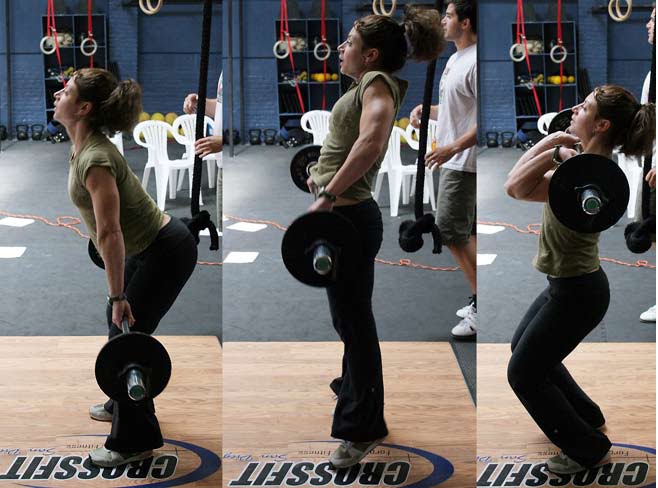
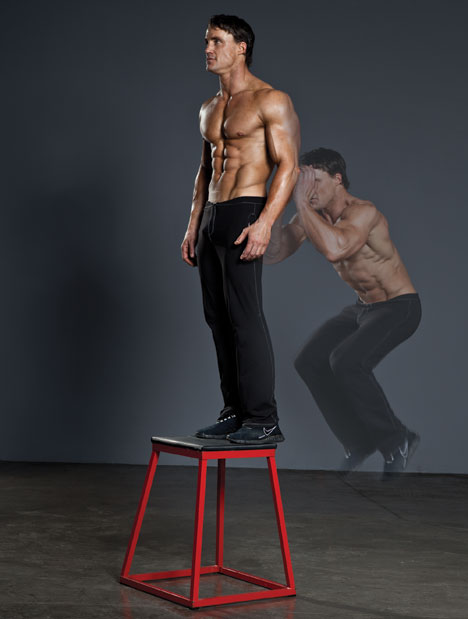
The power clean: bar from mid thigh, hips and knees snap to full extension (the same triple extension as a jump), then the bar is caught on the shoulders in a quarter squat. The full clean catches in a deep squat and lets you lift more weight; the power clean forces more acceleration because the bar has to travel further.
Study 1: Olympic Lifts Versus Jump Training
Thirty two physically active men trained for eight weeks, three sessions a week. One group did Olympic lifts (high pull, power clean, clean and jerk) plus half squats. The other did plyometric jumps (hurdle hops, single leg hops, 40cm drop jumps) plus the same half squats.1| Test | Olympic lifting group | Jump training group |
|---|---|---|
| Squat jump | 38.9 to 42.6cm (+9.5%) | 36.5 to 37.5cm (+2.7%) |
| Countermovement jump | 42.2 to 45.0cm (+6.6%) | 40.2 to 42.5cm (+5.7%) |
| 10m sprint speed | +3.7% | +2.7% |
| 30m sprint speed | 0.0% | +0.8% |
| Agility test time | -2.8% | -3.6% |
| Half squat | +43.7% | +47.8% |
| Clean and jerk | +34.8% | not tested |
Each group won three of the six shared tests, but the two that are actually vertical jumps, the squat jump and the countermovement jump, both went to the lifters, and the squat jump gain was more than three times larger. Both programs are useful. If you can only do one, the lifting program moves the number you care about further.
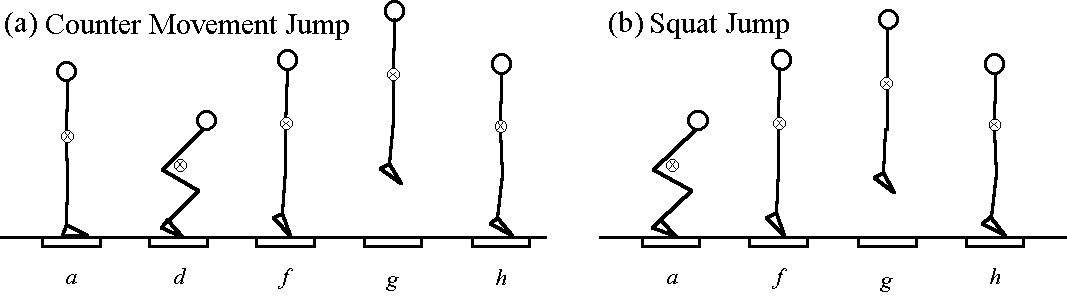
The two jump tests. A countermovement jump starts standing and uses a quick dip, which is how you jump in sport. A squat jump starts from a held squat with no dip, which isolates pure concentric leg power. Vertec and jump mat tests are countermovement jumps.
The eight week programs, for anyone who wants to copy them:
| Group | Exercise | Weeks 1 to 4 | Weeks 5 to 8 |
|---|---|---|---|
| Olympic lifting | High pull | 3 x 6RM | 4 x 6RM |
| Power clean | 4 x 4RM | 6 x 4RM | |
| Clean and jerk | 4 x 4RM | 6 x 4RM | |
| Half squat | 4 x 6RM | 4 x 6RM | |
| Jump training | Double leg hurdle hops | 6 x 4 | 10 x 4 |
| Alternating single leg hurdle hops | 4 x 4 | 6 x 4 | |
| Single leg hurdle hops | 4 x 4 | 6 x 4 | |
| 40cm drop jump | 4 x 4 | 6 x 4 | |
| Half squat | 4 x 6RM | 4 x 6RM |
RM = repetition maximum, so 4 x 4RM means four sets of four with a weight you could lift four times and no more.
Study 2: Olympic Lifts Versus Ordinary Weight Training
Twenty seven high school boys trained for eight weeks. One group built their program around Olympic lifts (power clean, hang clean, clean pulls, snatch), the other around traditional lifts (squat, overhead squat, deadlift, leg press). Both did the same assisting exercises: bench press, military press, lunges, push-ups, sit-ups and back extensions. A control group stopped training.2| Group | Vertical jump change |
|---|---|
| Olympic lifting | +4.5% (about +3cm) |
| Traditional lifting | +2.3% (about +1cm) |
| Control (stopped training) | about -2cm |
Same eight weeks, same assisting work, and the Olympic lifting group gained almost twice as much, although with only 27 boys the gap between the two lifting groups did not reach statistical significance; both clearly beat the control group. The more telling result was the correlation: after adjusting for body weight, power clean strength predicted vertical jump at r = 0.75, squat strength at only r = 0.42. The control group is the other lesson: stop training for two months and jump height goes backwards. A separate study on college football players comparing Olympic lifting with powerlifting programs over 15 weeks found the same direction, with the Olympic lifting group improving vertical jump more.3
How Much Strength Gain Adds How Many Centimetres
The same high school study reproduced a table from strength coach Allen Hedrick that answers the question every athlete asks: if I add this much to my lifts, how much does my jump go up?2| Lift | Increase | Expected vertical jump gain |
|---|---|---|
| Squat | 0 to 50lb (0 to 23kg) | 4.0cm |
| 50 to 100lb (23 to 45kg) | 6.4cm | |
| 100 to 150lb (45 to 68kg) | 6.6cm | |
| over 150lb (68kg) | 10.4cm | |
| Power clean | 0 to 20lb (0 to 9kg) | 3.7cm |
| 20 to 45lb (9 to 20kg) | 3.9cm | |
| 45 to 60lb (20 to 27kg) | 6.5cm | |
| over 60lb (27kg) | 9.5cm |
Read the power clean rows against the squat rows. A 27kg power clean increase is worth about the same jump gain as a 68kg squat increase. That is the efficiency of the lift: every kilo added to it is worth roughly two and a half kilos added to the squat.
A 10cm jump increase is a serious improvement, the difference between touching the rim and grabbing it. It needs a squat up by about 70kg and a power clean up by about 27kg, which for most people is a 6 to 12 month project. For a 3 to 6 month goal, aim for half of that, roughly 35kg on the squat and 14kg on the power clean, for around 5cm.
Study 3: Strength Plus Plyometrics Beats Either Alone
Forty eight untrained men were split into squat only, plyometrics only, squat plus plyometrics, and control, training twice a week for six weeks.5| Group | Vertical jump gain |
|---|---|
| Squats only | 3.3cm |
| Plyometrics only | 3.8cm |
| Squats plus plyometrics | 10.7cm |
The combination gave nearly three times the gain of either method alone, greater than the sum of the two. Squats make the muscle stronger. Plyometrics teach the nervous system to use that strength explosively, in a third of a second. Neither can do the other's job. A four week study on 45 baseball players found the same thing in trained athletes: complex training (lifting and plyometrics in the same program) came out ahead of heavy lifting alone and plyometrics alone on five of six power measures, although the difference between groups did not reach statistical significance (p = 0.11).6
Two cautions on the untrained numbers. These men were starting from zero, so 10cm in six weeks is the fast early gain of a beginner, not a rate attainable for a trained athlete. Given Studies 1 and 2, swapping some of that squat volume for power cleans should do at least as well.
A Program That Covers Both Halves
Two sessions a week, each with a lifting half and a plyometric half, based on the six week squat plus plyometric program that produced the 10.7cm result, with the power clean added on the strength of the first two studies.5Warm up (10 minutes)
Five minutes of jogging, then bodyweight squats, walking lunges, high knees, and a few easy jumps at half effort. Before a heavy set, work up through two lighter sets, for example 20kg then 60kg before a 100kg squat.Lifting half
| Exercise | Week 1 | Week 2 | Week 3 | Week 4 | Week 5 | Week 6 |
|---|---|---|---|---|---|---|
| Power clean (session 1) | 4 x 4 at 70% | 4 x 4 at 75% | 4 x 3 at 80% | 4 x 3 at 85% | 4 x 2 at 90% | 3 x 2 at 90% |
| Back squat (session 1) | 3 x 8 at 70% | 3 x 6 at 80% | 2 x 5 at 85% | 2 x 3 at 90% | 2 x 2 at 95% | 2 x 1 at 95% |
| Deadlift (session 2) | 3 x 5 | 3 x 5 | 3 x 5 | 3 x 3 | 3 x 3 | 2 x 3 |
| Back squat (session 2, light) | 2 x 8 at 50% | 2 x 8 at 60% | 2 x 8 at 70% | 1 x 8 at 70% | 1 x 8 at 70% | rest |
Percentages are of your one rep maximum at the start of the program; retest it after the week six taper. Add weight whenever every rep of every set is clean.
Plyometric half
| Exercise | Week 1 | Week 2 | Week 3 | Week 4 | Week 5 | Week 6 |
|---|---|---|---|---|---|---|
| Drop jump (sets x reps at box height) | 3 x 10 at 51cm | 3 x 10 at 61cm | 3 x 8 at 76cm | 3 x 8 at 89cm | 2 x 6 at 89cm | 2 x 4 at 89cm |
| Double leg hops (sets x metres) | 2 x 15 | 3 x 15 | 3 x 15 | 3 x 15 | 2 x 15 | 1 x 15 |
| Walking split squat jumps (sets x metres) | 2 x 15 | 2 x 15 | 1 x 15 | 1 x 15 | 1 x 15 | rest |
| Standing split squat jumps (sets x reps) | 2 x 10 | 2 x 8 | 3 x 6 | 2 x 6 | 2 x 6 | rest |
Every landing is followed by the next jump as fast as possible. Bouncing over hurdles at half effort trains nothing. Box jumps and hurdle hops can replace drop jumps in any week. Two rules on drop jumps: a common coaching guideline is to be able to squat 1.5 times your body weight before adding them, and children should not do them because the landing loads are high for growing bones. The study this program is based on took drop jumps up to 114cm; the table is capped at 89cm, which is plenty for anyone who is not already an elite jumper. Younger or lighter athletes get the same benefit from hurdle hops and box jumps at lower heights.
The whole session takes about 45 minutes with rests. Week six is a taper, so test your jump at the end of it, not in the middle of week four.
A Free Trick for Test Day
Strength coach Joe DeFranco recommends a static hip flexor stretch of 30 to 60 seconds a side right before a jump test or a game.7 The reasoning is that a jump needs full hip extension and tight hip flexors resist it, so unlike most muscles you do not want them primed, you want them slack. Static stretching before power work is usually avoided, but here the muscle being stretched is a brake rather than an engine. Our own quick test with chalk on a wall agreed, though that is one person, not a study. It costs two minutes to check for yourself: jump, stretch, jump again.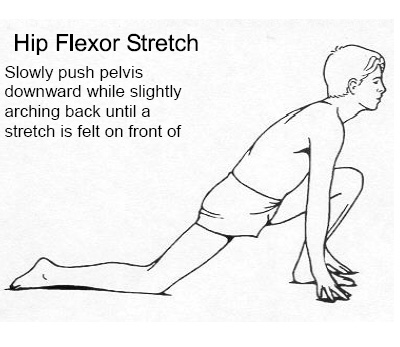
Measuring the Gain
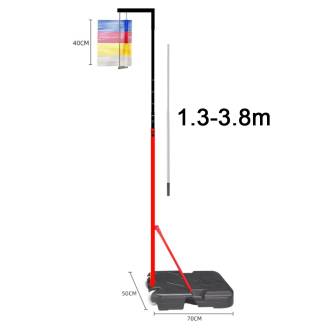
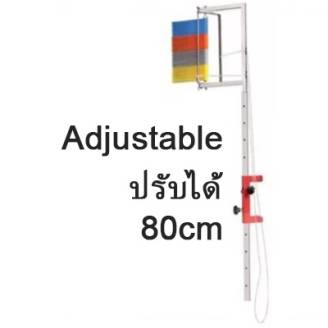
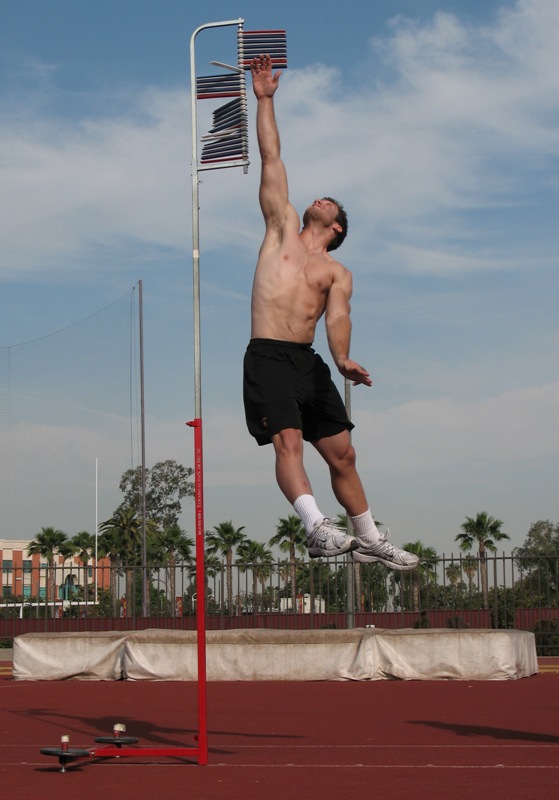
Every study above measured jump height the same way: standing reach first, then the best of three countermovement jumps, with the difference as the score. If you test any other way the numbers are not comparable, and if you test with chalk on a wall the error is a few centimetres, which is most of a month's progress.- Vertec. The athlete stands under the vanes, reaches up to set the standing reach, then jumps and swats the highest vane they can. Height is read in 1cm steps from the vanes moved. The 3.6m pole reset model and the 3.8m weighted base model are free standing, the wall mounted model is a permanent installation, and the electronic model reads the height on a digital display so nobody has to count vanes or reset between attempts.
- Protocol. Three attempts, best one counts, same warm up every time, same time of day if possible. Test every four to six weeks, not every session. Jump height moves slowly and daily testing just shows noise.
- Track the lifts too. The Hedrick table above only works if you know how much your squat and power clean have moved, so log both alongside the jump. If the lifts go up and the jump does not, the plyometric half needs more attention, not the lifting half.
The Vertec range is in our sports testing equipment category with free delivery in Thailand. The power clean itself needs nothing but a bar, and it is the single most cost effective thing on this page.
References
- Tricoli V, Lamas L, Carnevale R, Ugrinowitsch C. Short-term effects on lower-body functional power development: weightlifting vs. vertical jump training programs. Journal of Strength and Conditioning Research. 2005;19(2):433-437.
- Channell BT, Barfield JP. Effect of Olympic and traditional resistance training on vertical jump improvement in high school boys. Journal of Strength and Conditioning Research. 2008;22(5):1522-1527. Table 4 in this paper reproduces the strength gain to jump gain criteria adapted from Hedrick A (1996).
- Hoffman JR, Cooper J, Wendell M, Kang J. Comparison of Olympic vs. traditional power lifting training programs in football players. Journal of Strength and Conditioning Research. 2004;18(1):129-135.
- Rippetoe M, Kilgore L. Starting Strength: Basic Barbell Training. 3rd ed. The Aasgaard Company; 2011. Chapter on the power clean.
- Adams K, O'Shea JP, O'Shea KL, Climstein M. The effect of six weeks of squat, plyometric and squat-plyometric training on power production. Journal of Applied Sport Science Research. 1992;6(1):36-41.
- Dodd DJ, Alvar BA. Analysis of acute explosive training modalities to improve lower-body power in baseball players. Journal of Strength and Conditioning Research. 2007;21(4):1177-1182.
- DeFranco J. The Vertical Jump: Advanced Speed and Strength Methods. DeFranco's Training Systems. Coaching manual; no longer in print.
Daniel Brady has spent more than ten years reading sports science journal articles and turning their numbers into practical articles, to answer questions with reliable data backing, first for SportsScience.co and now for Isaan Sport Technology, where he tests the equipment the articles describe. His background is in data, which is why the articles show the study figures and the calculations to back the answers.