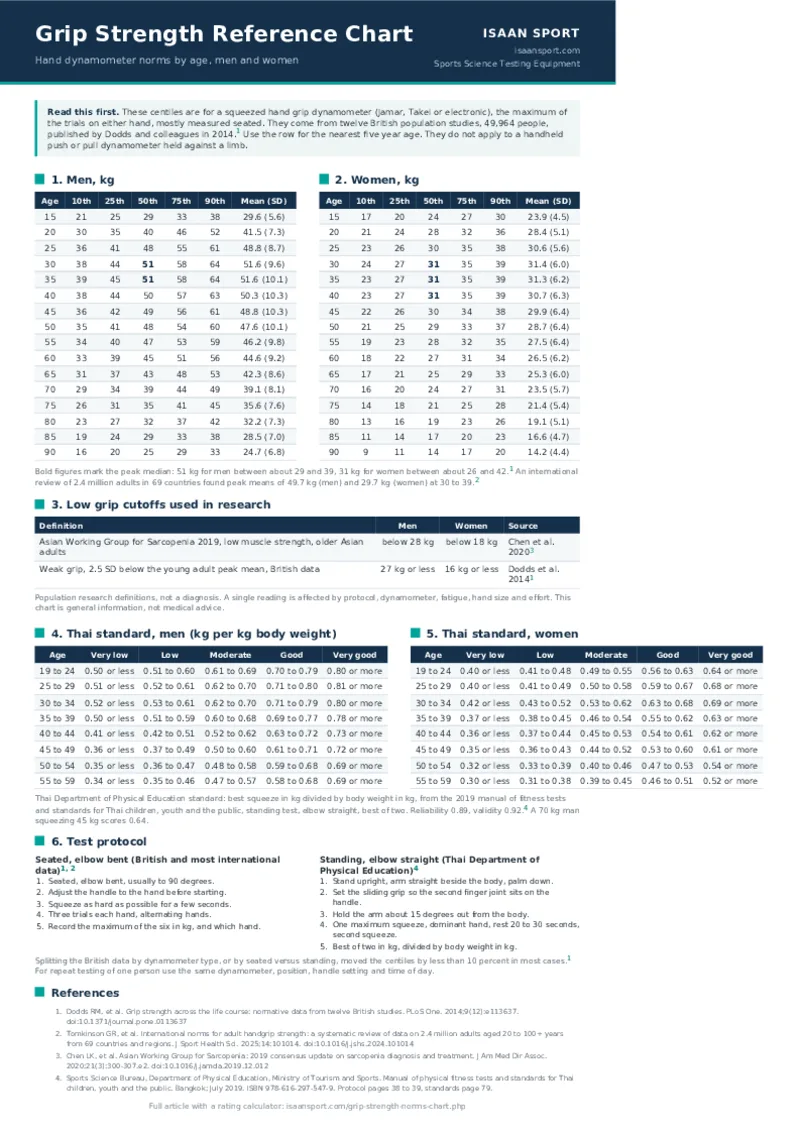
A grip strength reading in kilograms means little on its own. The same 40 kg is a strong result for a woman of any age, an ordinary one for a man of 20, and a weak one for a man of 35. This page gives you two published reference tables to compare a hand dynamometer reading against: British centiles by age from 20 to 90 in kilograms, and the Thai Department of Physical Education bands for ages 19 to 59, which are scored per kilogram of body weight. Enter a result in the box below to rate it against both, or read the tables and use the printable.
This page is general information for coaches, teachers and athletes rating a fitness test result. It is not medical advice. The low grip strength cutoffs quoted below are research definitions used in population studies, not a diagnosis, and anyone concerned about a reading should talk to a doctor or physiotherapist.
Grip Strength Norms Calculator
Enter the best squeeze from either hand in kilograms. Body weight is optional: with it, the calculator also gives a 'Per kilogram of body weight' score, and the Thai Department of Physical Education rating for ages 19 to 59.How the Calculator Works
Centile rating. Your reading is looked up in the British grip strength centiles published by Dodds and colleagues in 2014 from twelve population studies, 49,964 people in all.1 The table runs in five year steps, so the calculator uses the row nearest your age: a 27 year old is rated on the age 25 row, a 28 year old on the age 30 row. The result tells you which two centiles your reading falls between.
Per kilogram of body weight. If you enter body weight, the reading is divided by it. A 70 kg man squeezing 45 kg scores 0.64.
Thai rating. For ages 19 to 59, that per kilogram score is looked up in the Thai Department of Physical Education standard, five bands from Very low to Very good for each five year age group.2 That standard was built from a standing test with the elbow straight, so a seated reading is being compared with a slightly different protocol. The difference is small, see the testing section below.
Two Ways to Read a Grip Score
Absolute strength, in kilograms. Most published norms, and every sarcopenia cutoff, use the raw dynamometer reading. It is the right figure for comparing an athlete with a population, and for tracking one person over time.
Relative strength, per kilogram of body weight. The Thai Department of Physical Education standard divides the reading by body weight, so a 70 kg man squeezing 45 kg scores 0.64 and a 90 kg man squeezing the same 45 kg scores 0.50.2 This flatters lighter people and penalises heavier ones, which is the point when the test is used as a general fitness measure rather than a strength measure.
The two are not interchangeable. A school or a fitness centre running the Thai battery should report the ratio and use the Thai bands. A strength coach comparing players, or anyone comparing with the international literature, should keep the kilograms.
Grip Strength Norms by Age: Men
Centiles in kilograms from the twelve British population studies, the maximum of the trials on either hand, mostly measured seated with a Jamar hydraulic dynamometer.1 The mean is the average reading for that age.| Age | 10th | 25th | 50th | 75th | 90th | Mean (SD) |
|---|---|---|---|---|---|---|
| 15 | 21 | 25 | 29 | 33 | 38 | 29.6 (5.6) |
| 20 | 30 | 35 | 40 | 46 | 52 | 41.5 (7.3) |
| 25 | 36 | 41 | 48 | 55 | 61 | 48.8 (8.7) |
| 30 | 38 | 44 | 51 | 58 | 64 | 51.6 (9.6) |
| 35 | 39 | 45 | 51 | 58 | 64 | 51.6 (10.1) |
| 40 | 38 | 44 | 50 | 57 | 63 | 50.3 (10.3) |
| 45 | 36 | 42 | 49 | 56 | 61 | 48.8 (10.3) |
| 50 | 35 | 41 | 48 | 54 | 60 | 47.6 (10.1) |
| 55 | 34 | 40 | 47 | 53 | 59 | 46.2 (9.8) |
| 60 | 33 | 39 | 45 | 51 | 56 | 44.6 (9.2) |
| 65 | 31 | 37 | 43 | 48 | 53 | 42.3 (8.6) |
| 70 | 29 | 34 | 39 | 44 | 49 | 39.1 (8.1) |
| 75 | 26 | 31 | 35 | 41 | 45 | 35.6 (7.6) |
| 80 | 23 | 27 | 32 | 37 | 42 | 32.2 (7.3) |
| 85 | 19 | 24 | 29 | 33 | 38 | 28.5 (7.0) |
| 90 | 16 | 20 | 25 | 29 | 33 | 24.7 (6.8) |
Grip Strength Norms by Age: Women
Same source and method as the men's table.1| Age | 10th | 25th | 50th | 75th | 90th | Mean (SD) |
|---|---|---|---|---|---|---|
| 15 | 17 | 20 | 24 | 27 | 30 | 23.9 (4.5) |
| 20 | 21 | 24 | 28 | 32 | 36 | 28.4 (5.1) |
| 25 | 23 | 26 | 30 | 35 | 38 | 30.6 (5.6) |
| 30 | 24 | 27 | 31 | 35 | 39 | 31.4 (6.0) |
| 35 | 23 | 27 | 31 | 35 | 39 | 31.3 (6.2) |
| 40 | 23 | 27 | 31 | 35 | 39 | 30.7 (6.3) |
| 45 | 22 | 26 | 30 | 34 | 38 | 29.9 (6.4) |
| 50 | 21 | 25 | 29 | 33 | 37 | 28.7 (6.4) |
| 55 | 19 | 23 | 28 | 32 | 35 | 27.5 (6.4) |
| 60 | 18 | 22 | 27 | 31 | 34 | 26.5 (6.2) |
| 65 | 17 | 21 | 25 | 29 | 33 | 25.3 (6.0) |
| 70 | 16 | 20 | 24 | 27 | 31 | 23.5 (5.7) |
| 75 | 14 | 18 | 21 | 25 | 28 | 21.4 (5.4) |
| 80 | 13 | 16 | 19 | 23 | 26 | 19.1 (5.1) |
| 85 | 11 | 14 | 17 | 20 | 23 | 16.6 (4.7) |
| 90 | 9 | 11 | 14 | 17 | 20 | 14.2 (4.4) |
Thai Department of Physical Education Bands, Ages 19 to 59
These are the grip strength standards in the 2019 manual of fitness tests for Thai children, youth and the public (แบบทดสอบและเกณฑ์มาตรฐานสมรรถภาพทางกายของเด็ก เยาวชน และประชาชนไทย), published by the Sports Science Bureau of the Department of Physical Education.2 The score is the best of two squeezes in kilograms divided by body weight in kilograms. The manual reports a test reliability of 0.89 and validity of 0.92 for this item.Men
| Age | Very low | Low | Moderate | Good | Very good |
|---|---|---|---|---|---|
| 19 to 24 | 0.50 or less | 0.51 to 0.60 | 0.61 to 0.69 | 0.70 to 0.79 | 0.80 or more |
| 25 to 29 | 0.51 or less | 0.52 to 0.61 | 0.62 to 0.70 | 0.71 to 0.80 | 0.81 or more |
| 30 to 34 | 0.52 or less | 0.53 to 0.61 | 0.62 to 0.70 | 0.71 to 0.79 | 0.80 or more |
| 35 to 39 | 0.50 or less | 0.51 to 0.59 | 0.60 to 0.68 | 0.69 to 0.77 | 0.78 or more |
| 40 to 44 | 0.41 or less | 0.42 to 0.51 | 0.52 to 0.62 | 0.63 to 0.72 | 0.73 or more |
| 45 to 49 | 0.36 or less | 0.37 to 0.49 | 0.50 to 0.60 | 0.61 to 0.71 | 0.72 or more |
| 50 to 54 | 0.35 or less | 0.36 to 0.47 | 0.48 to 0.58 | 0.59 to 0.68 | 0.69 or more |
| 55 to 59 | 0.34 or less | 0.35 to 0.46 | 0.47 to 0.57 | 0.58 to 0.68 | 0.69 or more |
Women
| Age | Very low | Low | Moderate | Good | Very good |
|---|---|---|---|---|---|
| 19 to 24 | 0.40 or less | 0.41 to 0.48 | 0.49 to 0.55 | 0.56 to 0.63 | 0.64 or more |
| 25 to 29 | 0.40 or less | 0.41 to 0.49 | 0.50 to 0.58 | 0.59 to 0.67 | 0.68 or more |
| 30 to 34 | 0.42 or less | 0.43 to 0.52 | 0.53 to 0.62 | 0.63 to 0.68 | 0.69 or more |
| 35 to 39 | 0.37 or less | 0.38 to 0.45 | 0.46 to 0.54 | 0.55 to 0.62 | 0.63 or more |
| 40 to 44 | 0.36 or less | 0.37 to 0.44 | 0.45 to 0.53 | 0.54 to 0.61 | 0.62 or more |
| 45 to 49 | 0.35 or less | 0.36 to 0.43 | 0.44 to 0.52 | 0.53 to 0.60 | 0.61 or more |
| 50 to 54 | 0.32 or less | 0.33 to 0.39 | 0.40 to 0.46 | 0.47 to 0.53 | 0.54 or more |
| 55 to 59 | 0.30 or less | 0.31 to 0.38 | 0.39 to 0.45 | 0.46 to 0.51 | 0.52 or more |
Worked example: a 30 year old woman weighing 58 kg who squeezes 34 kg scores 34 divided by 58, which is 0.59, Moderate for her age group. The same 34 kg on the British table sits between the 50th and 75th centile for women of 30. Both readings are correct, they are simply answering different questions.
When Grip Peaks and How It Declines
In the British data men reach a peak median of 51 kg between about 29 and 39 and women 31 kg between about 26 and 42, then both decline, slowly at first and faster after 60.1 The median man of 70 squeezes 39 kg, about three quarters of the peak, and the median woman of 70 squeezes 24 kg.
The international picture is similar. A 2025 systematic review pooled 100 studies covering 2.4 million adults in 69 countries and regions and found peak means of 49.7 kg for men and 29.7 kg for women, both in the 30 to 39 age group.3 The United States reference values from the NIH Toolbox sample of 1,232 adults run from 49.7 kg for the dominant hand of men aged 25 to 29 down to 18.7 kg for the non dominant hand of women aged 75 to 79.4
Thai adult norms in kilograms are thinner on the ground, which is why the calculator uses the British centiles for the kilogram rating. One Thai figure worth having: among 198 outpatients aged 60 and over at Srinagarind Hospital in Khon Kaen, tested seated with a Takei T.K.K.5401 dynamometer and the best of three trials, the median grip was 27.8 kg for men and 17.8 kg for women.5 That is a hospital sample, not a community one, so expect healthy Thai people of the same age to score higher.
Low Grip Strength Cutoffs Used in Research
The Asian Working Group for Sarcopenia 2019 consensus defines low muscle strength as a grip below 28 kg for men and below 18 kg for women, for use in older Asian adults.6 The British study set its weak grip line at the point 2.5 standard deviations below the young adult peak, which works out at 27 kg or less for men and 16 kg or less for women.1 Those are the thresholds Thai and international research papers apply when they report how many older people have weak grip. In the Khon Kaen outpatient sample, 51 percent were below the Asian cutoff.5
They are population research definitions. A single reading under one of them says nothing on its own about a particular person, and this page does not go further than reporting what the papers say.
How to Test Grip Strength
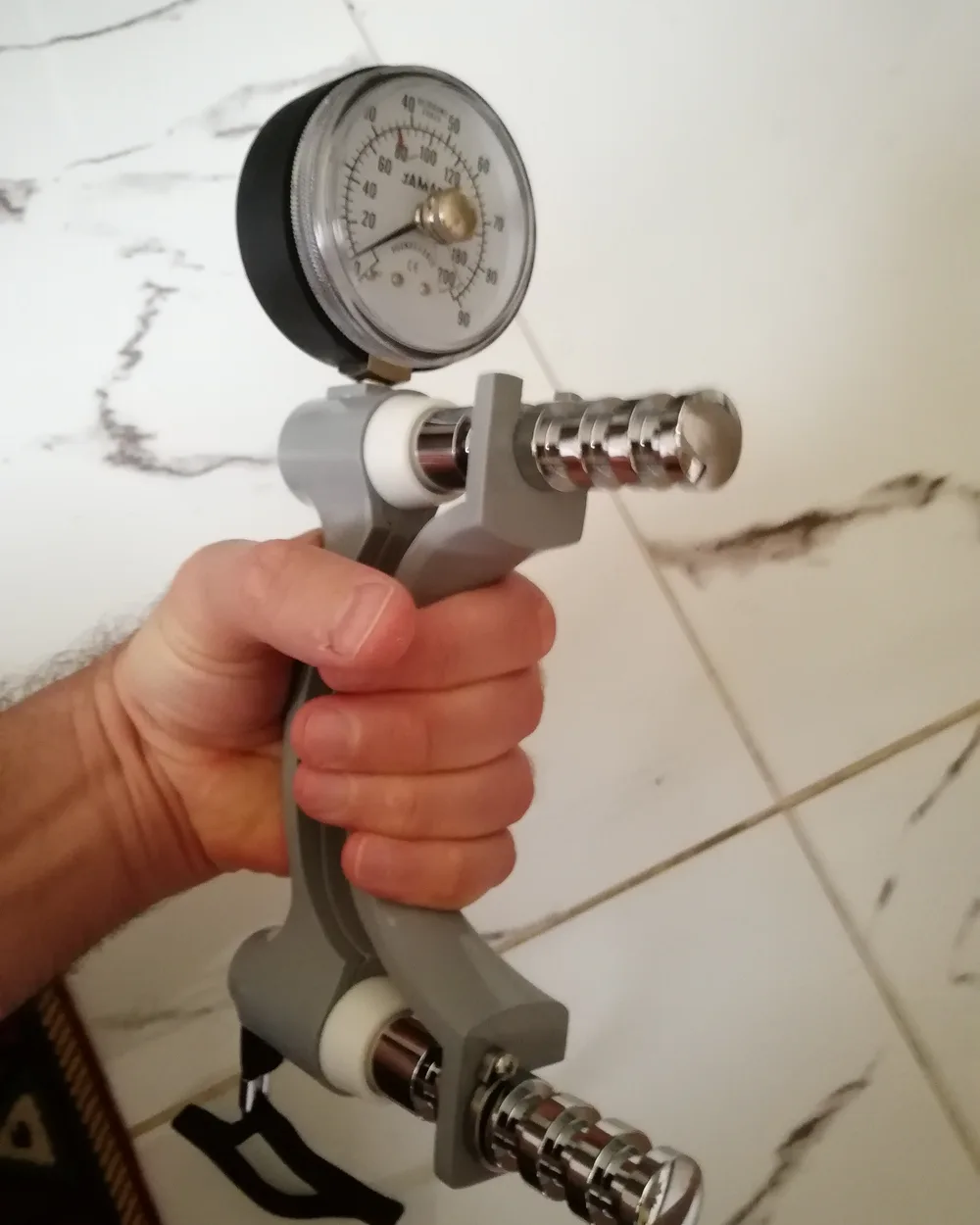
The protocol changes the number, so pick one and keep it. The two most common are:
Seated, elbow bent. Eight of the twelve British studies tested seated, seven used a Jamar hydraulic dynamometer, and most took three squeezes on each hand, alternating, and kept the best of the six.1 Across the 100 studies in the international review, 51 percent tested seated and 68 percent with the elbow bent, usually to 90 degrees, and 90 percent reported the maximum value.3
Standing, elbow straight. The Thai Department of Physical Education protocol: standing, arm straight beside the body and turned palm down, the dynamometer grip adjusted so the second joint of the fingers sits on the handle, arm held about 15 degrees away from the body, one maximum squeeze on the dominant hand, 20 to 30 seconds rest, a second squeeze, best of the two recorded and divided by body weight.2
The British authors checked how much these choices matter. Splitting their data by dynamometer type, and by seated versus standing, moved the centiles by less than 10 percent in most cases, so a reading from one protocol can be placed on the other table as a rough guide but not as a precise centile.1 For tracking one athlete across a season, use the same dynamometer, the same position, the same handle setting and the same time of day each time.
Record each hand separately, and always note which hand the best reading came from. The US reference data reports the dominant and non dominant hand as separate values because they differ.4
Which Dynamometer These Tables Are For
All of the figures above come from a hand grip dynamometer, the kind the person squeezes: hydraulic (Jamar and similar), spring (Takei T.K.K.) or electronic. Across the international review the split was 38 percent hydraulic, 32 percent electronic and 30 percent mechanical.3
They do not apply to a handheld muscle strength dynamometer, the instrument an assessor holds against a limb while the athlete pushes or pulls to test a muscle group such as the quadriceps or the shoulder. That is a different measurement with its own reference values, and it is the type we sell as the digital handheld muscle strength dynamometer. Do not compare a push reading from it with any table on this page.
Frequently Asked Questions
What is a good grip strength for a man?
About 51 kg is the median for men aged 30 to 35 in the British population data, and around 58 kg puts a man in that age group on the 75th centile.1 The bar drops with age: the median is 45 kg at 60 and 39 kg at 70. Use the men's table above to find your own age row, and remember that these are best of either hand readings with a squeezed hand dynamometer.
What is a good grip strength for a woman?
Around 31 kg is the median for women aged 30 to 40 in the British data, and 35 kg reaches the 75th centile in that range.1 The international review of 2.4 million adults found a very similar peak mean of 29.7 kg for women aged 30 to 39.3 The median falls to 27 kg at 60 and 24 kg at 70, so check the women's table for your own age.
Why does the Thai standard use kilograms per kilogram of body weight?
Because it is a general fitness battery, not a strength competition, and dividing by body weight lets people of different sizes be rated on the same scale.2 A 55 kg woman squeezing 33 kg scores 0.60, which is Good for a 25 to 29 year old, while a 75 kg woman squeezing the same 33 kg scores 0.44 and rates Low. If you want to compare with international norms, keep the raw kilogram reading as well.
Does it matter whether I sit or stand for the test?
A little. The British study reran its centiles for seated versus standing and for different dynamometer types and found differences of under 10 percent in most cases.1 That is enough to shift a borderline reading by one band, so for repeat testing of the same person use one position every time. The Thai standard was built standing with the elbow straight, the British and most international data seated with the elbow at 90 degrees.
How many attempts should I record?
Record the best single squeeze, not an average. The British protocol takes three trials on each hand, alternating, and keeps the highest of the six.1 The Thai protocol takes two squeezes on the dominant hand with 20 to 30 seconds rest and keeps the better one.2 In the international review 90 percent of studies reported the maximum value.3 Every table on this page is built on maximum readings, so an averaged score will rate lower than it should.
Is a low reading a sign of a health problem?
Not by itself, and this page cannot tell you. Research studies use cutoffs of 28 kg for men and 18 kg for women in older Asian adults to flag low muscle strength, alongside other measurements, and always in context.6 A single reading is affected by the protocol, the dynamometer, fatigue, hand size and effort. If a result worries you or a client, take it to a doctor or physiotherapist rather than to a chart.
Related Reading
- Standing long jump norms chart: lower body power reference tables with a printable.
- YMCA 3 minute step test calculator: a step test with age and sex norms, no running track needed.
- Beep test VO2max calculator: rates a 20 m shuttle run result against age and sex percentiles.
References
- Dodds RM, Syddall HE, Cooper R, et al. Grip strength across the life course: normative data from twelve British studies. PLoS One. 2014;9(12):e113637. doi:10.1371/journal.pone.0113637. Table 2 gives the centiles reproduced above.
- สำนักวิทยาศาสตร์การกีฬา กรมพลศึกษา กระทรวงการท่องเที่ยวและกีฬา. คู่มือแบบทดสอบและเกณฑ์มาตรฐานสมรรถภาพทางกายของเด็ก เยาวชน และประชาชนไทย (Manual of physical fitness tests and standards for Thai children, youth and the public). Bangkok: Department of Physical Education; July 2019 (พ.ศ. 2562). ISBN 978-616-297-547-9. Grip strength protocol pages 38 to 39, standards for ages 19 to 59 page 79.
- Tomkinson GR, Lang JJ, Rubín L, et al. International norms for adult handgrip strength: a systematic review of data on 2.4 million adults aged 20 to 100+ years from 69 countries and regions. Journal of Sport and Health Science. 2025;14:101014. doi:10.1016/j.jshs.2024.101014
- Wang YC, Bohannon RW, Li X, Sindhu B, Kapellusch J. Hand-grip strength: normative reference values and equations for individuals 18 to 85 years of age residing in the United States. Journal of Orthopaedic and Sports Physical Therapy. 2018;48(9):685-693. doi:10.2519/jospt.2018.7851
- Manjavong M, So-Ngern A, Limpawattana P, et al. The prevalence of low handgrip strength and its predictors among outpatient older adults in a tertiary care setting: a cross-sectional study. Geriatrics. 2022;7(4):74. doi:10.3390/geriatrics7040074
- Chen LK, Woo J, Assantachai P, et al. Asian Working Group for Sarcopenia: 2019 consensus update on sarcopenia diagnosis and treatment. Journal of the American Medical Directors Association. 2020;21(3):300-307.e2. doi:10.1016/j.jamda.2019.12.012
Dr Wannaporn Sumranpat Brady is a physiotherapist with a PhD, not a medical doctor, and a lecturer in the Department of Health Science and Sports at Mahasarakham University's Faculty of Education. Her research is on patellofemoral pain (PFP). She holds a PhD in Exercise and Sport Science from Mahasarakham University, an MSc in Physical Therapy from Khon Kaen University and a BSc in Physical Therapy from Naresuan University, and has also published on athletic injury rehabilitation, sports biomechanics and physical training programme design. She co-founded Isaan Sport Technology and writes its sports science articles, which take their figures from journal studies and from tests on the equipment the store sells.