How the Calculator Works
YMCA rating: the one minute recovery pulse is looked up in the YMCA age adjusted standards for men and women, shown in full further down this page.1 The bands run from Excellent to Very Poor in six age groups from 18 to 25 up to 65 and over. Where a count falls in the gap between two printed bands, the calculator gives the lower rating.
VO2max estimate: the pulse count, age, height and weight go into the equation developed for this test by the Korea Institute of Sport Science, as used by Kieu and colleagues in their 2020 validation study:2
Men: VO2max = 70.597 − 0.246 × age + 0.077 × height − 0.222 × weight − 0.147 × pulse
Women: VO2max = 70.597 − 0.185 × age + 0.097 × height − 0.246 × weight − 0.122 × pulse
Age is in years, height in centimetres, weight in kilograms and pulse is the one minute recovery count. The result is in ml/kg/min.
Percentile rating: the estimate is then placed on the ACSM cardiorespiratory fitness percentiles (Cooper Institute data, ages 20 to 79) that our beep test calculator uses, and labelled Poor (below the 20th percentile), Fair (20th to 39th), Average (40th to 59th), Good (60th to 79th), Excellent (80th to 94th) or Superior (95th and above). Percentiles between the published points are interpolated, so treat the figure as approximate. Under 20, the 20 to 29 row is used.
The YMCA test was designed to be scored on the recovery pulse alone, and that is the number to track between tests. The VO2max figure is an inference from it, added so that a step test can be compared with a beep test or a treadmill result, and it carries the error of any field prediction: roughly plus or minus 4 to 5 ml/kg/min for an individual.3
YMCA 3 Minute Step Test Protocol
The test needs a step 30.5 cm (12 inches) high, a metronome and a stopwatch.1 A phone metronome app is fine. The height matters: the rating tables were built on a 12 inch step, so a 20 cm aerobics step or a 40 cm plyometric box gives a pulse that does not work for this calculation.
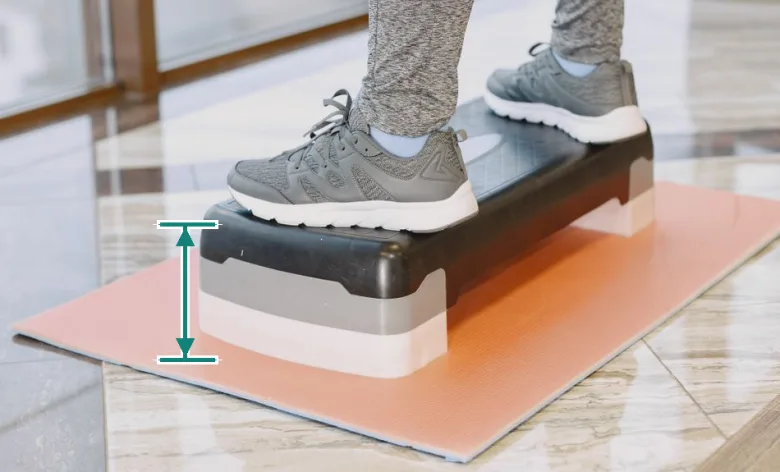
The arrow shows where to measure: floor to the top surface. The rating tables assume 30.5 cm, so measure your own step rather than trusting the label. Marking added by us.
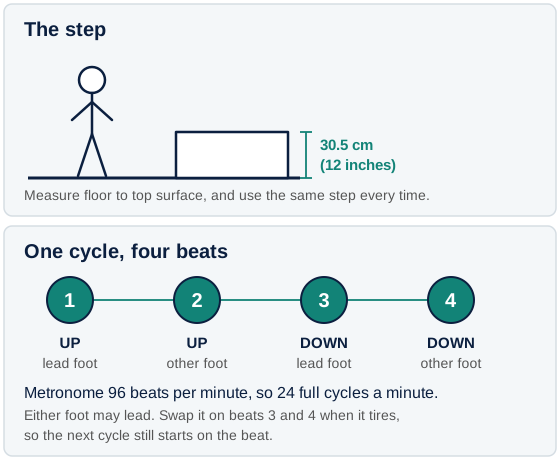
- Set the metronome to 96 beats per minute. Each step cycle takes four beats: up with the first foot, up with the second, down with the first, down with the second. That is 24 full step cycles a minute.
- Step for exactly 3 minutes in time with the beat. Either foot may lead, and the lead leg can be swapped during the test. Keep the body upright and put the whole foot on the step.
- Sit down straight away. Within 5 seconds of the last step, start counting the pulse at the wrist or neck, or with a stethoscope or chest strap.
- Count for one complete minute. The total is the score. Do not count for 15 seconds and multiply by four: the pulse is highest in the first seconds and falls through the minute, so a short count gives a different, and higher, number than the tables expect.
The full minute is the part people most often get wrong. A 15 second count of 30 beats at the start of recovery might be followed by a whole minute count of 100, not 120, because the heart rate is dropping the whole time. The tables were built on whole minute counts, so count for 60 seconds exactly.
Setting the test up the same way twice
Two step tests only compare with each other if the set-up is the same. Fix these before the first test and write them on the recording sheet.
- Measure the step. Floor to top surface, with a tape. The rating tables were built on 30.5 cm,1 so note the real figure even if it is 29 or 32 cm, and use the same step every time. A bench that flexes or slides underfoot is the wrong bench. Placing the bench on a soft floor, like a yoga mat, would similarly be wrong.
- Put the chair beside the step. The count starts within 5 seconds of the last step, so the seat has to be within one pace. Hunting for a chair loses the first beats of recovery, which are the fastest ones.
- Set the metronome where both people can hear it. Footfalls are loud. Turn the volume up, or use an app with a visual beat as well, and keep the same beat sound each time.
- Two timers, or one restarted. One runs the 3 minutes of stepping, the other the recovery minute. Whoever holds the watch should not also be counting the pulse.
- Flat shoes, same shoes. A thick heel changes the effective height of the step by a centimetre or two. Test in the same footwear each time.
- One person at a time, in a quiet corner. A pulse count is hard to hear or feel over someone else's stepping. In a group, keep the chair free and the next person warming up out of earshot.
- Same tester, same words. Stand beside the step, call "up, up, down, down" with the metronome for the first few cycles, and say "sit" on the third minute. The same short script keeps one test like the next.
Stepping technique, and whether to lead with the same leg
The protocol does not prescribe a lead leg: either foot may start the cycle, and the lead leg can be swapped during the test.1 The work is the same either way, because it is the same body lifted the same height 24 times a minute, so swap when the lead leg tires, and change on the "down, down" so the next cycle still starts on the beat. What matters more is that the cycle stays four beats, and that the movement in the third minute looks like the movement in the first.
- Whole foot on the step. The ball of the foot alone is a shorter climb and a less stable one. The heel goes down as well.
- Straighten the leading leg at the top. Half a step up and straight back down is less work, and gives a lower pulse than the tables expect. Stand up on the step before coming down.
- Upright, arms free. No leaning on a wall, a rail or the tester. Anything that carries part of the body weight takes part of the work out of the test.
- One footfall per beat. Up, up, down, down. Two feet landing together, or a hop to catch up, breaks the cadence the tables assume.
- Down onto the whole foot, softly. Three minutes of heavy landings on a hard floor is a lot of jarring for no extra measurement.
- If the beat is lost, stop the test. Someone a cycle or two behind is no longer doing the protocol, and pulse based estimates only hold for people who complete the full 3 minutes.4 Record it as not completed and test again another day, rather than scoring a short test.
How to take the pulse
The score is a count of beats over one whole minute, seated, starting within 5 seconds of the last step. Fingers at the wrist or the neck, a stethoscope, or a chest strap all work.1
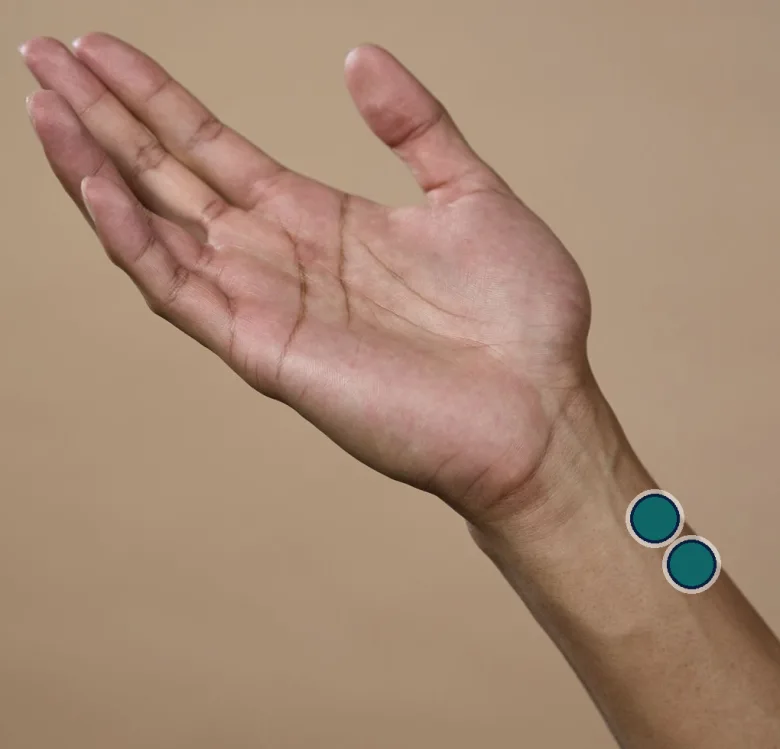
The two marks are where the fingers go: the thumb side of the wrist, just below the base of the thumb. Marks added by us.
- At the wrist. Turn the palm up and lay the pads of the index and middle fingers on the thumb side of the wrist, just below the base of the thumb, then press gently until the beat comes through.5 Not with your thumb: it has a pulse of its own, and you will count that instead.
- At the neck. The index and middle fingers go just to the side of the Adam's apple, in the soft hollow. Use light pressure, one side only, and never both sides at once. The neck arteries are sensitive to pressure in some people, and pressing on them can slow the heart or cause fainting.5
- Find it before the test, not after. Whoever will count, the tester or the person themselves, should find the pulse on the seated person while the metronome is being set. Ten seconds of searching at the start of the recovery minute is ten seconds of the count lost.
- Count everything, or mark it as a miscount. Start the watch and count every beat until the minute is up. If the pulse is lost partway, say so and test again, rather than estimating the rest.
- Counting your own is allowed, and it is harder. The person who stepped can count their own wrist while the tester holds the watch, which is how a solo test works. For a squad, one tester counting everybody keeps the error the same from person to person.
- Heart rate monitors. A chest strap is the easiest way to test alone. Use the average across the recovery minute, not the figure on the screen at the end: the pulse falls all the way through that minute, so the last reading sits well below the count the tables are built on.
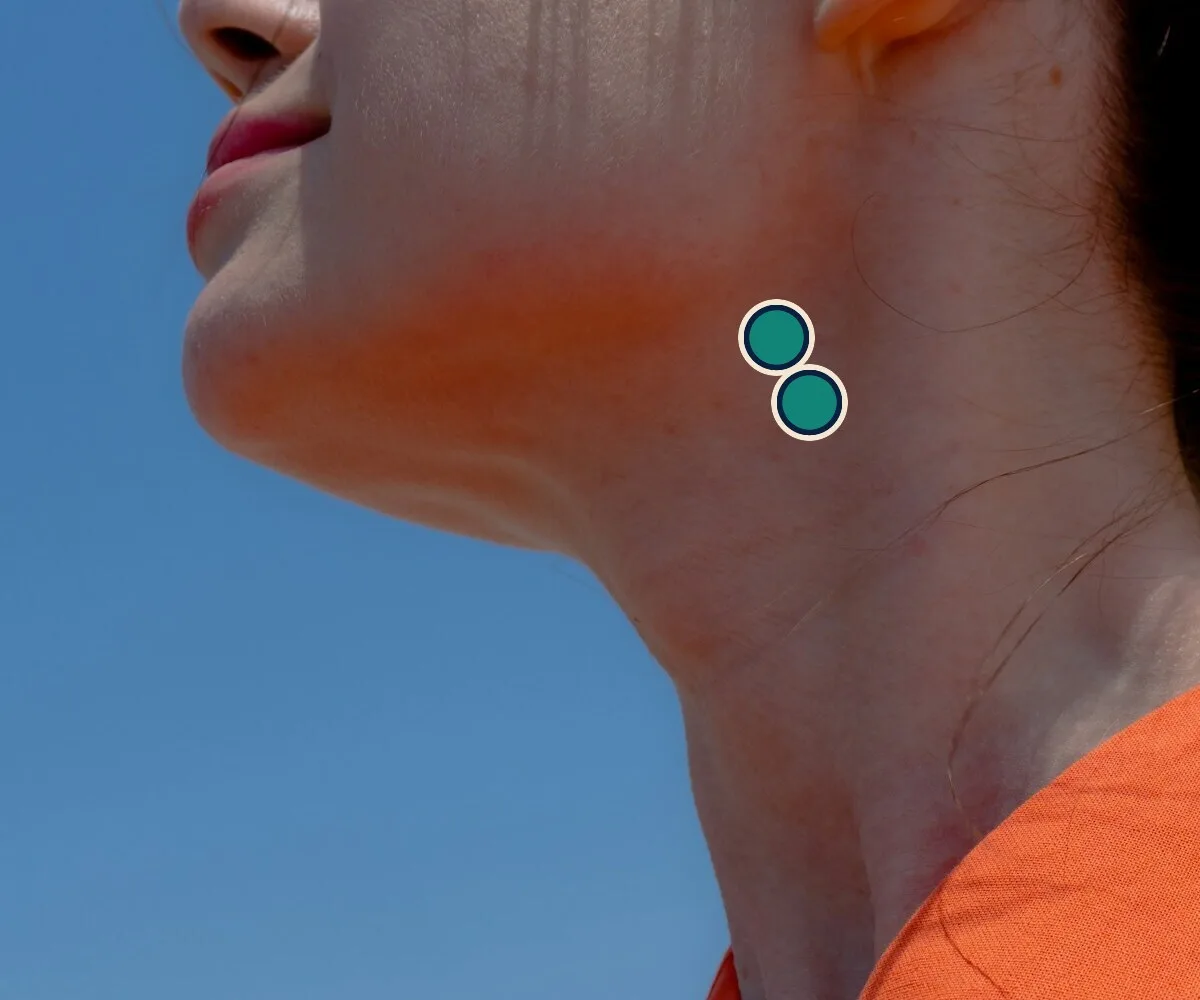
The two marks show where the index and middle fingertips go: just below the angle of the jaw, in the groove beside the windpipe, on one side only, with very light pressure. Marking added by us.
Before the test
- Light warm up. Two or three minutes of easy walking and a few practice step cycles at the metronome pace, so the rhythm is learnt before the clock starts. Nothing harder: the test is submaximal and a real warm up would raise the recovery pulse.
- No caffeine, food or hard training beforehand. A coffee or a training session in the hours before the test lifts the heart rate and moves the rating a band. Test on a rest day, or before training, and keep it the same each time.
- Cool, shaded, same time of day. A step test at two in the afternoon in the heat is not the same test as one at seven in the morning. The pulse responds to heat as well as to effort.
- Same step, same metronome, same counter. If the same person counts the pulse every time, the counting error at least stays constant.
YMCA Step Test 1-Minute Recovery Pulse Norms
One minute recovery pulse, beats in one minute, by age group. These are the YMCA age adjusted standards from Y's Way to Physical Fitness, as reproduced in Morrow and colleagues' measurement textbook and in most trainer certification manuals.1
Men
| Rating | 18 to 25 | 26 to 35 | 36 to 45 | 46 to 55 | 56 to 65 | 65 and over |
|---|---|---|---|---|---|---|
| Excellent | 50 to 76 | 51 to 76 | 49 to 76 | 56 to 82 | 60 to 77 | 59 to 81 |
| Good | 79 to 84 | 79 to 85 | 80 to 88 | 87 to 93 | 86 to 94 | 87 to 92 |
| Above Average | 88 to 93 | 88 to 94 | 92 to 98 | 95 to 101 | 97 to 100 | 94 to 102 |
| Average | 95 to 100 | 96 to 102 | 100 to 105 | 103 to 111 | 103 to 109 | 104 to 110 |
| Below Average | 102 to 107 | 104 to 110 | 108 to 113 | 113 to 119 | 111 to 117 | 114 to 118 |
| Poor | 111 to 119 | 114 to 121 | 116 to 124 | 121 to 126 | 119 to 128 | 121 to 126 |
| Very Poor | 124 to 157 | 126 to 161 | 130 to 163 | 131 to 159 | 131 to 154 | 130 to 151 |
Women
| Rating | 18 to 25 | 26 to 35 | 36 to 45 | 46 to 55 | 56 to 65 | 65 and over |
|---|---|---|---|---|---|---|
| Excellent | 52 to 81 | 58 to 80 | 51 to 84 | 63 to 91 | 60 to 92 | 70 to 92 |
| Good | 85 to 93 | 85 to 92 | 89 to 96 | 95 to 101 | 97 to 103 | 96 to 101 |
| Above Average | 96 to 102 | 95 to 101 | 100 to 104 | 104 to 110 | 106 to 111 | 104 to 111 |
| Average | 104 to 110 | 104 to 110 | 107 to 112 | 113 to 118 | 113 to 118 | 116 to 121 |
| Below Average | 113 to 120 | 113 to 119 | 115 to 120 | 120 to 124 | 119 to 127 | 123 to 126 |
| Poor | 122 to 131 | 122 to 129 | 124 to 132 | 126 to 132 | 129 to 135 | 128 to 133 |
| Very Poor | 135 to 169 | 134 to 171 | 137 to 169 | 137 to 171 | 141 to 174 | 135 to 155 |
The printed bands leave small gaps (for example 77 and 78 for men aged 18 to 25). The calculator gives the lower rating for a count in a gap. The men's 36 to 45 Above Average band is printed as 92 to 88 in the reproduced table; 92 to 98 follows from the bands either side.
How Accurate Is the Step Test at Predicting VO2max
Three studies have put the YMCA protocol beside a treadmill test with gas analysis. Kieu and colleagues tested 30 Korean and Vietnamese adults aged 19 to 35 on a 30 cm step at 96 beats per minute, with the pulse taken for one minute after stepping. The estimate from the equation used here correlated with measured VO2max at r = 0.80 across the group (0.81 in the Koreans, 0.93 in the Vietnamese), but ran high: the Korean group measured 35.7 ml/kg/min on the treadmill against an estimate of 39.1, a bias of 3.4, and the Vietnamese group 38.2 against 39.3, a bias of 1.2.2 That is the closest published sample to Thai adults, and it says two things: the correlation is good, but the estimated number may be overestimated by a few points.
Hong and colleagues tested 73 Korean adults (37 men, 36 women, mean age 31) on a 30 cm step at 24 steps a minute and found the step test explained 72 per cent of the variance in measured VO2max with a standard error of 4.7 ml/kg/min. A 20 cm step run the same way did just as well (R² 0.73, standard error 4.7), which the authors suggest for people who find a 30 cm step awkward.3 Beutner and colleagues, in 97 German adults, reported R = 0.83 for the traditional YMCA model and the same for a shortened version using a 45 second recovery count, but noted that pulse based models only worked in people who completed the full 3 minutes.4
So: a step test ranks a squad or a class about as well as a beep test does, and an individual estimate should be read as a band of roughly 5 ml/kg/min either side, not a point. The recovery pulse itself is more reliable than the VO2max derived from it, which is why the YMCA rating is the first line of the result.
What Moves a Step Test Score
- Step height. The tables assume 30.5 cm. A lower step means less work, a lower pulse and a better rating that has not been earned. Measure the step before the first test and write the height on the recording sheet.
- Leg length. The same step is a bigger climb for a short person. Two people of equal fitness and different height will not score the same, which the YMCA manual itself notes as a limitation of a fixed height step. Compare people with themselves over time rather than with each other.
- Cadence drift. Stepping ahead of the metronome does more work; falling behind does less. A tester calling the beat keeps the count more accurate.
- The pulse count. A whole minute, seated, starting within 5 seconds. A count that starts late, or stops early and is scaled up, is the commonest reason a repeat test disagrees with the first.
- Heat, caffeine, sleep and the last training session. All push the recovery pulse up. Keep the conditions the same each time, and note anything that was different.
Step Test or Beep Test
The beep test is maximal: it ends when the runner cannot hold the pace, and the VO2max prediction is built on the final speed. The step test is submaximal: everyone does the same 3 minutes of work, and fitness is read from how fast the heart settles afterwards. That makes the step test the better choice for large groups, mixed ages, people new to exercise, anyone who should not be run to exhaustion, and indoor spaces too small for a 20 m shuttle. It takes about five minutes per person, needs no running surface and can be scored by a pulse count alone.
For athletes, the beep test or a Yo-Yo test is the stronger measure, because the step test tops out: a fit player's recovery pulse sits in the Excellent band and stays there, and the test cannot separate good from very good. Use the step test for screening and for tracking the general population, and a maximal test for a squad.
What is a good YMCA step test score?
For men aged 18 to 25, a one minute recovery pulse of 79 to 84 is Good and 76 or below is Excellent; for women of the same age, 85 to 93 is Good and 81 or below is Excellent. The Good band rises with age, to 87 to 93 for men and 95 to 101 for women aged 46 to 55. The full men's and women's tables are above.1
What VO2max is a recovery heart rate of 100?
For a 25 year old man of 175 cm and 70 kg, a one minute recovery count of 100 gives an estimated VO2max of about 47.7 ml/kg/min with the equation used here, which sits close to the 50th percentile for his age on the ACSM table. The same count for a 25 year old woman of 160 cm and 55 kg gives about 55.8, because the women's equation weights height and pulse differently.
Why count the pulse for a full minute?
Because the YMCA tables were built on whole minute counts, and the pulse is falling throughout that minute. A 15 second count taken straight after the last step catches the highest part of recovery, and multiplying it by four gives a number 10 to 20 beats above the true one minute total for the same person. That pushes a Good rating into Average. Other step tests (the Queens College test, for one) do use a 15 second count, but with their own tables; do not mix the two.
Can I use a 20 cm step or a 40 cm box?
Not with these tables. The rating bands were built on a 30.5 cm step, and a different height changes the work done and the recovery pulse. A 20 cm step run at the same cadence predicted VO2max as well as the 30 cm step in Hong and colleagues' Korean sample, but with its own equation, so the numbers are not interchangeable.3 If you only have another height, use it consistently and track the pulse over time rather than reading the YMCA bands.
Is the YMCA step test valid for Thai adults?
No Thai validation has been published that we can find, but the equation used here was checked in Korean and Vietnamese adults aged 19 to 35, where it ranked people well (r = 0.80) and overestimated VO2max by 1 to 3 ml/kg/min on average.2 Thai adults of similar age and build should expect the same pattern: a reliable ranking and an absolute figure that may read a little high. The YMCA rating bands themselves come from American YMCA members, so treat them as a guide rather than a Thai norm.
How often should the step test be repeated?
Every six to eight weeks is enough to see real change. Aerobic fitness moves over weeks, and a recovery pulse also moves a few beats from day to day with sleep, heat and caffeine, so a retest inside a fortnight mostly records noise. Test at the same time of day, on the same step, with the same person counting, and record the conditions beside the score so a surprising result can be explained.
Related Reading
- Beep test and Yo-Yo test VO2max calculator, the maximal alternative, with the same percentile ratings.
- Skinfold testing guide, since body weight sits in the VO2max equation and body fat moves it.
- Standing long jump norms, for the power side of a fitness battery.
- Sports testing equipment, for the tools that measure the rest of the battery.
References
- Golding LA, editor. YMCA Fitness Testing and Assessment Manual. 4th ed. Champaign, IL: Human Kinetics; 2000. Age adjusted standards from Y's Way to Physical Fitness, 3rd ed, YMCA of the USA, 1989, as reproduced in Morrow JR, Jackson AW, Disch JG, Mood DP. Measurement and Evaluation in Human Performance. 3rd ed. Champaign, IL: Human Kinetics; 2005. p. 234.
- Kieu NTV, Jung SJ, Shin SW, Jung HW, Jung ES, Won YH, Yang YG, Chae SW. The validity of the YMCA 3-minute step test for estimating maximal oxygen uptake in healthy Korean and Vietnamese adults. Journal of Lifestyle Medicine. 2020;10(1):21 to 29. doi:10.15280/jlm.2020.10.1.21
- Hong SH, Yang HI, Kim DI, Gonzales TI, Brage S, Jeon JY. Validation of submaximal step tests and the 6-min walk test for predicting maximal oxygen consumption in young and healthy participants. International Journal of Environmental Research and Public Health. 2019;16(23):4858. doi:10.3390/ijerph16234858
- Beutner F, Ubrich R, Zachariae S, Engel C, Sandri M, Teren A, Gielen S. Validation of a brief step-test protocol for estimation of peak oxygen uptake. European Journal of Preventive Cardiology. 2015;22(4):503 to 512. doi:10.1177/2047487314533216
- Pulse. MedlinePlus Medical Encyclopedia. Bethesda, MD: US National Library of Medicine. medlineplus.gov/ency/article/003399.htm (finger placement at the wrist and neck, and the warning about pressure on the neck arteries), read 23 September 2026.
Dr Wannaporn Sumranpat Brady is a physiotherapist with a PhD, not a medical doctor, and a lecturer in the Department of Health Science and Sports at Mahasarakham University's Faculty of Education. Her research is on patellofemoral pain (PFP). She holds a PhD in Exercise and Sport Science from Mahasarakham University, an MSc in Physical Therapy from Khon Kaen University and a BSc in Physical Therapy from Naresuan University, and has also published on athletic injury rehabilitation, sports biomechanics and physical training programme design. She co-founded Isaan Sport Technology and writes its sports science articles, which take their figures from journal studies and from tests on the equipment the store sells.