How the Calculator Works
Beep test: VO2max is estimated from the running speed of your final stage using the Léger et al. (1988) equation: VO2max = 31.025 + 3.238 × speed − 3.248 × age + 0.1536 × speed × age, where speed is in km/h and age in years. The equation was validated for ages 8-19; for adults, age is held at 18 (as the authors recommend), which simplifies to VO2max = 6.0 × speed − 27.4. Finishing part-way through a level is credited proportionally, so level 9 shuttle 4 scores a little higher than level 8 completed.
Yo-Yo tests: VO2max is estimated from total distance covered (40 m per shuttle) using the Bangsbo, Iaia & Krustrup (2008) equations: Yo-Yo IR1: VO2max = 0.0084 × distance + 36.4 and Yo-Yo IR2: VO2max = 0.0136 × distance + 45.3.
Rating: your estimate is placed on the ACSM cardiorespiratory fitness percentiles (Cooper Institute data, ages 20-79) shown further down this page, then labelled Poor (below 20th percentile), Fair (20-39th), Average (40-59th), Good (60-79th), Excellent (80-94th) or Superior (95th and above). Percentiles between the published points are interpolated, so treat the number as approximate.
All of these are field-test predictions, not laboratory measurements. Expect an error of roughly ±3-5 ml/kg/min against a treadmill VO2max test, and remember that beep test versions differ slightly (some start at 8.5 km/h rather than 8.0 km/h), which shifts the numbers by a fraction of a level.
Warm-Up and Important Notes
The beep test and Yo-Yo tests are maximal efforts, so a proper warm-up matters both for your score and for avoiding injury. The first levels feel easy but they are not a warm-up - by level 5 you are already running at 10.5 km/h. A simple routine that works for school groups and teams:
- 5-10 minutes easy jogging - just enough to raise heart rate and body temperature.
- Dynamic movements - leg swings, walking lunges, high knees, heel flicks, 20-30 m each. Save static stretching for after the test.
- Rehearse the shuttle - 4-6 runs over the 20 m course at level 1-3 pace, practising the turn: plant one foot on the line, pivot, push off. Poor turns cost more than poor fitness in the later levels.
- 2-3 short strides at roughly level 8-10 pace to open up, then 2-3 minutes of walking recovery before the audio starts.
Eating and drinking: have a normal, carbohydrate-based meal 2-3 hours before the test and avoid anything heavy or fatty in the last hour - a full stomach and a maximal shuttle run do not mix. A small snack such as a banana 30-60 minutes out is fine if you are hungry. Arrive hydrated rather than trying to catch up at the start line: around 400-500 ml of water spread over the 2 hours before, then only sips in the last 15 minutes so it is not sloshing. Plain water is enough for a test this short; sports drinks are not needed. In hot conditions, hydration in the hours beforehand matters more than anything you drink just before the test.
Test on the same surface and in the same footwear each time if you are tracking progress, and avoid testing in extreme heat - Thai afternoon conditions can knock a level or more off a score.
Beep Test Levels, Speeds and VO2max
The table below uses the common 21-level protocol (level 1 at 8.0 km/h, level 2 at 9.0 km/h, then +0.5 km/h per level, 20 m shuttles, 1-minute stages), with VO2max from the Léger equation above for adults and for two school ages. Because the calculator credits each shuttle within a level, two values are given per level: the estimate at the first shuttle (just above the previous level's finishing value) and at the last shuttle (the level's full speed, in bold). A score of level 2 shuttle 1, for example, gives 21.3 for an adult, rising to 26.6 by shuttle 8 of 8. Level 1 is credited the same way, stepping up from a notional 7.5 km/h (one standard 0.5 km/h increment below its 8.0 km/h). This within-level credit is a convention used by most beep test calculators; the Léger equation itself only defines the value at each level's full speed.
| Level | Speed (km/h) | Shuttles | Distance at end (m) | VO2max, adult 18+ | VO2max, age 15 | VO2max, age 12 | |||
|---|---|---|---|---|---|---|---|---|---|
| 1st shuttle | last shuttle | 1st shuttle | last shuttle | 1st shuttle | last shuttle | ||||
| 1 | 8.0 | 7 | 140 | 18.0 | 20.6 | 24.3 | 26.6 | 30.5 | 32.7 |
| 2 | 9.0 | 8 | 300 | 21.3 | 26.6 | 27.3 | 32.2 | 33.3 | 37.8 |
| 3 | 9.5 | 8 | 460 | 27.0 | 29.6 | 32.5 | 35.0 | 38.1 | 40.3 |
| 4 | 10.0 | 9 | 640 | 29.9 | 32.6 | 35.3 | 37.7 | 40.6 | 42.9 |
| 5 | 10.5 | 9 | 820 | 32.9 | 35.6 | 38.0 | 40.5 | 43.1 | 45.4 |
| 6 | 11.0 | 10 | 1020 | 35.9 | 38.6 | 40.8 | 43.3 | 45.7 | 47.9 |
| 7 | 11.5 | 10 | 1220 | 38.9 | 41.6 | 43.5 | 46.0 | 48.2 | 50.5 |
| 8 | 12.0 | 11 | 1440 | 41.9 | 44.6 | 46.3 | 48.8 | 50.7 | 53.0 |
| 9 | 12.5 | 11 | 1660 | 44.9 | 47.6 | 49.1 | 51.6 | 53.3 | 55.6 |
| 10 | 13.0 | 11 | 1880 | 47.9 | 50.6 | 51.8 | 54.4 | 55.8 | 58.1 |
| 11 | 13.5 | 12 | 2120 | 50.8 | 53.6 | 54.6 | 57.1 | 58.3 | 60.6 |
| 12 | 14.0 | 12 | 2360 | 53.8 | 56.6 | 57.4 | 59.9 | 60.9 | 63.2 |
| 13 | 14.5 | 13 | 2620 | 56.8 | 59.6 | 60.1 | 62.7 | 63.4 | 65.7 |
| 14 | 15.0 | 13 | 2880 | 59.8 | 62.6 | 62.9 | 65.4 | 65.9 | 68.3 |
| 15 | 15.5 | 13 | 3140 | 62.8 | 65.6 | 65.6 | 68.2 | 68.5 | 70.8 |
| 16 | 16.0 | 14 | 3420 | 65.8 | 68.6 | 68.4 | 71.0 | 71.0 | 73.3 |
| 17 | 16.5 | 14 | 3700 | 68.8 | 71.6 | 71.2 | 73.7 | 73.5 | 75.9 |
| 18 | 17.0 | 15 | 4000 | 71.8 | 74.6 | 73.9 | 76.5 | 76.1 | 78.4 |
| 19 | 17.5 | 15 | 4300 | 74.8 | 77.6 | 76.7 | 79.3 | 78.6 | 81.0 |
| 20 | 18.0 | 16 | 4620 | 77.8 | 80.6 | 79.5 | 82.1 | 81.1 | 83.5 |
| 21 | 18.5 | 16 | 4940 | 80.8 | 83.6 | 82.2 | 84.8 | 83.7 | 86.1 |
Source: Léger LA, Mercier D, Gadoury C, Lambert J. The multistage 20 metre shuttle run test for aerobic fitness. Journal of Sports Sciences. 1988;6(2):93-101. PubMed
Yo-Yo Intermittent Recovery Test Level 1
Scores are recorded as speed level and shuttle (e.g. 16.3). Each shuttle is 2 × 20 m = 40 m, with a 10-second active recovery between shuttles.
| Speed level | Speed (km/h) | Shuttles in level | Distance at end (m) | Est. VO2max (ml/kg/min) |
|---|---|---|---|---|
| 5 | 10.0 | 1 | 40 | 36.7 |
| 8 | 12.0 | 1 | 80 | 37.1 |
| 11 | 13.0 | 2 | 160 | 37.7 |
| 12 | 13.5 | 3 | 280 | 38.8 |
| 13 | 14.0 | 4 | 440 | 40.1 |
| 14 | 14.5 | 8 | 760 | 42.8 |
| 15 | 15.0 | 8 | 1080 | 45.5 |
| 16 | 15.5 | 8 | 1400 | 48.2 |
| 17 | 16.0 | 8 | 1720 | 50.8 |
| 18 | 16.5 | 8 | 2040 | 53.5 |
| 19 | 17.0 | 8 | 2360 | 56.2 |
| 20 | 17.5 | 8 | 2680 | 58.9 |
| 21 | 18.0 | 8 | 3000 | 61.6 |
| 22 | 18.5 | 8 | 3320 | 64.3 |
| 23 | 19.0 | 8 | 3640 | 67.0 |
Yo-Yo Intermittent Recovery Test Level 2
The Level 2 test starts faster (13 km/h) and is intended for well-trained athletes.
| Speed level | Speed (km/h) | Shuttles in level | Distance at end (m) | Est. VO2max (ml/kg/min) |
|---|---|---|---|---|
| 11 | 13.0 | 1 | 40 | 45.8 |
| 15 | 15.0 | 1 | 80 | 46.4 |
| 17 | 16.0 | 2 | 160 | 47.5 |
| 18 | 16.5 | 3 | 280 | 49.1 |
| 19 | 17.0 | 4 | 440 | 51.3 |
| 20 | 17.5 | 8 | 760 | 55.6 |
| 21 | 18.0 | 8 | 1080 | 60.0 |
| 22 | 18.5 | 8 | 1400 | 64.3 |
| 23 | 19.0 | 8 | 1720 | 68.7 |
| 24 | 19.5 | 8 | 2040 | 73.0 |
| 25 | 20.0 | 8 | 2360 | 77.4 |
| 26 | 20.5 | 8 | 2680 | 81.7 |
Source: Bangsbo J, Iaia FM, Krustrup P. The Yo-Yo intermittent recovery test: a useful tool for evaluation of physical performance in intermittent sports. Sports Medicine. 2008;38(1):37-51. PubMed
VO2max Norms by Age and Sex (ml/kg/min)
Percentile values for cardiorespiratory fitness in adults, from maximal treadmill tests in the Cooper Institute's Aerobics Center Longitudinal Study, as published in the ACSM Guidelines. The 50th percentile is the median for that age group.
Men
| Age | 5th | 10th | 25th | 50th | 75th | 90th | 95th |
|---|---|---|---|---|---|---|---|
| 20-29 | 29.0 | 32.1 | 40.1 | 48.0 | 55.2 | 61.8 | 66.3 |
| 30-39 | 27.2 | 30.2 | 35.9 | 42.4 | 49.2 | 56.5 | 59.8 |
| 40-49 | 24.2 | 26.8 | 31.9 | 37.8 | 45.0 | 52.1 | 55.6 |
| 50-59 | 20.9 | 22.8 | 27.1 | 32.6 | 39.7 | 45.6 | 50.7 |
| 60-69 | 17.4 | 19.8 | 23.7 | 28.2 | 34.5 | 40.3 | 43.0 |
| 70-79 | 16.3 | 17.1 | 20.4 | 24.4 | 30.4 | 36.6 | 39.7 |
Women
| Age | 5th | 10th | 25th | 50th | 75th | 90th | 95th |
|---|---|---|---|---|---|---|---|
| 20-29 | 21.7 | 23.9 | 30.5 | 37.6 | 44.7 | 51.3 | 56.0 |
| 30-39 | 19.0 | 20.9 | 25.3 | 30.2 | 36.1 | 41.4 | 45.8 |
| 40-49 | 17.0 | 18.8 | 22.1 | 26.7 | 32.4 | 38.4 | 41.7 |
| 50-59 | 16.0 | 17.3 | 19.9 | 23.4 | 27.6 | 32.0 | 35.9 |
| 60-69 | 13.4 | 14.6 | 17.2 | 20.0 | 23.8 | 27.0 | 29.4 |
| 70-79 | 13.1 | 13.6 | 15.6 | 18.3 | 20.8 | 23.1 | 24.1 |
Source: American College of Sports Medicine. ACSM's Guidelines for Exercise Testing and Prescription, 11th ed. Wolters Kluwer; 2021, Table 4.7 (data from The Cooper Institute, Dallas, TX).
Running the Beep Test
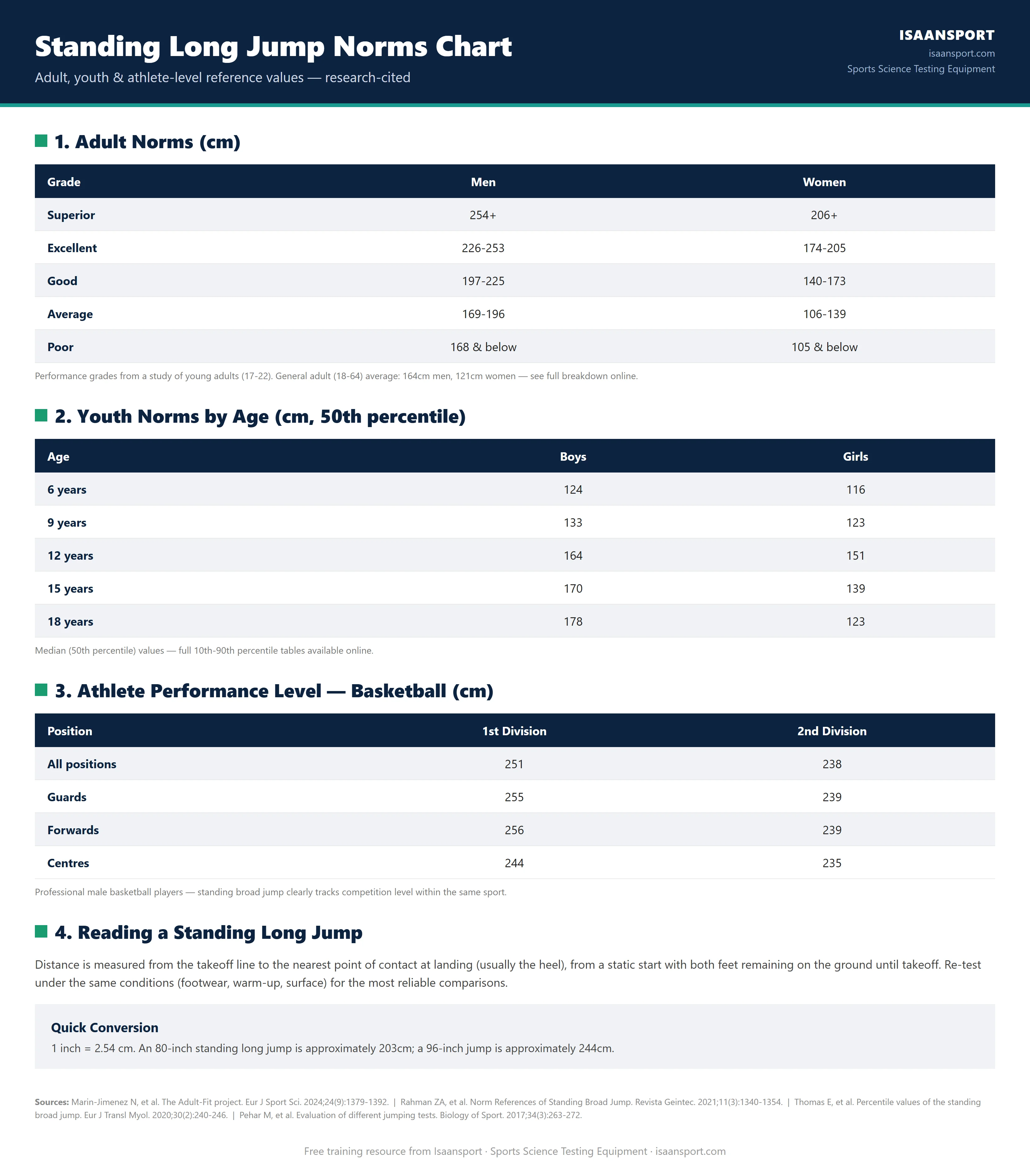
You need a flat 20 m course marked with cones or tape at each end, the audio track (freely available as apps and recordings, e.g. on YouTube), and a recording sheet. Runners must reach the line before each beep; the first missed beep is a warning, and the test ends on the second consecutive miss. Record the last level and shuttle completed. For other fitness benchmarks, see our standing long jump norms, and browse our sports testing equipment for measuring tools.
What Moves a Beep Test Score
Two runners of the same fitness can finish a level apart, and most of the reasons sit with whoever is running the test. The clearest case on record is the surface. Male collegiate footballers did the Yo-Yo Intermittent Recovery Test on natural grass and on artificial turf: 2,370m covered on grass against 1,441m on turf, which converts to estimated VO2max figures of 58.0 and 49.8 ml/kg/min against a laboratory measurement of 54.2.3 Same players, days apart, and the surface alone put the two estimates eight points apart, one either side of the truth.
- Surface. Grass, artificial turf, a sports hall floor and a concrete court are four different tests. Pick one and stay on it.
- Heat. A maximal shuttle run at two in the afternoon here is not the same test as the same run at seven in the morning.
- Turning technique. In the later levels the turn costs more than the running does, which is why a rehearsal beforehand is worth the five minutes.
- Audio version. Some tracks start at 8.5 km/h rather than 8.0, so every level after that sits at a different speed.
- Motivation and who is watching. The test ends when the runner decides to stop, and that decision moves with the group, the day and the stakes.
How Much Change Is Real
Aerobic scores move slowly and noisily, so one retest is weak evidence on its own. Fifty under-17 footballers were tested before and after a 47 day pre-season: Yo-Yo IR1 distance changed by an average of minus 26.2m, which was not statistically significant, and only 54 per cent of the squad improved at all. Over the same block their jump and change of direction scores improved clearly.4
Two habits follow from that. Read the squad average and the individual column together, because a group mean that holds steady can hide half a squad improving and half sliding. And treat the VO2max number as a label attached to the distance rather than as the measurement. In adolescent players, the Yo-Yo IR1 estimate underestimated laboratory VO2max by 5.2 per cent while still correlating strongly with it at r = 0.82.5 The distance is what you measured. The VO2max is an inference from it.
Beep Test Score Ratings
What is a good beep test score?
For men in their 20s, about level 11.2 reaches the ACSM "Good" band (60th percentile) and level 13.4 reaches "Excellent" (80th percentile). For women in their 20s, about level 7.7 is Good and level 9.9 is Excellent. The table below gives the level needed for each rating at every age, in level.shuttle format.
| Age | Men - beep test level for rating | Women - beep test level for rating | ||||
|---|---|---|---|---|---|---|
| Average | Good | Excellent | Average | Good | Excellent | |
| 20-29 | 9.1 | 11.2 | 13.4 | 5.7 | 7.7 | 9.9 |
| 30-39 | 7.5 | 9.2 | 11.5 | 3.5 | 4.9 | 6.8 |
| 40-49 | 5.9 | 7.7 | 9.11 | 2.6 | 3.7 | 5.6 |
| 50-59 | 4.3 | 5.9 | 8.1 | 2.2 | 2.6 | 3.7 |
| 60-69 | 2.8 | 4.4 | 6.3 | 1.4 | 2.2 | 2.6 |
| 70-79 | 2.3 | 3.1 | 4.9 | <1 | 1.5 | 2.2 |
Derived by converting the ACSM / Cooper Institute percentile thresholds (above) to running speed with the adult Léger equation, then to the beep test level and shuttle at which that speed is first credited. Approximate; a beep test version starting at 8.5 km/h shifts these by a fraction of a level.
What VO2max is beep test level 10?
Completing level 10 (13.0 km/h) predicts a VO2max of about 50.6 ml/kg/min for an adult using the Léger equation. Level 8 gives about 44.6 and level 12 about 56.6. The full level-by-level table is earlier on this page.
How accurate is the beep test at predicting VO2max?
Léger and colleagues reported a correlation of r = 0.90 with laboratory-measured VO2max in adults and r = 0.71 in children aged 8-19. In practice, expect an individual estimate to sit within roughly ±3-5 ml/kg/min of a treadmill test; running economy, turning technique, motivation and heat all move the score.
Are the Yo-Yo test ratings valid for everyone?
The Yo-Yo IR1 and IR2 equations were developed on male football players, so the VO2max estimates and ratings are most reliable for team-sport athletes. For women, youth players or people who are not runners, treat the Yo-Yo result as a rough guide and use the beep test if a VO2max estimate is the goal.
Beep test or Yo-Yo test - which should I use?
The beep test is continuous and is the better VO2max predictor. The Yo-Yo tests add a 10-second recovery after every 40 m, so they rank players on the ability to repeat high-intensity efforts, which is why football and other team sports prefer them. Use the beep test for aerobic capacity and the Yo-Yo tests for match-fitness tracking.
Does the surface change a beep test result?
Yes, by more than most people expect. In the same group of collegiate footballers, Yo-Yo IR1 distance was 2,370m on natural grass against 1,441m on artificial turf, and the VO2max estimates from those runs sat 8.2 points apart on either side of their laboratory value.3 Run every test of a series on the same surface, and note the surface on the recording sheet.
How often should the beep test be repeated?
Every six to eight weeks during a season is enough. Aerobic fitness changes over weeks rather than days, and a whole 47 day pre-season produced no significant group change in Yo-Yo IR1 distance in one squad of under-17 players.4 Testing more often mostly records heat, fatigue and motivation. Keep the surface, the time of day and the warm up the same each time.
Related Reading
- Standing long jump norms, for the power half of a fitness battery.
- Free recording sheets, set up the same way as a beep test sheet.
- Skinfold testing guide, since body composition moves VO2max per kilogram.
- Laser timing gates, if you are timing sprints in the same session.
References
- Leger LA, Mercier D, Gadoury C, Lambert J. The multistage 20 metre shuttle run test for aerobic fitness. Journal of Sports Sciences. 1988;6(2):93 to 101. doi:10.1080/02640418808729800
- Bangsbo J, Iaia FM, Krustrup P. The Yo-Yo intermittent recovery test: a useful tool for evaluation of physical performance in intermittent sports. Sports Medicine. 2008;38(1):37 to 51. doi:10.2165/00007256-200838010-00004
- Ferigne G, Martin K, Ottinger C, Biscardi L. Playing surface impacts Yo-Yo Intermittent Recovery Test (Level 1) performance and validity of indirect VO2max estimation. International Journal of Exercise Science. 2025;18:1142 to 1150. doi:10.70252/pgpl8156
- Preissler AAB, Clemente FM, Silva AF, Mendes RS, Schons P. Short-term changes, individual variability, and associations with baseline physical performance in young male soccer players during the pre-season. Sports. 2026;14(8):344. doi:10.3390/sports14080344
- Xu Y, Xu N, Wang R, et al. Relationships and agreement between Yo-Yo Intermittent Recovery Test Level 1 performance and laboratory VO2max in adolescent male soccer players. Annals of Human Biology. 2025;52:2566327. doi:10.1080/03014460.2025.2566327
Dr Wannaporn Sumranpat Brady is a physiotherapist with a PhD, not a medical doctor, and a lecturer in the Department of Health Science and Sports at Mahasarakham University's Faculty of Education. Her research is on patellofemoral pain (PFP). She holds a PhD in Exercise and Sport Science from Mahasarakham University, an MSc in Physical Therapy from Khon Kaen University and a BSc in Physical Therapy from Naresuan University, and has also published on athletic injury rehabilitation, sports biomechanics and physical training programme design. She co-founded Isaan Sport Technology and writes its sports science articles, which take their figures from journal studies and from tests on the equipment the store sells.