
A phone on a tripod and Kinovea (free for Windows) will show you things about your technique that you cannot feel while doing it. This article uses four worked examples: tracking Usain Bolt's feet, tracking his hands, a stride length experiment that we recorded, and tracking the bar path of a power clean. The sprint half starts with the two numbers that decide sprint speed, stride length and stride frequency, because those numbers tell you what to look for once the video is open.
Speed = Stride Length x Stride Frequency
There is no third term. If you cover more ground per stride at the same cadence, or take the same strides faster, you run quicker. Usain Bolt's 9.63s in the 2012 Olympic final is a useful reference because the stride count is well documented:| Runner | 100m time | Strides | Average stride length | Stride frequency |
|---|---|---|---|---|
| Usain Bolt (2012 final - 6 ft 5 in tall) | 9.63s | 41 | 2.44m | 4.26 per second |
| Realistic target for a shorter athlete | ~10.3s | ~44 | 2.25m | 4.3 per second |
| Typical untrained runner (example) | 14s | 60 | 1.67m | 4.3 per second |
Notice that the stride frequency in the 3 rows is very similar. Almost the whole gap between a recreational runner and the fastest in the world is stride length, and stride length is a combination of height, power and technique. Bolt is 1.95m tall, so if you are shorter, do not expect a 2.44m stride, but a 2.25m stride at the same cadence is a realistic target for a male runner and still puts you well under 11 seconds.
Measure Your Own Two Numbers
You need one video of a full 100m sprint, filmed from the side, and a stopwatch time. Then:- Count the strides. Play the video back and count every foot contact from the first step out of the start to the one that crosses the finish line. Frame by frame playback makes this easy, and Kinovea (covered below) does frame stepping with the arrow keys.
- Average stride length = 100m divided by the number of strides. Bolt: 100 / 41 = 2.44m.
- Stride frequency = number of strides divided by the 100m time. Bolt: 41 / 9.63 = 4.26 strides per second.
If your frequency is already above 4 per second and your stride length is short, then train stride length (strength/power, hip extension, ground contact). If your stride length is fine but your frequency is low, then train turnover. Most untrained runners find that the issue is the stride length.
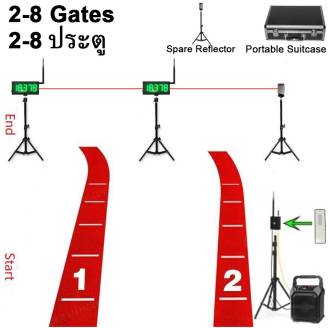
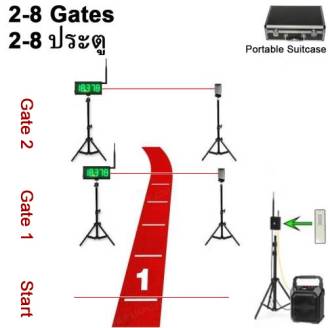
A hand-held stopwatch is fine for this calculation, but reaction time puts about 0.2s of error into every result, which is 2% on a 10s sprint and enough to hide a real improvement. For repeatable times, a set of laser timing gates starts and stops on the beam break to 0.001s, and gives you 10m and 20m splits so you can see whether acceleration or top speed is the problem.
Kinovea: Free Video Analysis Software
Kinovea is a free, open source video analysis program for Windows, made for exactly this kind of work. The feature that matters most is Track Path: right click on any point in the video (a toe, a hand, the end of a barbell), choose Track Path, press play, and Kinovea follows that point frame by frame and draws its path on screen. Right click the path again and choose Configuration to change its colour or label. Beyond tracking, you can:- Play frame by frame, slowed down or sped up
- Run a stopwatch between any two frames
- Measure angles at a joint
- Calibrate the image to a known distance so paths and lengths read in metres
- Zoom into a region with an inset magnifier
- Add notes and labels on the video
- Play two videos side by side, synchronised, and export the pair as a single image or video
The four examples below are the kind of output you get. The first two track Usain Bolt's feet and then his hands in the 100m final, the third is a run we recorded, and the fourth tracks a barbell. Watch them, then film yourself and do the same.
Example 1: Foot Tracking - Usain Bolt
The frame at the top of this article is from that video. The blue line is Kinovea's Track Path following one shoe through a full stride, and the green line is a calibrated distance measurement from one landing to the next, reading 2.44m. Tracking the foot shows:- A 2.44m average stride, 41 strides in 100m.
- 4.26 strides per second.
- The foot landing directly below the chest and face, never out in front.
- The heel passing close to the glutes on recovery. This is an elastic reflex from the force applied, not something he is trying to do.
- Landing on the toes and staying on the toes for the whole race. The heels never touch the track.
- A slight forward lean, chest ahead of the hips.
- A stable head with no bounce, because the power is going forward rather than up and down.
Example 2: Hand Tracking - Usain Bolt
Tracking the hand shows:- Half clenched fists, relaxed rather than tight.
- The hand pumping up to head height on the forward swing.
- The arm swinging back almost fully extended at the elbow.
- About 90 degrees at the elbow on the forward swing.
- A little shoulder rotation, which comes from the force of the arm drive rather than being a fault.
Example 3: Stride Length Experiment - Our Recorded Run
Does simply focusing on a longer stride help immediately? Two 110m sprints on the same evening, the first with a natural stride and the second consciously reaching for a longer one, filmed from the same spot. The right hand frame below is the second run at the halfway mark, about a metre ahead of the first.
- Strides: 66 over 110m with a natural technique, 60 when focusing on stride length. That is about a 10% longer stride.
- Time: roughly 5% faster on the second run, even though it was the second effort and legs were more tired.
- Frequency: the stride got 10% longer but the time only improved 5%, so cadence dropped a little. A worthwhile trade.
This is a psychological cue, not training, and it worked because the natural stride was short to begin with. A trained sprinter with an efficient stride will not get 5% from thinking about it, and there is a risk that the cue could lead to overstriding, where the foot lands well in front of the hips and acts as a brake, which is exactly the sort of fault the video will show you. Bolt's foot lands almost directly below his chest, and that is the target. However, it is an example where the cue helped the amateur runner.
The same video also showed three obvious technique faults in the natural run, compared against the Bolt examples above: a backward lean (which also means not staying on the toes), a bouncing head, and arms swinging inward across the body. None of these were noticeable to the runner while running, but all of them were obvious on the video.
Example 4: Bar Path Tracking - Power Clean
The same Track Path tool works on a barbell. Right click on the end of the bar, choose Track Path, press play, and the bar path is drawn over the lift. This video tracks a power clean: The more vertical the bar path, the better, from a mechanical efficiency standpoint. It is not a rule for every lift and every situation, but it is a good first check on a clean, snatch or deadlift. Below is Kinovea's side by side mode used to compare two trainees on the same lift. The pink path on the left stays close to vertical. The blue path on the right swings forward and then loops back, and that lifter lost balance at the top of the lift. Neither of them would have seen that without the video.
That comparison took about ten minutes to make, most of it waiting for the tracking to run. All you need beyond the software is a steady camera on a stand.
How to Do It on Your Own Video
- Film from the side, on a tripod. For a sprint, put the camera level with the lane, 10 to 15m back, so the runner passes across the frame rather than towards it. For a lift, set it at bar height, square on to the lifter's side. Any phone works. If it can record at 60 or 120 frames per second, use that, because sprint foot contacts last about 0.1s and 30fps gives you only three frames of each one.
- Put two markers a known distance apart in the plane the athlete moves through, for example cones 10m apart on the track, or use the known diameter of a 45cm weight plate in the gym. Kinovea can calibrate the image from that, and stride lengths and bar paths then read in metres rather than pixels.
- Open the video in Kinovea and step through it with the arrow keys. Count your strides here if you have not already.
- Right click on the toe of one shoe and choose Track Path. Press play. Kinovea draws the path. Check where each landing sits relative to the hips (a vertical line tool helps), whether the heel touches down, and how high the heel recovers.
- Do the same on one hand. Look at the height of the forward swing, the extension at the back, and whether the hand crosses the midline of the body.
- Use the angle tool at the elbow on the forward swing and at the trunk to check the lean. Bolt's elbow is around 90 degrees at the front and close to straight at the back.
- For a lift, track the end of the bar instead and judge how far the path wanders from vertical, and where.
- Save a side by side comparison. Kinovea can play two videos synchronised, so put your first run next to your second, this month next to last month, or yourself next to a better athlete, and export the pair as one image or one video.
Sprinting: What to Fix First
Working from the two Bolt videos and the experiment above, in the order that usually gives the most speed for the least effort:- Foot landing under the hips, not in front. Overstriding brakes every step. Reach for stride length with hip extension behind the body, not by throwing the foot out ahead.
- Stay on the toes. If a heel touches the track, ground contact time goes up and the elastic return from the calf and Achilles is lost.
- Slight forward lean from the ankles, chest ahead of the hips. A backward lean makes both of the above worse.
- Head still. Any bounce is force going upward instead of forward.
- Arms straight forward and back, hand to head height in front, elbow nearly straight behind, no crossing the body. The arms set the rhythm the legs follow.
Fix one at a time, film again, and compare in Kinovea. The change is usually visible on the first re-test, and the stride count tells you whether it turned into speed.
Exercises to Increase Stride Length
Technique cues and training may get you the quick 5%+, but after that, stride length comes from two things: how much force you put into the track on each contact, and how fast the recovery leg comes through to set up the next one. Three kinds of training have research behind them for exactly that, and the numbers below are what the studies measured, not estimates.1. Hip Flexor Strength
The hip flexors pull the thigh forward and up after each push-off. They are small, they are not trained by squats or deadlifts, and most athletes never load them directly. In an eight week study of hip flexor resistance training, men increased hip flexor strength by 11.4% and women by 14.3%, and their 40 yard dash times dropped by 4.4% and 3.2%.1 On a 12.00s 100m, 4.4% is 11.47s, from one small muscle group in two months.


- Band knee drive. Anchor a resistance band low behind you, loop it around the ankle, and drive the knee up to hip height against it. Hold a wall or chair for balance. Buy a set of bands in several strengths so the resistance can go up as you get stronger.
- Multi-hip machine. If your gym has one, it is the easiest to progress because the weight stack changes in small steps. Raise until the thigh is parallel with the ground.
- Hanging knee raise. Needs nothing but a bar. Add a dumbbell held between the feet once bodyweight is easy. The straight-leg version works too but is limited by hamstring flexibility rather than hip flexor strength, so the knee raise is the better one to load.
2. Strength Relative to Body Weight
Absolute strength barely predicts sprint speed. Strength divided by body weight predicts it well, and full body power lifts predict it best of all. In one analysis of strength measures against sprint times, the correlations were:2| Strength measure | 10m sprint | 40m sprint |
|---|---|---|
| 3RM squat | -0.06 | -0.19 |
| 3RM squat / body weight | -0.39 | -0.66 |
| 3RM hang clean | -0.36 | -0.24 |
| 3RM hang clean / body weight | -0.56 | -0.72 |
A stronger negative correlation means a faster sprint. The hang clean, a power lift where the bar moves fast, outpredicts the squat at both distances.

The rough targets for a competitive sprinter are a squat of 2 times body weight and a hang clean of 1.3 times body weight.2 A 70kg athlete is looking at a 91kg hang clean. Exercises worth the time: hang clean, power clean, back squat, jump squat and Romanian deadlift. This is also where the bar path tracking from Example 4 earns its keep, since a clean that loops forward is wasting the power you are trying to build.
3. Resisted and Assisted Sprinting
Resisted sprinting (a sled, a parachute, a partner holding a band, or a steep hill) makes each push-off harder and builds the force side of stride length. Assisted sprinting (a band pulling you forward, or a gentle downhill) forces a faster leg turnover than you can produce on your own.- Parachute, three sessions a week for four weeks: the resisted group improved 0 to 20m speed by 3.3% against 1.8% for unresisted sprinting. Neither group changed over 20 to 50m, so the gain is in acceleration. Choose a parachute that slows you by no more than 10% or technique falls apart.3
- Steep hills: in a six week study of high school female footballers, both incline treadmill sprinting and band-resisted sprinting on the ground cut the 9m start time from 1.75 to 1.68 seconds, about 4%, apparently through different mechanisms, with the treadmill group gaining mostly from stride frequency.4 If you have no incline treadmill, a parachute or sled up a hill is the practical version.
- Assisted versus resisted: in a four week comparison, both improved maximum speed while ordinary sprint training did not. Assisted work was most effective for sprints under 13.7m, resisted work for 13.7 to 36.6m.5 Doing both beats either alone,6 which fits, since they train different halves of the stride length equation.
A Week That Covers All Three
| Day | Session |
|---|---|
| Monday | Power clean 5 x 4 at 80% of max, front lunge 3 x 10, Romanian deadlift 3 x 10, hanging knee raise 3 x 10, planks |
| Tuesday | Resisted sprints: 6 to 8 x 20m with parachute or sled, full recovery between each |
| Wednesday | Jump squat 4 x 5, hang clean 4 x 6, band knee drive 3 x 12 each leg, rows and press for balance |
| Thursday | Rest or easy technique work with the camera running |
| Friday | Back squat 5 x 4 at 80% of max, Norwegian hamstring 3 x 10, multi-hip or weighted knee raise 3 x 10, weighted sit-ups |
| Saturday | Assisted sprints: 4 to 6 x 15m with band or slight downhill, then 2 to 3 flat 40m sprints filmed for stride count |
Adapted from the sample resistance training program in a review of sprint speed training methods,6 with the sprint days added. Over four weeks, drop the lifting reps and raise the percentage (5 x 3 at 85%, 5 x 2 at 90 to 95%).
Re-film the 100m every four weeks and count the strides. If the count is falling and the time with it, the stride is getting longer and the training is doing its job.
Measuring It Properly
Video gives you technique, stride count and bar path. For sprint times themselves, especially splits, timing gates take the human reaction out of the result, and a GPS tracker will log maximum speed, acceleration and sprint distance across a whole training session or match rather than one filmed run. Both are in our sports testing equipment range, with free delivery in Thailand. The Kinovea part costs nothing, so start there.Common Questions
Is Kinovea free?
Kinovea is free and open source, and it runs on Windows. There is no licence to buy and no limit on how many videos you analyse. Everything used in this article is in the standard download: path tracking, frame by frame stepping, a stopwatch between any two frames, the angle tool, image calibration and synchronised side by side playback. The only other things you need are a camera and something steady to stand it on.
What frame rate should I film at?
Film at 60 or 120 frames per second if your phone offers it. A sprint foot contact lasts about 0.1 seconds, so 30fps gives you only three frames of the part you most want to look at, and the exact moment of landing is easy to miss. Higher frame rates also make frame stepping more useful, because each press of the arrow key moves a smaller slice of the stride.
How do I get measurements in metres instead of pixels?
Calibrate the image against a known distance in the plane the athlete moves through. Put two cones a measured distance apart beside the track, for example 10m, or use the 45cm diameter of a weight plate in the gym, then tell Kinovea what that distance is. Stride lengths and bar paths then read in metres. Without calibration the figures are pixels, and they cannot be compared between two videos.
Is a phone camera good enough?
A phone on a tripod is enough for everything on this page. Film from the side rather than from the front: for a sprint, set the camera level with the lane about 10 to 15m back so the runner crosses the frame, and for a lift, set it at bar height and square on to the lifter. The part that matters is that the camera does not move, because a hand held shot makes the tracked path wander.
Does video analysis replace timing gates?
No, the two answer different questions. Video shows technique, stride count and bar path, but a hand held stopwatch carries about 0.2 seconds of reaction time error, which is 2% of a 10 second sprint and enough to hide a real improvement. Laser timing gates start and stop on the beam break, so 10m and 20m splits tell you whether acceleration or top speed is the limit.
How often should I re-film?
Every four weeks is enough to see a change. Film the same distance from the same camera position, count the strides, and compare the count and the time against the previous video. If the stride count is falling and the time is falling with it, the stride is getting longer and the training is doing its job. Kinovea has a side by side mode that will play the two runs together for the comparison.
References
- Deane RS, Chow JW, Tillman MD, Fournier KA. Effects of hip flexor training on sprint, shuttle run, and vertical jump performance. Journal of Strength and Conditioning Research. 2005;19(3):615-621.
- Stone MH, Moir G, Glaister M, Sanders R. How much strength is necessary? Physical Therapy in Sport. 2002;3(2):88-96. doi:10.1054/ptsp.2001.0102 (Circulated as "How Strong is Strong Enough?")
- Martinopoulou K, Argeitaki P, Paradisis G, Katsikas C, Smirniotou A. The effects of resisted training using parachute on sprint performance. Biology of Exercise. 2011;7(1):7-23.
- Myer GD, Ford KR, Brent JL, Divine JG, Hewett TE. Predictors of sprint start speed: the effects of resistive ground-based vs. inclined treadmill training. Journal of Strength and Conditioning Research. 2007;21(3):831-836.
- Upton DE. The effect of assisted and resisted sprint training on acceleration and velocity in Division IA female soccer athletes. Journal of Strength and Conditioning Research. 2011;25(10):2645-2652.
- Behrens MJ, Simonson SR. A comparison of the various methods used to enhance sprint speed. Strength and Conditioning Journal. 2011;33(2):64-71. doi:10.1519/SSC.0b013e318210174d
Dr Wannaporn Sumranpat Brady is a physiotherapist with a PhD, not a medical doctor, and a lecturer in the Department of Health Science and Sports at Mahasarakham University's Faculty of Education. Her research is on patellofemoral pain (PFP). She holds a PhD in Exercise and Sport Science from Mahasarakham University, an MSc in Physical Therapy from Khon Kaen University and a BSc in Physical Therapy from Naresuan University, and has also published on athletic injury rehabilitation, sports biomechanics and physical training programme design. She co-founded Isaan Sport Technology and writes its sports science articles, which take their figures from journal studies and from tests on the equipment the store sells.