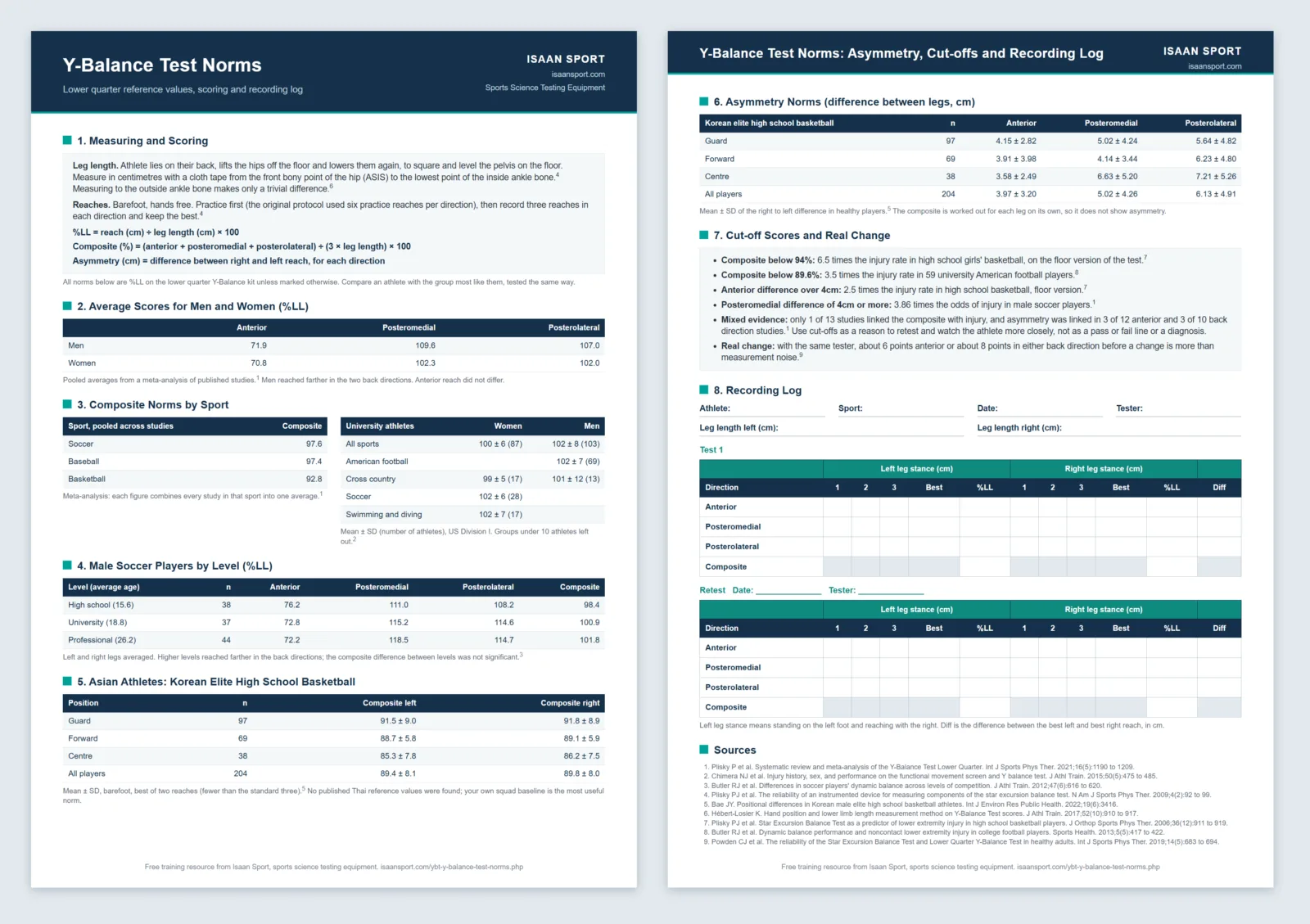
Individual Recording Sheet
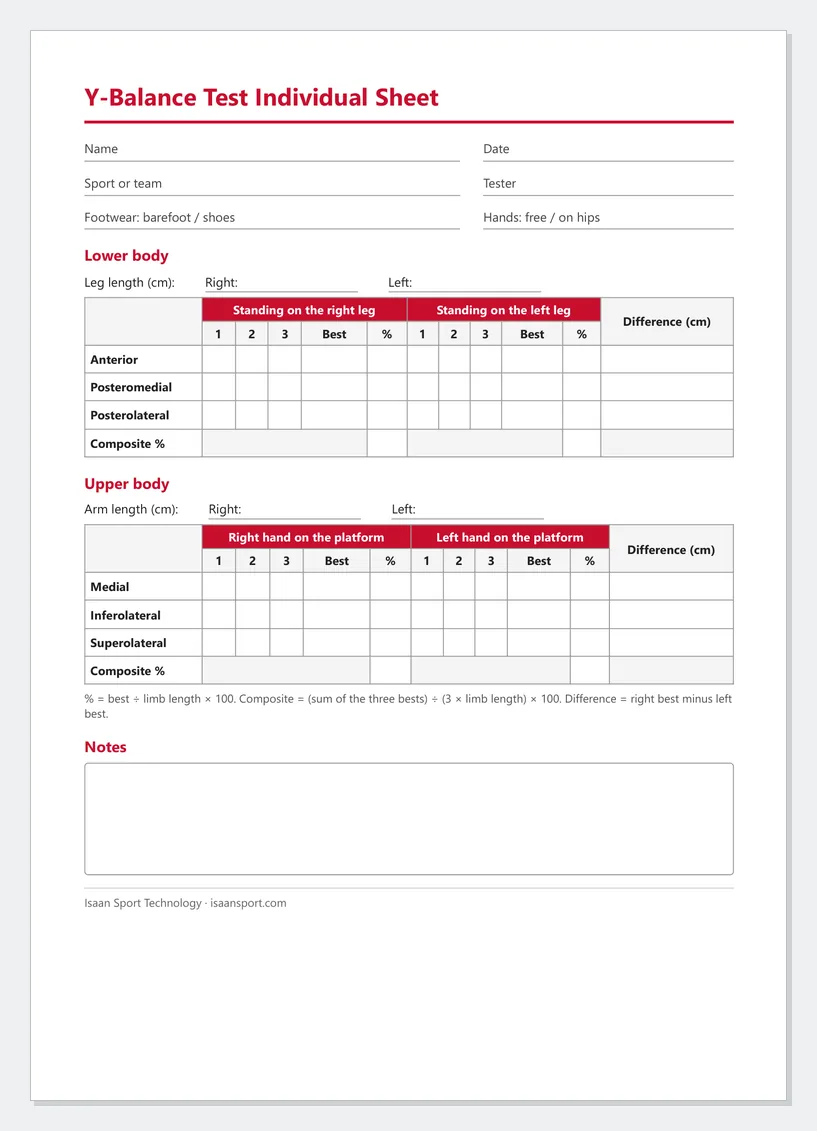
One portrait page per athlete, with both tests. Each direction has boxes for three recorded reaches on each side, the best of the three, the reach as a percentage of leg or arm length, and the right to left difference in centimetres. There are lines for name, date, sport, tester, footwear and hand position, and a notes box at the foot of the page.
Group Recording Sheets
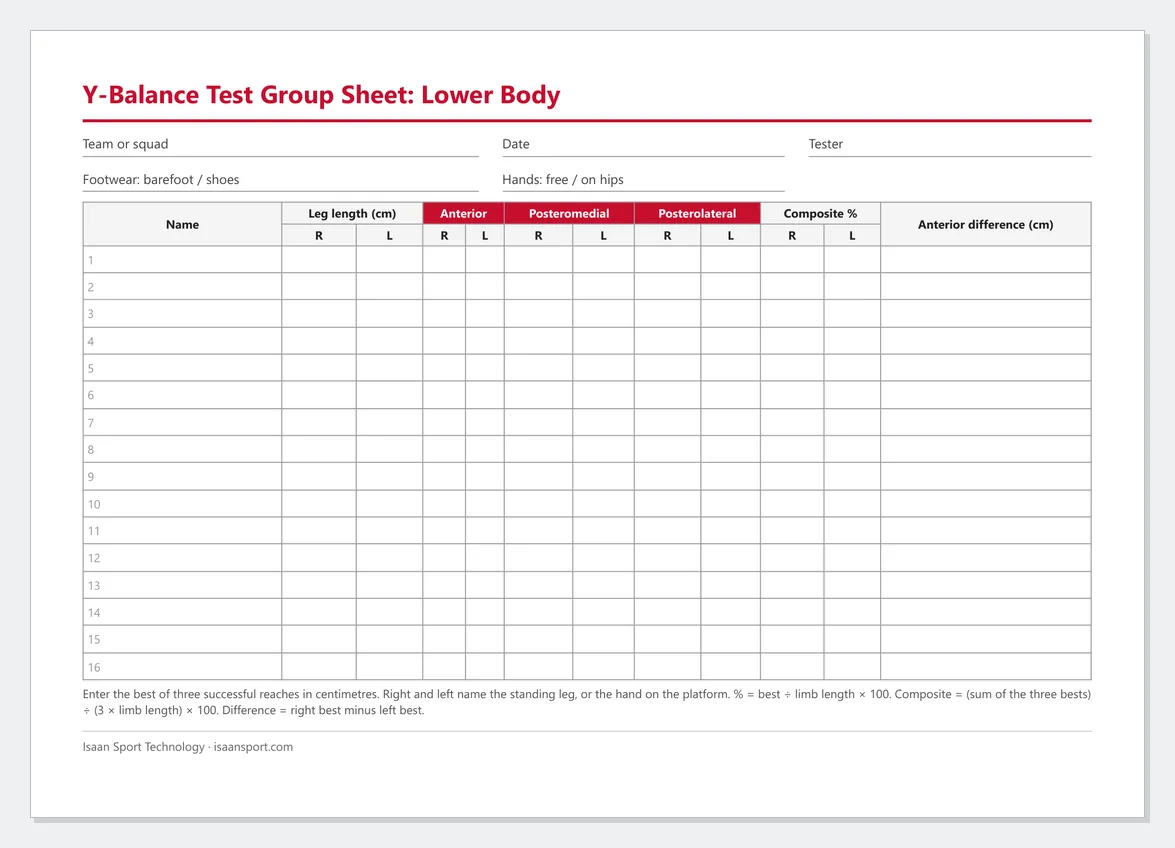
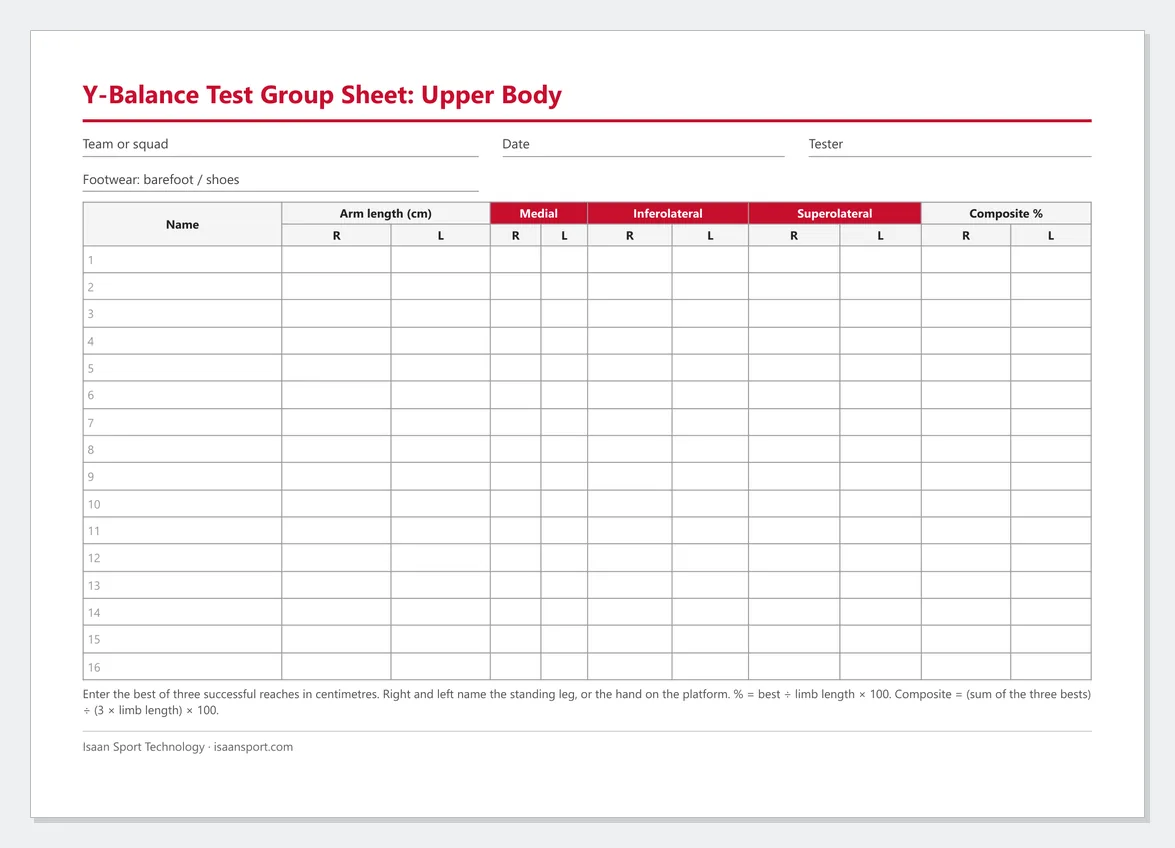
Two landscape pages, one for the lower body test and one for the upper body test, each with 16 rows. Enter each athlete's limb length and best reach for each direction on the right and the left, then the composite score for each side. The lower body sheet has an extra column for the right to left difference in anterior reach. For published asymmetry figures, see YBT norms.
Quick Reference (1 Page)
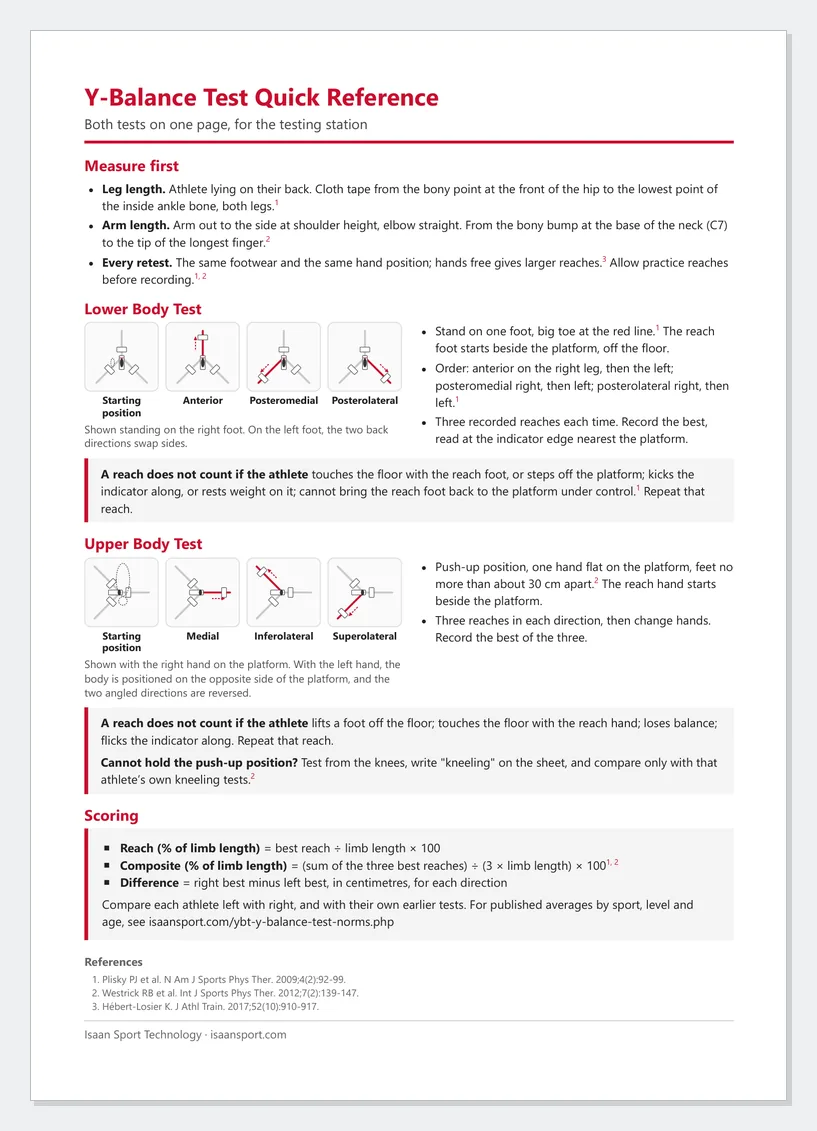
Both tests on a single portrait page to print with the sheets: how to measure limb length, a small diagram of each reach, the order and recording rules, what makes a reach not count, and the scoring formulas. The two page guide below has the full steps and photos.
Quick Usage Guide (2 Pages)
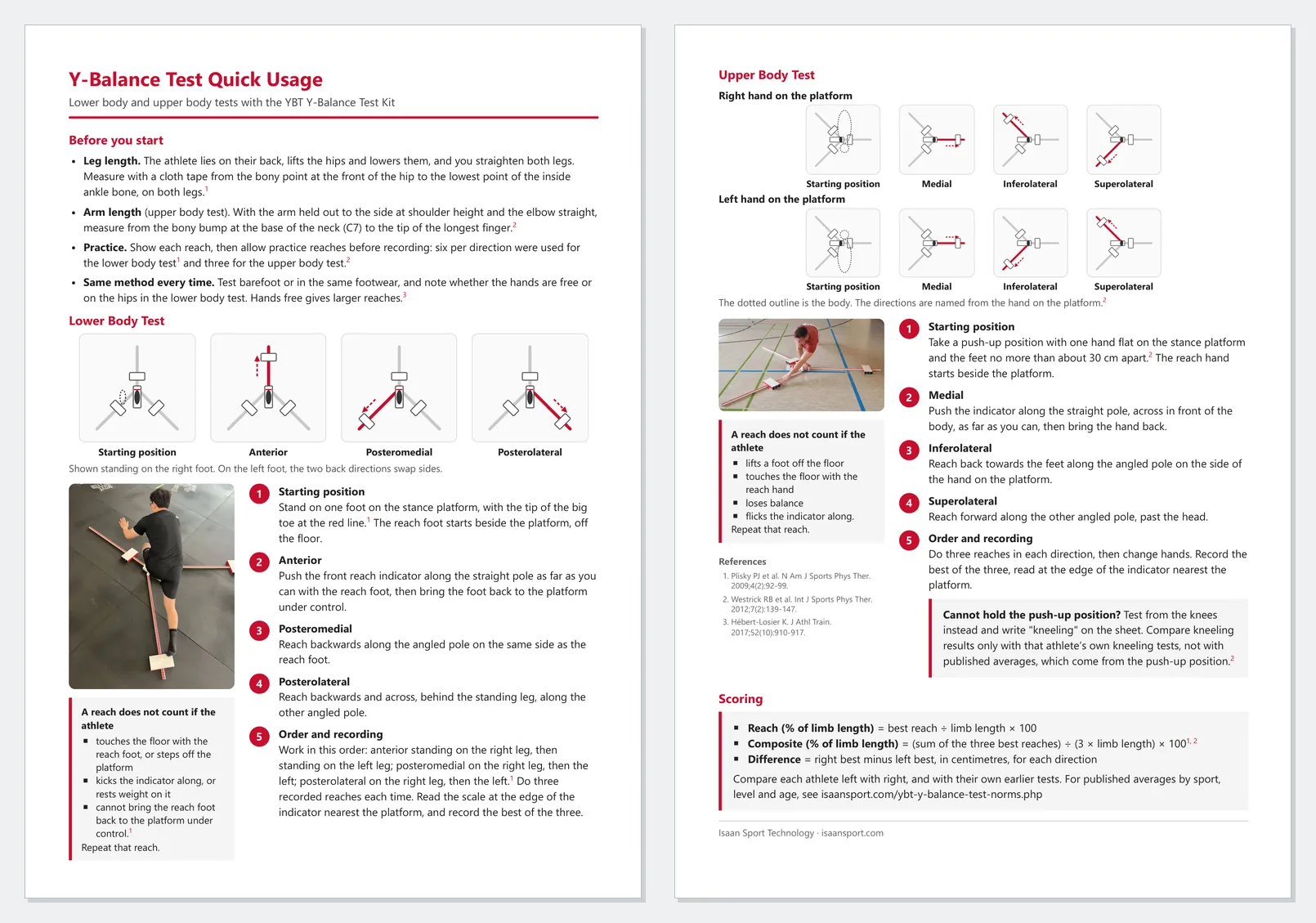
Two portrait pages to keep at the testing station: a diagram for each reach direction, the steps for each test, what makes a reach not count, an option for athletes who cannot hold the push-up position, and the scoring formulas. They are the usage pages of the Quick Set-up Guide for our YBT Y-Balance Test Kit.
How to Fill In the Sheets
- Limb length first. Measure leg length with a cloth tape from the bony point at the front of the hip (ASIS) to the lowest point of the inside ankle bone, with the athlete lying on their back.1 For the upper body test, measure arm length from the bony bump at the base of the neck (C7) to the tip of the longest finger, with the arm held out to the side at shoulder height.2
- Right and left. In the lower body test, right and left name the standing leg. In the upper body test, they name the hand on the platform.1,2
- Footwear and hands. Circle barefoot or shoes, and hands free or on hips. Reaches are larger with the hands free, so keep both the same at every retest.4
- Successful reaches only. A reach that touches the floor, kicks the indicator along or loses balance does not count. Repeat it, and write down the three that do.1
- Kneeling. If an athlete does the upper body test from the knees, write "kneeling" in the notes.
Working Out the Scores
- Reach % = best reach ÷ limb length × 100
- Composite % = (sum of the three best reaches) ÷ (3 × limb length) × 1001,3
- Difference = right best minus left best, in centimetres, for each direction
An example: an athlete with a 90 cm right leg whose best reaches standing on the right leg are 63 cm anterior, 99 cm posteromedial and 95 cm posterolateral has an anterior reach of 63 ÷ 90 × 100 = 70.0%, and a composite of (63 + 99 + 95) ÷ (3 × 90) × 100 = 95.2%.
Compare each athlete with their other side and with their own earlier tests. For published averages by sport, level and age, see YBT norms.
Common Questions
Can I use these sheets for the Star Excursion Balance Test?
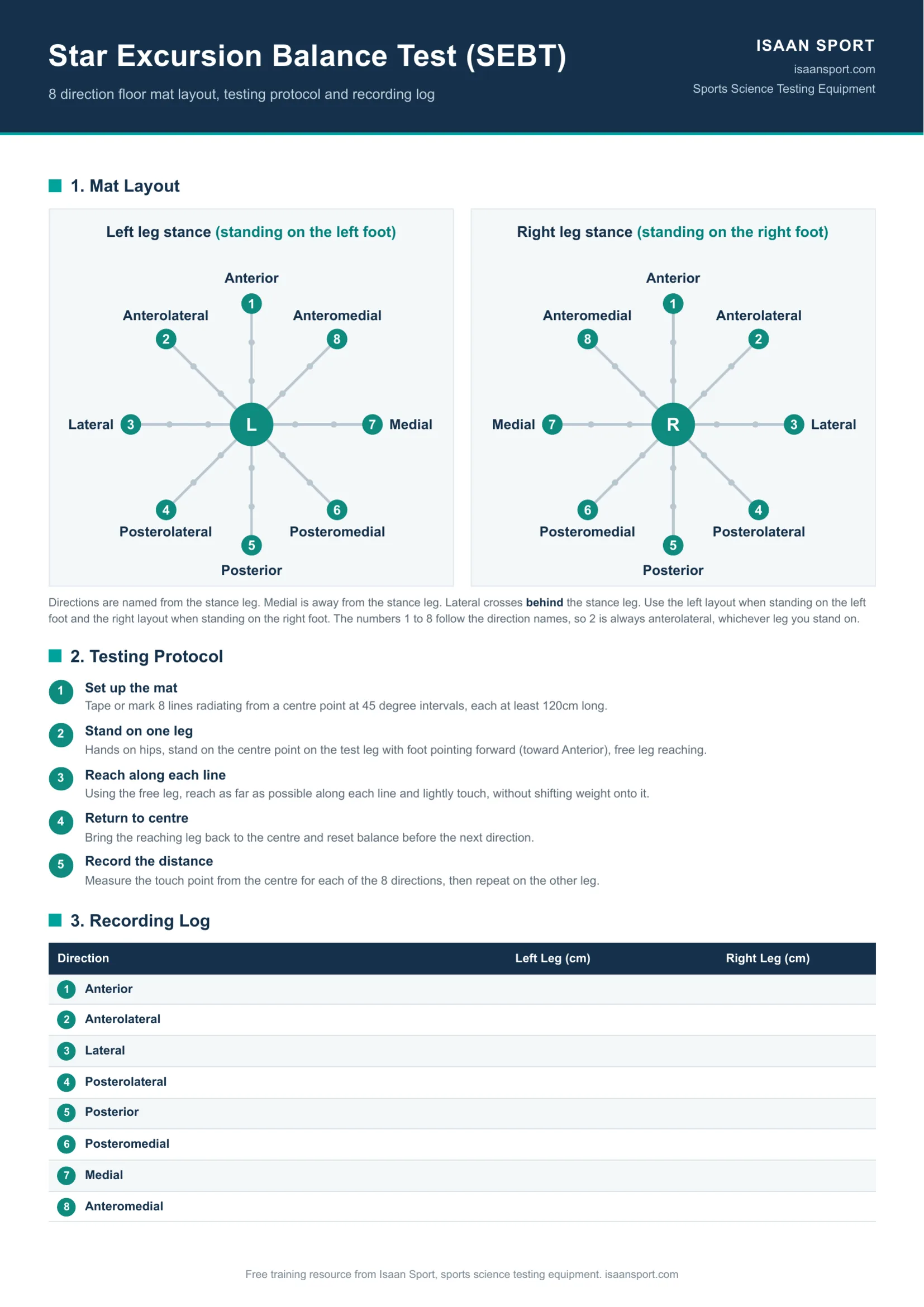
Only for the three directions the sheets list, and keep floor test scores apart from kit scores. In 20 active men, anterior reach was further on the floor test than on the Y-Balance Test kit, while posteromedial and posterolateral reach did not differ.5 For all eight floor directions, use the Star Excursion Balance Test printable, which has its own recording log.
How do I measure arm length for the upper body Y-Balance Test?
Measure from the bony bump at the base of the neck (C7) to the tip of the longest finger, with the arm held out to the side at shoulder height and the elbow straight.2 Use a cloth tape, measure both arms, and write each length on the sheet before testing, because every upper body score is worked out as a percentage of arm length.
What if an athlete cannot hold the push-up position?
Test them from the knees and write "kneeling" on the sheet. Published upper body averages come from the push-up position, with the feet no more than about 30 cm apart,2 so compare kneeling results only with that athlete's own kneeling tests. Move them to the full position once they can hold it for every reach, and start a new record from that test.
Related Reading
- YBT norms, published scores by sport, level and age.
- Star Excursion Balance Test instructions, a free printable for the floor test.
References
- Plisky PJ, Gorman PP, Butler RJ, Kiesel KB, Underwood FB, Elkins B. The reliability of an instrumented device for measuring components of the star excursion balance test. North American Journal of Sports Physical Therapy. 2009;4(2):92 to 99. PubMed 21509114
- Westrick RB, Miller JM, Carow SD, Gerber JP. Exploration of the Y-balance test for assessment of upper quarter closed kinetic chain performance. International Journal of Sports Physical Therapy. 2012;7(2):139 to 147. PubMed 22530188
- Gorman PP, Butler RJ, Plisky PJ, Kiesel KB. Upper Quarter Y Balance Test: reliability and performance comparison between genders in active adults. Journal of Strength and Conditioning Research. 2012;26(11):3043 to 3048. doi:10.1519/JSC.0b013e3182472fdb
- Hébert-Losier K. Clinical implications of hand position and lower limb length measurement method on Y-Balance Test scores and interpretations. Journal of Athletic Training. 2017;52(10):910 to 917. doi:10.4085/1062-6050-52.8.02
- Coughlan GF, Fullam K, Delahunt E, Gissane C, Caulfield BM. A comparison between performance on selected directions of the star excursion balance test and the Y balance test. Journal of Athletic Training. 2012;47(4):366 to 371. doi:10.4085/1062-6050-47.4.03
Dr Wannaporn Sumranpat Brady is a physiotherapist with a PhD, not a medical doctor, and a lecturer in the Department of Health Science and Sports at Mahasarakham University's Faculty of Education. Her research is on patellofemoral pain (PFP). She holds a PhD in Exercise and Sport Science from Mahasarakham University, an MSc in Physical Therapy from Khon Kaen University and a BSc in Physical Therapy from Naresuan University, and has also published on athletic injury rehabilitation, sports biomechanics and physical training programme design. She co-founded Isaan Sport Technology and writes its sports science articles, which take their figures from journal studies and from tests on the equipment the store sells.