Cite this article
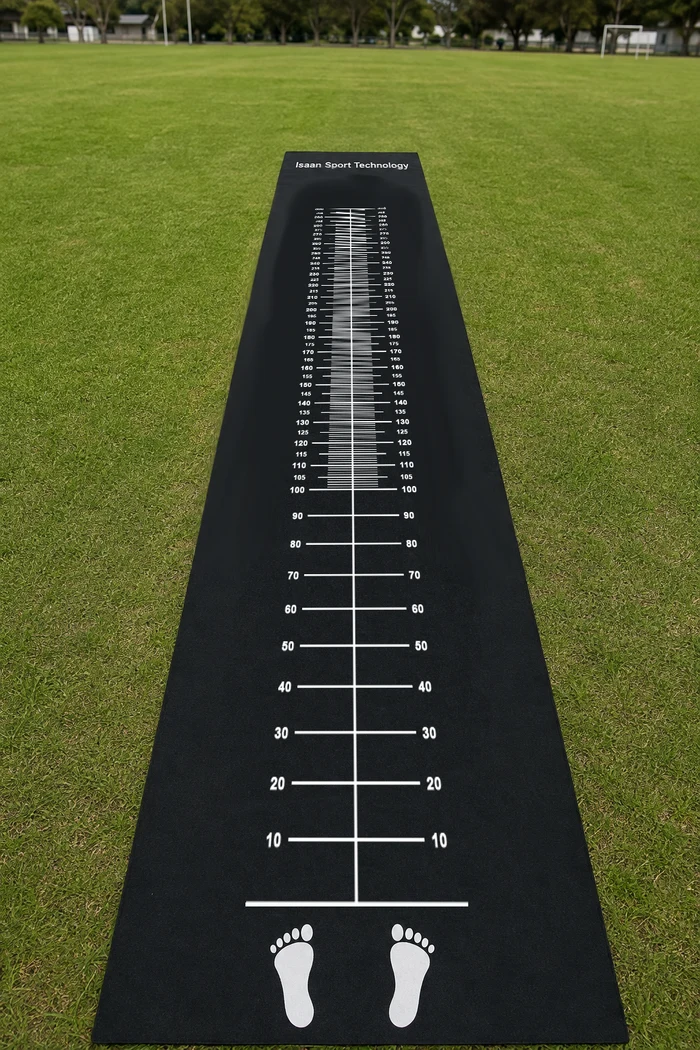
While we stock broad jump mats, along with other testing equipment, we're aware that we cannot deliver to everybody internationally, and you may want to make your own broad jump mat instead. For that, we have a reasonable solution.
Below is a free Photoshop file for your own standing long jump / broad jump measuring mat, that you may modify (feel free to change the logo too) and take to a printing shop to have printed. That is the challenge, however, finding a suitable printing shop or factory willing and able to print it onto a suitable material (eg. diatomaceous earth padded mat, but it's far easier to find a shop that prints onto vinyl which is only semi-suitable). The design includes a start line with two foot markers and a dual-sided scale running from 0-300cm.
What You're Downloading
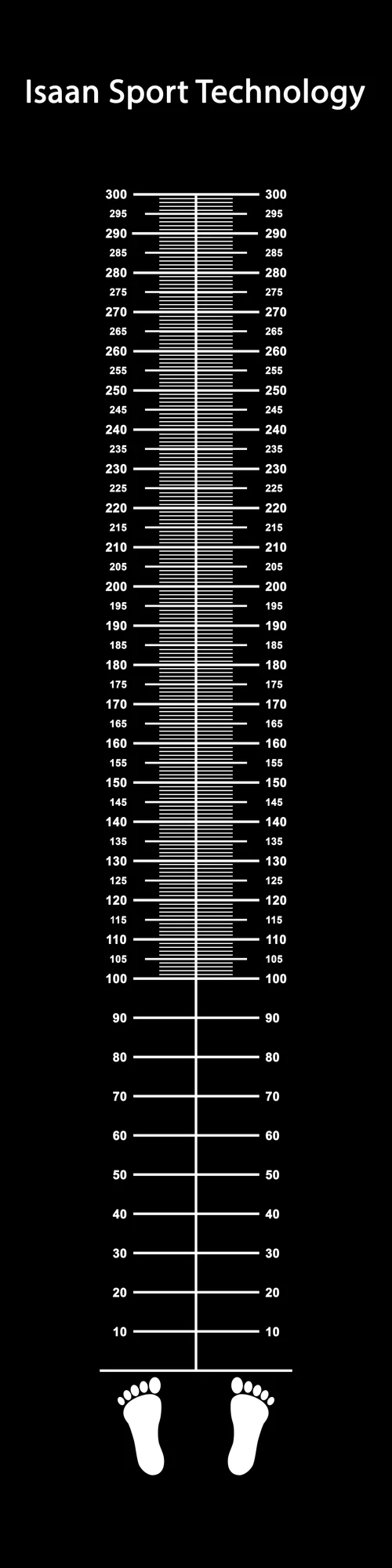
- Dimensions: 5,900 x 23,600 pixels
- Format: Photoshop Big (.psb) - required because the canvas is too large for a standard .psd
- Scale: marked both sides from 0 to 300, readable from either edge of the mat
How to Use It
- Open the .psb in Photoshop, add your own branding or adjust colours if you want to
- Send it to a large-format print shop (the kind that prints banners, vinyl decals, or exhibition signage) - most can work directly from a Photoshop file at this size
- Have it printed onto a durable, non-slip material so it holds up to repeated jump testing
- Lay it flat on the ground with the foot markers at the start line and read the landing distance straight off the scale
Why Make Your Own
A dedicated measuring mat is faster and more consistent than a tape measure for standing long jump testing - no re-measuring between athletes, no arguing over the exact landing point. Printing your own means you can brand it, or adapt the colours, but not the scale, which is pre-sized as cm.If You Prefer a Ready-Made Mat
If you're in Thailand, then you can order one of our pre-made ones instead, such as the 3.6m Digital Broad Jump Test Mat.Why a Marked Mat Beats a Tape
The error in a standing long jump measurement sits in the judgement, not in the ruler. A 2026 paper on automated jump measurement says it plainly: traditional distance measurement relies on manual judgement, which leaves it open to subjective bias and disputes, and it is slow in large testing sessions.1 Two people with a tape have to agree where the zero end sits and where the heel touched down, then do it again for the next athlete.A printed mat fixes the zero at the start line permanently and leaves one decision, which is the back edge of the heel. The scale does not move between athletes, so a squad of twenty gets through testing in a fraction of the time, and the person recording never has to ask whether the tape slipped.
As for precision, the automated camera system in that paper used careful manual tape measurement as its reference and landed within a mean absolute error of 0.71cm.1 The change worth detecting in a child is around 12cm.2,3 A scale printed to the centimetre is well inside what the test can resolve.
How Long the Mat Needs to Be
The template runs to 300cm. That is more than enough for school testing and close to the limit for trained adults, which is worth knowing before you pay for printing.| Group tested | Average standing long jump |
|---|---|
| 171 preschoolers, mean age 5.4 years2 | 79cm, standard deviation 19cm |
| 33 rhythmic gymnasts aged 5 to 103 | 104cm, standard deviation 13cm |
| 7,842 male college students4 | 2.29m, standard deviation 0.24m |
Three metres sits about three standard deviations above that college average, so it covers all but the strongest jumpers. If you test trained adult men, expect the occasional jump past the end of the mat and decide in advance whether those get a tape measurement or a note.
Check the Print Before You Trust It
Large format printers scale artwork to fit the material they are running, and a print that comes back 2 per cent short turns a 200cm jump into 196cm with nothing on the mat to show it. That error is invisible, it is consistent, and it will sit under every number you collect.Before the first test, lay the mat flat and check it against a steel tape at three points: 50cm, 150cm and 300cm. If the marks line up at all three, the print is fine. If they drift further apart as you go along the mat, the artwork has been scaled and the mat needs reprinting, since a stretch that grows cannot be corrected by subtracting a fixed amount. Keep the tape with the mat and repeat the check once a season, because printed vinyl can shrink.
What the Test Is Good For
The standing long jump earns its place in a testing battery by being cheap and quick while still tracking other things. In 7,842 male college students, jump distance correlated most strongly with pull-up performance (r = 0.516), then sit and reach (r = 0.266), and weakly and negatively with 1000m run time and body mass index.4Two limits come with that. The study was cross-sectional, so it shows the jump travelling with general fitness rather than proving that training the jump improves the rest. The authors also state that the findings should not be generalised to women, to other age groups or to people outside college.4 Read the mat as a measure of lower limb power, and keep the rest of the battery.
Frequently Asked Questions
Is a printed mat as accurate as a tape measure?
Yes, and it is usually more consistent. The scale is the same on every jump and the zero cannot drift, which removes two of the ways tape measurement goes wrong. What a mat does not remove is the judgement of where the heel landed, which is the main source of disagreement in manual measurement.1 Agree the rule before testing and have one person call every landing.How long should the mat be?
Three metres covers school and general adult testing. Preschool averages sit near 79cm and gymnasts aged 5 to 10 near 104cm, while male college students average 2.29m with a standard deviation of 0.24m.2,3,4 A 300cm scale therefore reaches about three standard deviations past that adult average. Trained male athletes will occasionally clear it, so plan for that case.What material should it be printed on?
A padded, non-slip material is worth the search, because the mat has to stay flat and take repeated landings. Vinyl is far easier to find and works, but it is slippery when damp and it curls at the edges in the sun. Ask for a matt finish rather than gloss, ask for the thickest stock the printer offers, and have the edges hemmed or welded if that is an option.Can I use a phone app instead?
Not for anything you plan to track. The automated measurement paper reviews a smartphone inertial sensor method that reported a root mean square error of 0.122m, which is around ten times the error of careful tape measurement and about the size of the change you are trying to detect in a child.1 A printed mat costs one print run and settles the question.Where is the landing measured from?
From the start line to the nearest point of contact, which is normally the back of the heel. Vision based systems segment the heel for exactly this reason.1 If an athlete falls backwards and puts a hand down behind the heels, that hand becomes the nearest point of contact and the jump is measured to it, so write the rule on the recording sheet and apply it every time.Does the surface under the mat matter?
Yes, so treat it as part of the protocol. A mat on grass gives slightly under the take off, a mat on a gym floor does not, and neither is wrong as long as the same surface is used every test. Note the surface in the session details of your recording sheet, and lay the mat so there is no fold or ridge near the expected landing zone.Related Reading
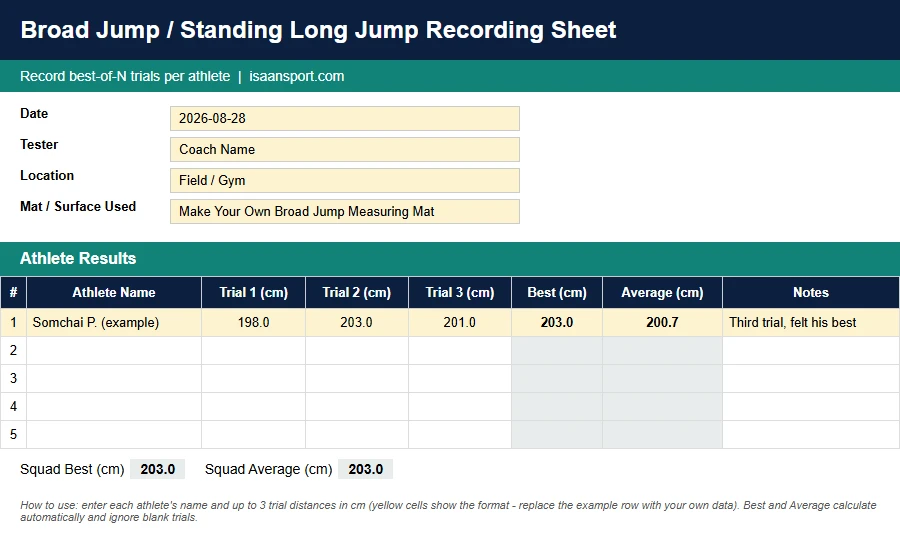
- Broad jump recording sheets, free spreadsheets for the numbers the mat produces.
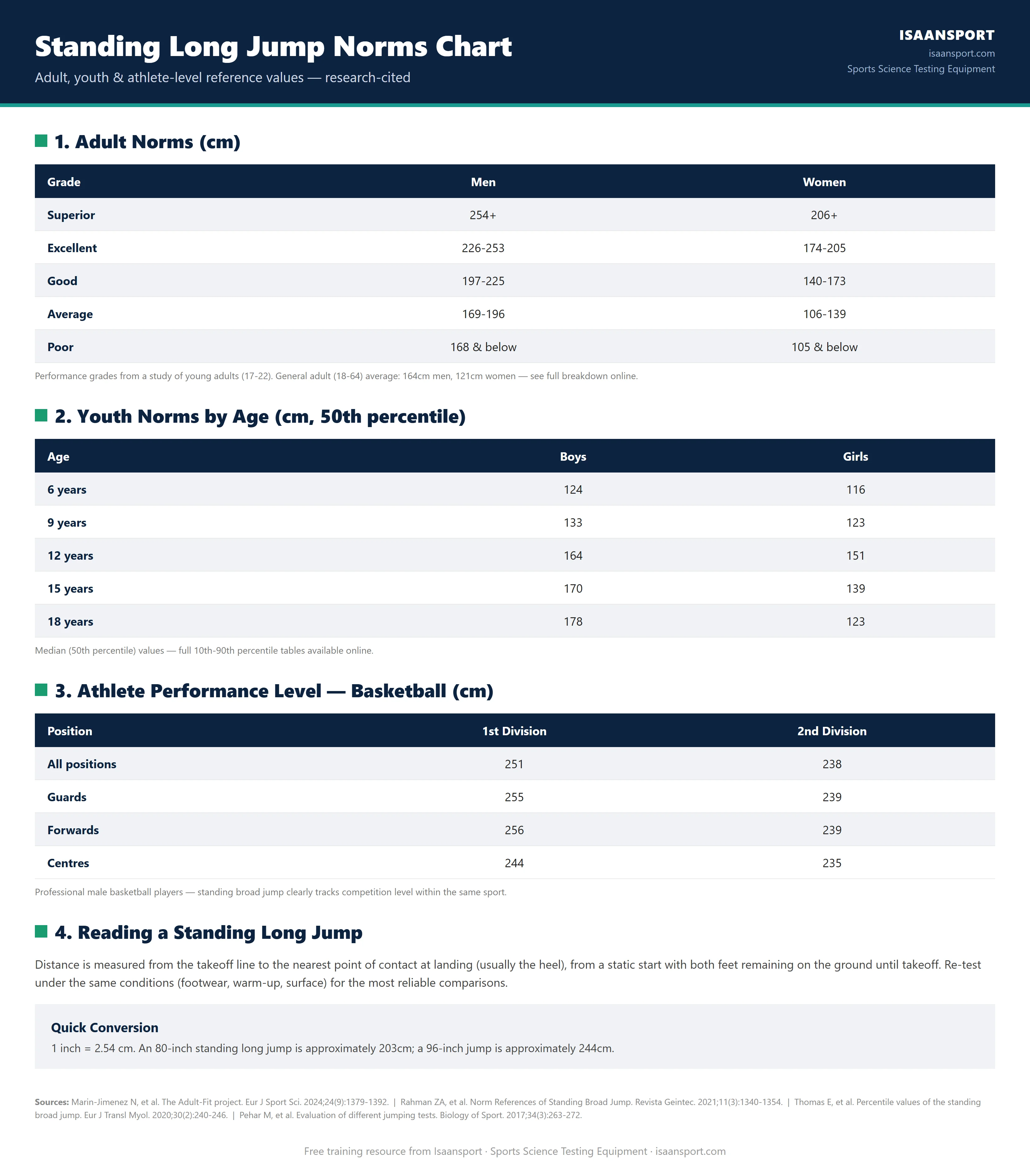
- Standing long jump norms by age, to read the results against a population.
- Electronic long jump test mat, if you would rather the mat did the reading.
- Free video analysis with Kinovea, for checking take off and landing from the side.
References
- Kuang G, Li S, Liu Y, Jia S. A smart monocular vision metrology system based on computer for standing long jump. Scientific Reports. 2026. doi:10.1038/s41598-026-44523-3
- Soto-Sanchez J, Leyton-Dinamarca B, Kain J, et al. Reliability of the PREFIT fitness-test battery in Chilean preschoolers. Frontiers in Pediatrics. 2025. doi:10.3389/fped.2025.1654731
- Rashid Xamidovich K, Mehriddin Junaydulloyevich A, Nodir Nuriddinovich X, et al. Evaluation of adaptation based on biological variability and substantial changes in young rhythmic gymnasts. Frontiers in Sports and Active Living. 2026. doi:10.3389/fspor.2026.1860505
- Chen CF, Wu HJ, He YZ, et al. Standing long jump is associated with multiple field-based fitness indicators in young adult males. Frontiers in Psychology. 2026. doi:10.3389/fpsyg.2026.1856443
By the Isaan Sport Technology team with Dr Wannaporn Sumranpat Brady · 28 Aug 2026 (updated 16 Sep 2026)
Dr Wannaporn Sumranpat Brady is a physiotherapist with a PhD, not a medical doctor, and a lecturer in the Department of Health Science and Sports at Mahasarakham University's Faculty of Education. Her research is on patellofemoral pain (PFP). She holds a PhD in Exercise and Sport Science from Mahasarakham University, an MSc in Physical Therapy from Khon Kaen University and a BSc in Physical Therapy from Naresuan University, and has also published on athletic injury rehabilitation, sports biomechanics and physical training programme design. She co-founded Isaan Sport Technology and writes its sports science articles, which take their figures from journal studies and from tests on the equipment the store sells.
Dr Wannaporn Sumranpat Brady is a physiotherapist with a PhD, not a medical doctor, and a lecturer in the Department of Health Science and Sports at Mahasarakham University's Faculty of Education. Her research is on patellofemoral pain (PFP). She holds a PhD in Exercise and Sport Science from Mahasarakham University, an MSc in Physical Therapy from Khon Kaen University and a BSc in Physical Therapy from Naresuan University, and has also published on athletic injury rehabilitation, sports biomechanics and physical training programme design. She co-founded Isaan Sport Technology and writes its sports science articles, which take their figures from journal studies and from tests on the equipment the store sells.
Cite this article
Sumranpat Brady, W. (2026, August 28). Make Your Own Broad Jump Measuring Mat (Free Template). Isaan Sport Technology. https://www.isaansport.com/make-broad-jump-measuring-mat.php