Cite this article
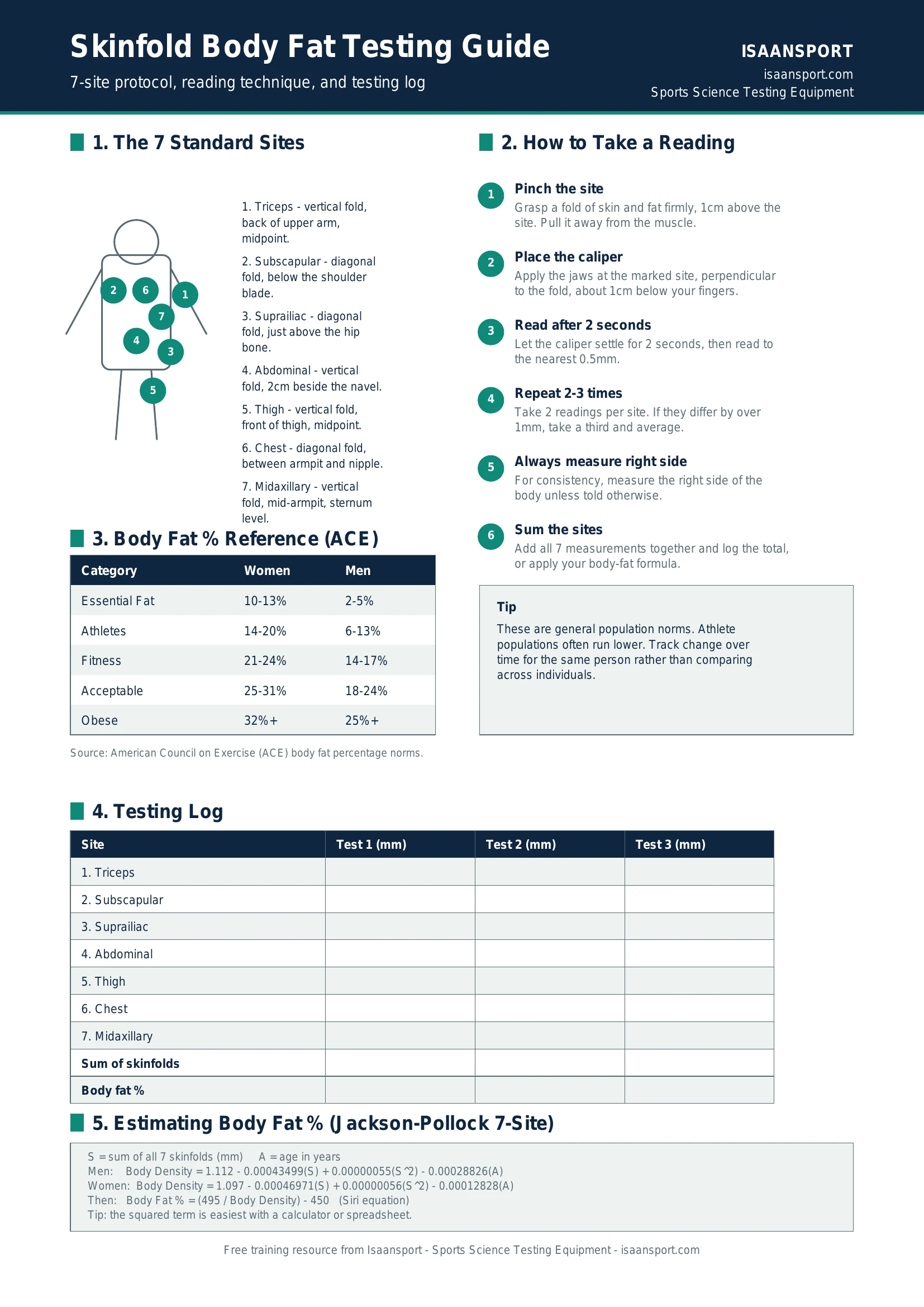
A free printable guide covering the 7-site skinfold testing protocol, correct caliper technique, and a fillable log for recording results. It acts as a reference guide to remind you of the steps, and also to act as a log where you can record the measurements. The 'Body Fat %' row requires some moderately complicated calculations, and requires a calculator or spreadsheet (we've also included a spreadsheet below for just that purpose). It is also possible to use the guide for skinfold measurements only, referring back when you repeat the test at a future date, to note whether any changes in measurements have taken place.
Download the Printable PDF
How to Use It
Print the guide and keep it on hand during testing sessions. Use the site diagram to confirm caliper placement, then record each reading directly in the log so progress can be tracked over time.The 7 Standard Sites
- Triceps - vertical fold, back of the upper arm, midpoint
- Subscapular - diagonal fold, below the shoulder blade
- Suprailiac - diagonal fold, just above the hip bone
- Abdominal - vertical fold, 2cm beside the navel
- Thigh - vertical fold, front of the thigh, midpoint
- Chest - diagonal fold, between the armpit and nipple
- Midaxillary - vertical fold, mid-armpit, sternum level
Taking a Reading
- Pinch the site - grasp a fold of skin and fat firmly, 1cm above the site, and pull it away from the muscle
- Place the caliper - apply the jaws at the marked site, perpendicular to the fold, about 1cm below your fingers
- Read after 2 seconds - let the caliper settle, then read to the nearest 0.5mm
- Repeat 2-3 times - take two readings per site, and a third if they differ by more than 1mm
- Always measure the right side of the body for consistency
- Sum the sites and log the total, or apply a body-fat formula
Body Fat % Reference (ACE)
The guide includes the American Council on Exercise body fat percentage norms for men and women, from essential fat through to obese. These are general population norms - athlete populations often run lower, so it is best to track change over time for the same person rather than comparing across individuals.Testing Log
A blank log for all 7 sites, three readings each, plus rows for the sum of skinfolds and calculated body fat percentage - so every session can be recorded in one place.Spreadsheet (Free Download for Microsoft Excel)
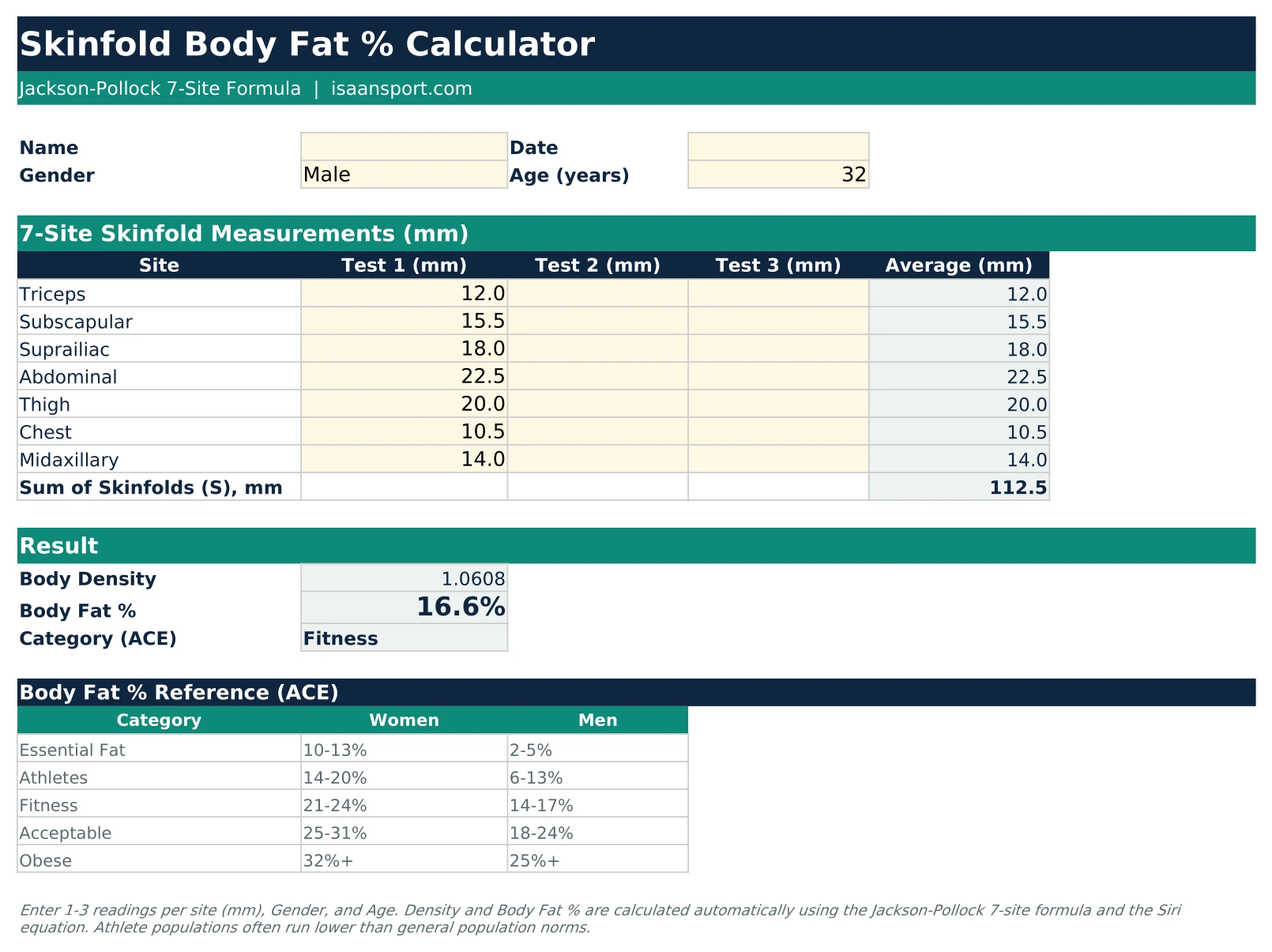
Download the Body Fat % Calculator (Excel)
Enter gender, age, and the skinfold readings and the spreadsheet works out body density and body fat % automatically, using the same formula as above. This is the simplest way to do the Body Fat % calculations.
The Formulas the Spreadsheet Uses
The spreadsheet averages your readings at each site, adds the seven sites together, and puts that sum through the Jackson and Pollock generalised equations for body density. Siri's equation then turns density into a percentage. In all three lines, sum is the total of the seven readings in millimetres and age is in years.- Men: body density = 1.112 - (0.00043499 x sum) + (0.00000055 x sum x sum) - (0.00028826 x age)1
- Women: body density = 1.097 - (0.00046971 x sum) + (0.00000056 x sum x sum) - (0.00012828 x age)2
- Both: body fat percentage = (495 / body density) - 4505
How Accurate the Percentage Is
Treat the percentage as a wide estimate and the sum of skinfolds as the measurement. A standard error close to 4 percentage points means a result of 25 per cent sits somewhere around 21 to 29, before any error in your own pinching is added.2Checks against DXA scanning tell the same story. In 25 male academy footballers, the better prediction equations reached intraclass correlations of 0.858 to 0.891 for fat mass, but the Bland and Altman plots showed mean bias and wide limits of agreement, and the authors concluded that the equations had limited validity against DXA.4
A 2026 review of skinfold standards puts the practical alternative plainly: several authors now recommend recording the sum of skinfold thicknesses, at six or eight sites, and reading it against reference percentiles, rather than pushing it through a prediction equation at all.3 On the log sheet that means the Sum row is the one to watch. A drop from 92mm to 84mm in the same person, measured by the same tester, is a real change no matter what the percentage column says.
Getting Readings You Can Repeat
The same review compared five standards and found 17 skinfold sites described 31 different ways across 22 site selection protocols, with more disagreement at the trunk sites than at the limbs.3 The protocols are not interchangeable, so pick one description of each site, write it on the sheet, and use that one every time.Six technique points are common to all of them:3
- Measure on the right side of the body
- Use a caliper that is calibrated and in good condition
- Pinch the fold between the tips of the left thumb and index finger
- Hold the caliper in the right hand, jaws perpendicular to the fold
- Control the reading time, so every reading is taken after the same delay
- Keep holding the fold up until the reading has been taken
ACE Body Fat Categories
These are the bands printed on the guide and built into the spreadsheet, from the American Council on Exercise. They describe the general population, so athletes often sit in the band below the one their training would suggest.| Category | Men | Women |
|---|---|---|
| Essential fat | Under 6% | Under 14% |
| Athletes | 6 to 13% | 14 to 20% |
| Fitness | 14 to 17% | 21 to 24% |
| Acceptable | 18 to 24% | 25 to 31% |
| Obese | 25% and above | 32% and above |
Frequently Asked Questions
How accurate is a skinfold body fat test?
The percentage carries an error of several points, so read it as a band rather than a number. The equation used for women had standard errors of 3.7 to 4.0 percentage points against hydrostatic weighing.2 Compared with DXA scans in young footballers, skinfold equations showed mean bias and wide limits of agreement.4 The sum of the seven readings is far more repeatable, and it is the number to track.Which formula does the spreadsheet use?
It uses the Jackson and Pollock seven site generalised equations, one for men and one for women, then the Siri equation to convert body density into a percentage. All three are printed above, so you can check the spreadsheet against a calculator if you want to. The men's version was published in 1978 and the women's in 1980, and both remain the equations most fitness software is built on.Should I look at the sum of millimetres instead of the percentage?
Yes, for tracking one person over time the sum is the better number. It is what you actually measured, it carries no equation error, and it moves as soon as subcutaneous fat does. A 2026 review of skinfold standards recommends exactly that, with reference percentiles instead of predicted percentages.3 Keep the percentage for the times someone asks for one.How often should the test be repeated?
Every four to six weeks is enough for most training programmes. Subcutaneous fat changes slowly, and the measurement error at a single site is around a millimetre, so weekly testing mostly shows noise. Keep the conditions the same each time: the same tester, the same caliper, the same time of day, and before training rather than after it.Does the caliper change the result?
Yes, calipers differ in jaw pressure and scale, so readings from two different instruments should not be mixed in one series. The caliper types in general use are built to different designs, which is one of the reasons protocols are not interchangeable.3 Use one caliper for a person across a whole programme, and note on the sheet which one it was.Can I compare my result with someone else's?
Only loosely, and only if both tests used the same sites and the same technique. Site definitions vary between standards, trunk sites most of all, so two testers can produce different sums on the same person.3 Comparisons across people work best with the ACE bands above, which are wide enough to survive that variation. For anything finer, compare a person only with themselves.Related Reading
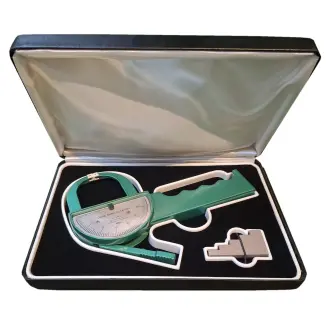
- Stainless steel body fat caliper, the tool the guide is written around.
- Vertical jump infographic, which covers what body composition does and does not do to jump height.
- Beep test calculator and norms, for the aerobic half of a testing session.
- Standing long jump norms, if you are building a testing battery.
References
- Jackson AS, Pollock ML. Generalized equations for predicting body density of men. British Journal of Nutrition. 1978;40(3):497 to 504. doi:10.1079/bjn19780152
- Jackson AS, Pollock ML, Ward A. Generalized equations for predicting body density of women. Medicine and Science in Sports and Exercise. 1980;12(3):175 to 181. doi:10.1249/00005768-198023000-00009
- Cintra JH, Costa-Pereira JP, Ripka WL, et al. Skinfolds measurement protocols and standards: a narrative review. Advances in Nutrition. 2026. doi:10.1016/j.advnut.2026.100662
- Efstathiou E, Wilson LJ, Dickinson B, Curtis C. Evaluating the reliability and validity of predictive anthropometric equations for estimating fat mass and lean mass within professional academy soccer players. Sports. 2026;14(3):91. doi:10.3390/sports14030091
- Siri WE. Body composition from fluid spaces and density: analysis of methods. 1961. Reprinted in Nutrition. 1993;9(5):480 to 491. PubMed 8286893
By the Isaan Sport Technology team with Dr Wannaporn Sumranpat Brady · 25 Aug 2026 (updated 16 Sep 2026)
Dr Wannaporn Sumranpat Brady is a physiotherapist with a PhD, not a medical doctor, and a lecturer in the Department of Health Science and Sports at Mahasarakham University's Faculty of Education. Her research is on patellofemoral pain (PFP). She holds a PhD in Exercise and Sport Science from Mahasarakham University, an MSc in Physical Therapy from Khon Kaen University and a BSc in Physical Therapy from Naresuan University, and has also published on athletic injury rehabilitation, sports biomechanics and physical training programme design. She co-founded Isaan Sport Technology and writes its sports science articles, which take their figures from journal studies and from tests on the equipment the store sells.
Dr Wannaporn Sumranpat Brady is a physiotherapist with a PhD, not a medical doctor, and a lecturer in the Department of Health Science and Sports at Mahasarakham University's Faculty of Education. Her research is on patellofemoral pain (PFP). She holds a PhD in Exercise and Sport Science from Mahasarakham University, an MSc in Physical Therapy from Khon Kaen University and a BSc in Physical Therapy from Naresuan University, and has also published on athletic injury rehabilitation, sports biomechanics and physical training programme design. She co-founded Isaan Sport Technology and writes its sports science articles, which take their figures from journal studies and from tests on the equipment the store sells.
Cite this article
Sumranpat Brady, W. (2026, August 25). Skinfold Body Fat Testing Guide (Free Printable). Isaan Sport Technology. https://www.isaansport.com/skinfold-testing-guide-printable.php