Students can run into a variety of pitfalls during their doctoral degrees, and often the same ones as prior students have. This free 15-minute educational game is designed to walk students through a doctoral degree, one decision at a time - from picking your research question in Year 1 to defending your thesis in Year 4. The intention is to give a glimpse at the common issues that students run into, what effect it will have on the process (eg. delays), and show them the alternative courses of action. It may save the advisor from having to explain as much, or having to solve as many mistakes.
How It Works
You play through a series of realistic scenes drawn from real doctoral experiences. At each one you decide how to handle it, see the consequence of that choice, and watch four running scores shift: Research, Wellbeing, Advisor relationship, and Progress, along with the numbers of years that you've spent researching. There's no single "right" path - the point is to learn about the good and the bad decisions, so picking a worse option is fine too. Some choices trade a faster finish for a shakier thesis, or a smoother advisor relationship for slower progress. At the end you get a PhD Health Index out of 100, an estimated time to degree, and a short list of the lessons that mattered most in your run.What It Covers
- Scoping your research question - choosing something you can actually finish, versus chasing an idea that could "change the field"
- The literature review - what happens when you skip it, and what a proper one saves you from later
- Methodology and preregistration - locking in your analysis plan before you see the data
- Data management - the unglamorous habits (backups, version control, reproducible code) that protect years of work
- Managing your advisor relationship - communication, expectations, and what to do when outside opportunities pull you off track
- Conferences, isolation, and burnout - recognising when the problem is support, not aptitude
- Replication failures - what a result that doesn't hold up actually means for your timeline
- Writing, publishing, and the final stretch - turning years of work into a thesis and a defense
Example Scenes From the Game
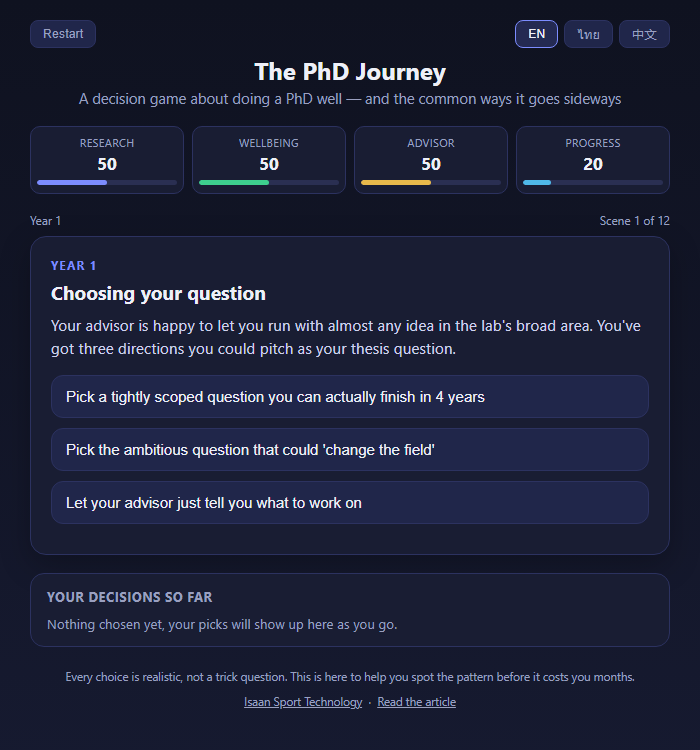
Two of the twelve scenes, so you know what you're getting into:Year 1. Choosing your question. Your advisor is happy to let you run with almost any idea in the lab's broad area. You've got three directions you could pitch as your thesis question:
- Pick a tightly scoped question you can actually finish in 4 years
- Pick the ambitious question that could "change the field"
- Let your advisor just tell you what to work on
Pick the narrow question, and the game tells you why: "Narrow, answerable questions are what finished theses are made of. You can always broaden the discussion later; you can't un-narrow a question that's eaten three years."
Year 2. Designing your methodology. You're about to start data collection. A colleague suggests preregistering your hypotheses and analysis plan before you look at any data:
- Preregister the hypotheses and analysis plan
- Skip it, plans always change anyway
- Write a plan privately but don't formally register it anywhere
Preregister, and the payoff shows up later: "Locks in your plan before the data can bias your decisions. It's extra paperwork now, and it's the single strongest defense against accusations of p-hacking later."
Who It's For
Current PhD students who want a second opinion on a decision, prospective students trying to understand what the degree actually involves day to day, and supervisors or mentors looking to open a conversation about the common failure points, or to cut down on avoidable student mistakes later. It plays in about 15 minutes and works just as well as a single pass or multiple sessions (your progress saves in the web browser).Languages - English, Chinese, Thai
The game is available in English, Thai (ไทย), and Simplified Chinese (中文) - switch languages at any point without losing your progress.The Research Behind the Scenes
The scenes are not invented hazards. Each one sits on a published finding, and the four scores move the way the literature says they move.| Scene in the game | What the research says |
|---|---|
| Wellbeing and isolation | Among 1,265 doctoral students at a large university in Barcelona, 40.6 per cent scored above the cut-off for anxiety symptoms and 46.5 per cent above the cut-off for depression symptoms1 |
| Wellbeing, second measure | A pilot of 352 PhD students at the University of Pavia found a 12 month prevalence of 18.5 per cent for mood disorders and 25.0 per cent for anxiety disorders2 |
| Preregistration | Of 2,006 sports science research articles published in 2024, 201 (10.0 per cent) were preregistered3 |
| Replication failure | Of 100 replications of published psychology studies, 36 per cent reached statistical significance against 97 per cent of the originals, and replication effects were half the size4 |
The advisor relationship score is there for the same reason. In the Barcelona sample, mentoring support ran with life satisfaction, and the authors point out that students with psychopathological disorders are at higher risk of academic failure and dropout.1 A supervisor is not a nice extra in the model, it is one of the variables.
The preregistration scene also carries the catch the game cannot show in one line. Preregistered sports science studies reported supported hypotheses 45 per cent of the time against 56 per cent for the rest, a real difference but a small one, and of the preregistered papers that stated a hypothesis, 69.4 per cent either had no hypothesis in the original registration or reported a different one.3 Registering a plan only helps if you then follow it.
Frequently Asked Questions
How long does the game take to play?
About fifteen minutes for one run through the four years. It saves in your browser, so you can stop after Year 2 and come back to the same run later. Most people play it more than once, because the interesting part is seeing what a different set of decisions does to the same four scores, and second runs go faster.Is the game specific to one field of research?
No, the scenes are written around decisions common to most doctoral programmes: scoping the question, the literature review, the analysis plan, data management, the supervisor relationship, isolation, a result that does not replicate, and writing up. The evidence behind the preregistration scene comes from sports science and psychology, which is where the numbers are clearest, but the decision is the same in any empirical field.Is any of it based on research?
Yes, the four scores and the scenes follow published findings, listed in the references below. Doctoral mental health figures come from surveys of 1,265 and 352 PhD students, the preregistration scene from an analysis of 2,006 sports science papers, and the replication scene from the 100 study replication project in psychology.1,2,3,4Does my progress save?
Yes, progress is stored in your web browser, so closing the tab does not lose your run. Switching language keeps it too. Clearing your browser data, or opening the game in a private window or on another device, starts a fresh run, so finish a session on the machine you started it on if you want to keep the same one.Can a supervisor use it with a group?
Yes, and that is one of the reasons it exists. Run it on a screen with a new cohort, let the room vote on each decision, then read the consequence together. The arguments about which option to take are usually more useful than the score at the end, and it puts the awkward subjects, supervision and burnout among them, on the table without singling anyone out.Is it free, and do I need an account?
It is free and there is no account, no email address and no login. Open the page and play. Nothing is uploaded, since the run is stored in your own browser, and there is nothing to install. It is published for students and supervisors to use as they like, in English, Thai or Simplified Chinese.If You Are Researching in Sport Science
The measurement problems the game gestures at are covered in detail elsewhere on this site, with the numbers:- Standing long jump norms and recording sheets, for what counts as a real change rather than measurement error.
- Skinfold testing guide, including the published error attached to body fat equations.
- Free video analysis with Kinovea, for collecting kinematic data without a laboratory budget.
References
- Krieger V, Canete-Masse C, Amador-Campos JA, et al. Mental health among Spanish doctoral students: relationship between anxiety, depression, life satisfaction, and mentoring. European Journal of Investigation in Health, Psychology and Education. 2025;15(8):164. doi:10.3390/ejihpe15080164
- Vecchio R, Mosconi G, Gandola M, et al. Investigating PhD students wellbeing and mental health: towards evidence-led and innovative solutions. Frontiers in Psychology. 2026. doi:10.3389/fpsyg.2026.1900506
- Bennett H, Blake H, d Unienville N, Murray J, Fox J. The uptake of preregistration, and its impact on the proportion of supported hypotheses, in sports science. Sports Medicine. 2026. doi:10.1007/s40279-026-02451-2
- Open Science Collaboration. Estimating the reproducibility of psychological science. Science. 2015;349(6251):aac4716. doi:10.1126/science.aac4716
Play It Now
Dr Wannaporn Sumranpat Brady is a physiotherapist with a PhD, not a medical doctor, and a lecturer in the Department of Health Science and Sports at Mahasarakham University's Faculty of Education. Her research is on patellofemoral pain (PFP). She holds a PhD in Exercise and Sport Science from Mahasarakham University, an MSc in Physical Therapy from Khon Kaen University and a BSc in Physical Therapy from Naresuan University, and has also published on athletic injury rehabilitation, sports biomechanics and physical training programme design. She co-founded Isaan Sport Technology and writes its sports science articles, which take their figures from journal studies and from tests on the equipment the store sells.