Click the image for the full size version to save or print.
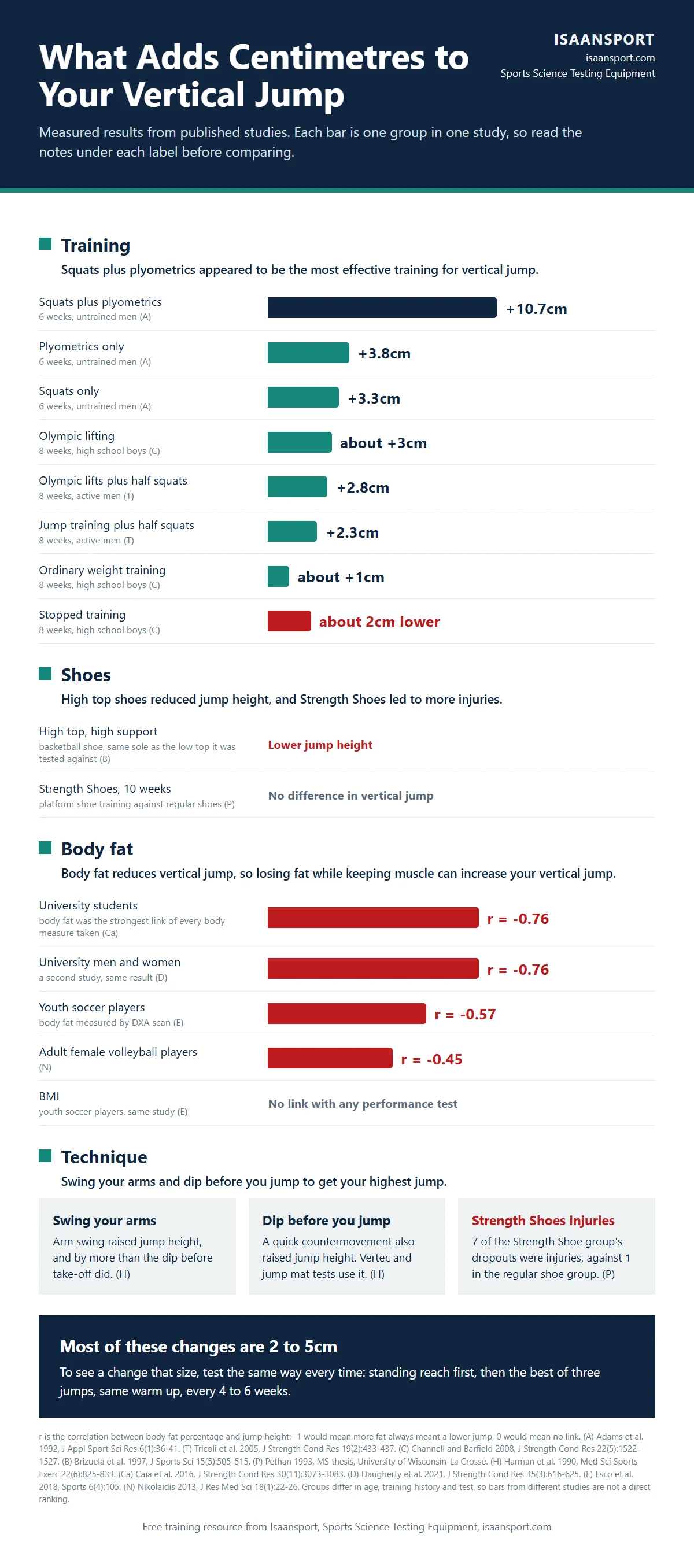
The largest measured gain in this infographic is 10.7cm, from six weeks of squats combined with plyometrics in untrained men. Most of the other results are between 1 and 4cm, and stopping training for eight weeks cost high school boys about 2cm. Body fat matters as well: in several studies, leaner people jumped higher. Every number comes from a published study, listed at the bottom of the page.
Which training adds the most centimetres?
Combining heavy lifting with plyometrics added the most, 10.7cm in six weeks, against 3.3cm for squats alone and 3.8cm for plyometrics alone in the same study.1 The combination gave more than the two single methods added together. Squats build the force, and plyometrics train the legs to apply it in the fraction of a second a jump lasts.
Two other studies compared lifting styles. Active men who trained Olympic lifts with half squats for eight weeks raised their countermovement jump from 42.2 to 45.0cm, while a jump training group went from 40.2 to 42.5cm.2 High school boys on an Olympic lifting program gained about 3cm in eight weeks, against about 1cm on ordinary weight training.3 Our power cleans for vertical jump article sets out those programs in full, with a six week plan that covers both halves.
Do shoes affect vertical jump?
They can cost you height. Basketball shoes built with a high top, heel counter and rearfoot lacing reduced jump height compared with a low top on the identical sole, and slowed an obstacle course run.4 Players who wear high tops or tape for ankle protection are trading some jump height for that support.
Platform training shoes did not help. In a ten week study, 72 college men were split into a Strength Shoe group, a regular shoe group on the same program, and a control group. There was no difference between the groups in vertical jump, broad jump or 40 yard time, and seven of the Strength Shoe group's dropouts were injuries, against one in the regular shoe group.5
Does arm swing make a difference?
Yes. In a force platform study of 18 men jumping with and without arm swing and with and without a countermovement, both raised jump height, and arm swing had the larger effect.6 That matters when you compare scores. A jump with arms and a dip is a different test from a squat jump with hands on hips, so record which one you used and keep it the same every session.
Does body fat affect vertical jump?
Yes. People with a higher body fat percentage jump lower, and the link is strong. In a study of 50 university students, body fat had the strongest link with jump height of every body measurement taken, at r = -0.76,7 and a second study of 60 university men and women found the same figure.8 A value of -1 would mean more fat always meant a lower jump, and 0 would mean no link. The same pattern showed in youth soccer players (r = -0.57)9 and adult female volleyball players (r = -0.45).10
A correlation on its own does not prove that losing fat raises your jump, but the mechanics point that way: fat adds weight the legs have to lift, without providing any contribution to power. In the second study, the jumpers also wore a weighted vest set to match a 5% rise in body fat, and a prediction built from the body fat data matched the jump heights they then achieved.8 Muscle matters more than fat, though. In youth soccer players, muscle mass was more strongly linked with jump height than fat mass,11 so the aim is to lose fat while keeping or building muscle, not to lose weight at any cost.
BMI will not show any of this. In the youth soccer study, body fat percentage was linked with jump height, but BMI was not linked with any of the performance tests,9 because BMI cannot tell muscle from fat. Track body fat directly instead. A skinfold caliper takes a few minutes per athlete, and our skinfold testing guide covers the measurement sites and how to take the readings. Log body fat alongside jump height, and a jump that stalls while body fat climbs has an obvious first suspect.
What happens when you stop training?
Jump height goes backwards. The control group in the high school study stopped training for the same eight weeks the other boys lifted, and finished about 2cm lower than they started.3 That is more than the ordinary weight training group gained in the same period, which is a good reason to keep a maintenance session going through a break.
Can you add the bars together?
No. Each bar is one group in one study, and the groups differ in age, training history, program length and the jump they were tested on. The 10.7cm came from untrained men, who improve quickly at first, so a trained athlete should not expect the same rate. Read the infographic as a guide to which changes are large and which are small, not as options to add up.
How do you know if your own jump has improved?
Most of the changes above are 2 to 5cm, so the test has to be consistent enough to show a change that size. Every study here measured standing reach first, then took the best of three jumps. Use the same warm up, the same shoes and the same jump style each time, and retest every four to six weeks rather than every session.
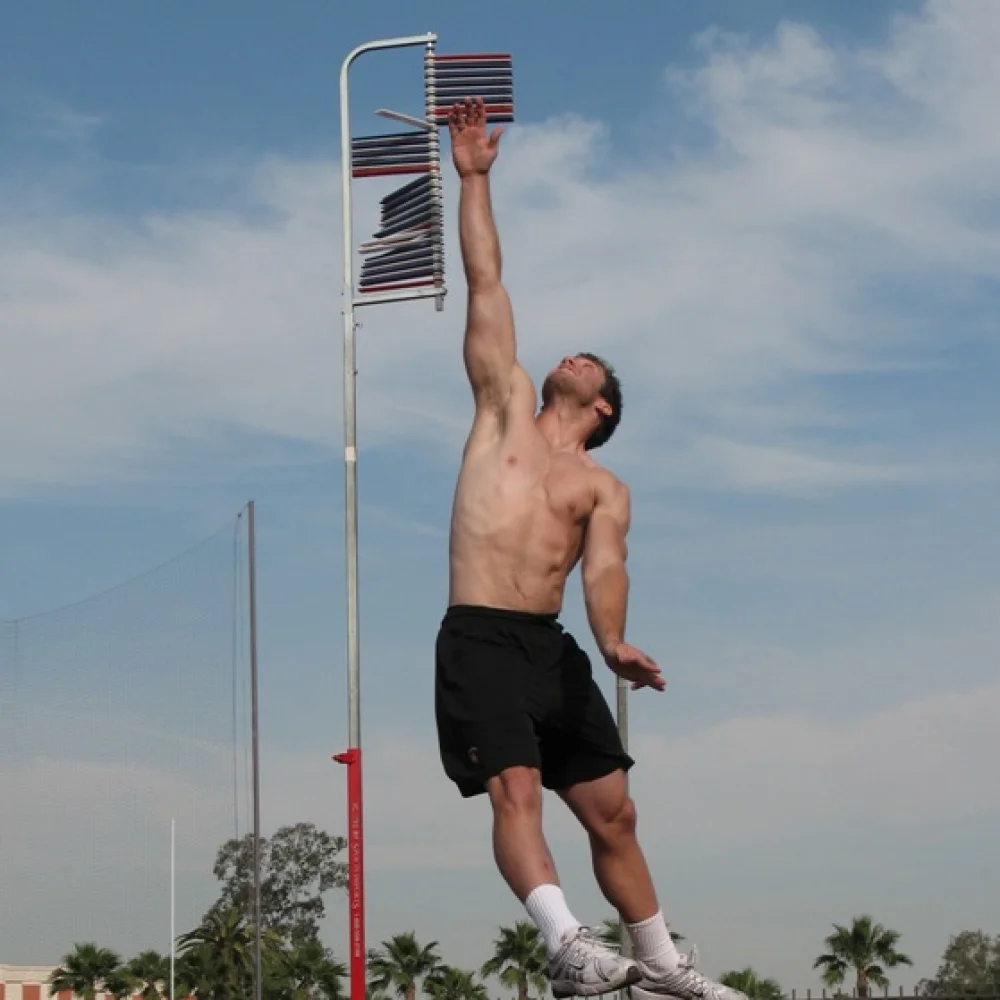
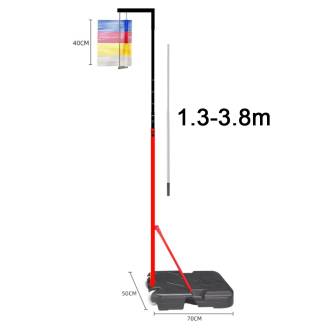
A Vertec makes that repeatable: the athlete sets standing reach against the vanes, then jumps and swats the highest vane they can. The 3.6m pole reset model and the 3.8m weighted base model stand on their own, the wall mounted model is a fixed installation, and the electronic model shows the height on a digital display. The whole range is in sports testing equipment.
References
- Adams K, O'Shea JP, O'Shea KL, Climstein M. The effect of six weeks of squat, plyometric and squat-plyometric training on power production. Journal of Applied Sport Science Research. 1992;6(1):36-41.
- Tricoli V, Lamas L, Carnevale R, Ugrinowitsch C. Short-term effects on lower-body functional power development: weightlifting vs. vertical jump training programs. Journal of Strength and Conditioning Research. 2005;19(2):433-437.
- Channell BT, Barfield JP. Effect of Olympic and traditional resistance training on vertical jump improvement in high school boys. Journal of Strength and Conditioning Research. 2008;22(5):1522-1527.
- Brizuela G, Llana S, Ferrandis R, García-Belenguer AC. The influence of basketball shoes with increased ankle support on shock attenuation and performance in running and jumping. Journal of Sports Sciences. 1997;15(5):505-515.
- Pethan S. Effects of training in Strength Shoes on speed, jumping ability, and calf girth. MS thesis, University of Wisconsin-La Crosse; 1993.
- Harman EA, Rosenstein MT, Frykman PN, Rosenstein RM. The effects of arms and countermovement on vertical jumping. Medicine and Science in Sports and Exercise. 1990;22(6):825-833.
- Caia J, Weiss LW, Chiu LZF, Schilling BK, Paquette MR, Relyea GE. Do lower-body dimensions and body composition explain vertical jump ability? Journal of Strength and Conditioning Research. 2016;30(11):3073-3083.
- Daugherty HJ, Weiss LW, Paquette MR, Powell DW, Allison LE. Potential predictors of vertical jump performance: lower extremity dimensions and alignment, relative body fat, and kinetic variables. Journal of Strength and Conditioning Research. 2021;35(3):616-625.
- Esco MR, Fedewa MV, Cicone ZS, Sinelnikov OA, Sekulic D, Holmes CJ. Field-based performance tests are related to body fat percentage and fat-free mass, but not body mass index, in youth soccer players. Sports. 2018;6(4):105.
- Nikolaidis PT. Body mass index and body fat percentage are associated with decreased physical fitness in adolescent and adult female volleyball players. Journal of Research in Medical Sciences. 2013;18(1):22-26.
- Leão C, Silva AF, Badicu G, Clemente FM, Carvutto R, Greco G, Cataldi S, Fischetti F. Body composition interactions with physical fitness: a cross-sectional study in youth soccer players. International Journal of Environmental Research and Public Health. 2022;19(6):3598.
Daniel Brady has spent more than ten years reading sports science journal articles and turning their numbers into practical articles, to answer questions with reliable data backing, first for SportsScience.co and now for Isaan Sport Technology, where he tests the equipment the articles describe. His background is in data, which is why the articles show the study figures and the calculations to back the answers. He also ran the testing and training programme for a regional division two football team, where every player improved in power, speed and agility over one and two month tracking periods.