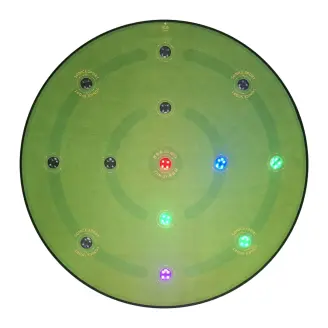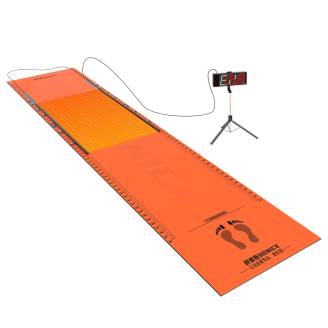
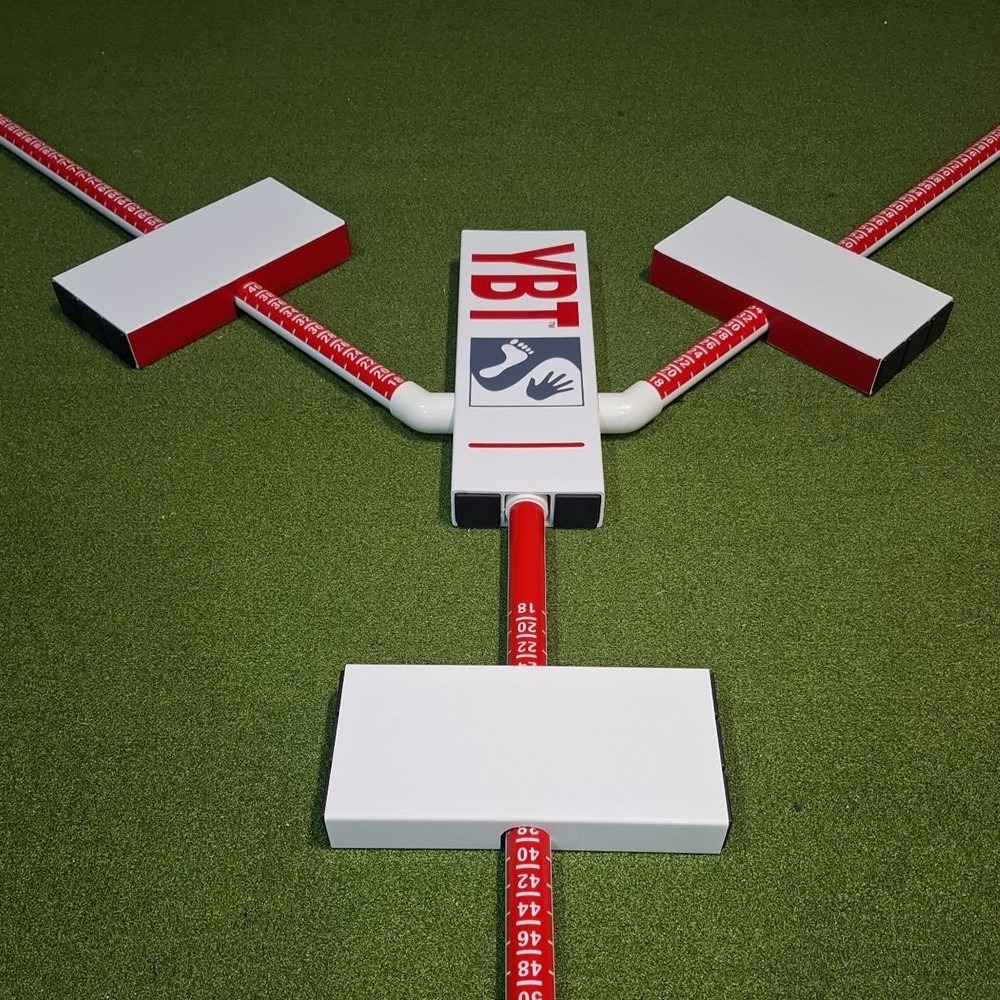
The three Y-Balance directions on a kit. The SEBT uses the same three lines plus five more.
Y-Balance Test vs SEBT at a Glance
| Star Excursion Balance Test | Y-Balance Test | |
|---|---|---|
| Directions | 8 lines, 45 degrees apart; often cut to 3 | 3: anterior, posteromedial, posterolateral |
| Equipment | Tape and a tape measure, or a printed mat | Stance platform, 3 poles with a scale, 3 reach indicators |
| Stance foot | Flat on the floor at the centre; the heel stays down | On a raised platform, big toe at the start line; the heel may lift |
| The reach | Light touch on the line, then back to centre | Pushes an indicator along the pole, which stays where the reach ended |
| Reading the score | Tester marks the touch point and measures it | Read from the scale at the edge of the indicator nearest the platform |
| Practice reaches | 4 per direction1 | 6 per direction in the original protocol4 |
| Agreement between testers | Good: reviews pool it with the Y-Balance Test, median ICC about 0.885 | ICC 0.97 to 1.00 in the founding study4 |
| Time per athlete (one study) | About 6 minutes | About 8.5 minutes3 |
Why Does the Y-Balance Test Use Only Three Directions?
When researchers analysed all eight SEBT directions together, the directions overlapped heavily, with correlations between them of 0.40 to 0.91, and were largely measuring the same thing.6 Posteromedial reach was the single direction that best represented performance across all eight. Testing three directions instead of eight cuts the testing time considerably while keeping most of the information,1 and the Y-Balance kit was built around those three.
Do SEBT and Y-Balance Test Scores Agree?
Only in the two back directions. Twenty active men did both tests a week apart, barefoot with hands on hips, and their averages were:2
| Direction (% of leg length) | SEBT left | YBT left | SEBT right | YBT right |
|---|---|---|---|---|
| Anterior | 69.9 | 64.8 | 69.5 | 64.9 |
| Posteromedial | 111.5 | 110.6 | 110.8 | 110.5 |
| Posterolateral | 104.0 | 104.0 | 104.0 | 104.8 |
Anterior reach was about 5 points lower on the Y-Balance kit, a large difference (effect sizes 0.76 and 1.04). A second study of 24 people found the same direction of gap: 64.5% on the SEBT against 61.7% on the Y-Balance Test.3 A third found athletes reached farther anteriorly on the SEBT, and bent more at the hip on the Y-Balance kit.7
Even where the averages match, individuals do not. For the left leg, the limits of agreement for anterior reach ran from about 5 points lower to 15 points higher on the SEBT,2 so one athlete's SEBT score cannot be turned into a Y-Balance score.
Why Is Anterior Reach Shorter on the Y-Balance Kit?
- A raised stance platform. The stance foot sits on a platform above the floor, so the reach happens at a set height rather than at floor level.
- Pushing, not touching. On the kit, the reach foot stays in contact with the indicator and pushes it; on the floor, it reaches out and lightly touches.
- A fixed start reference. On the kit, reach is measured from the big toe at the start line.
- Different feedback. The moving indicator gives the athlete a feel for the reach that a taped line does not.
The platform, the pushing and the feedback are the explanations offered by the authors of the comparison study.2 The start reference is one of the design changes listed in the SEBT review.1
Should I Use the Y-Balance Test or the SEBT?
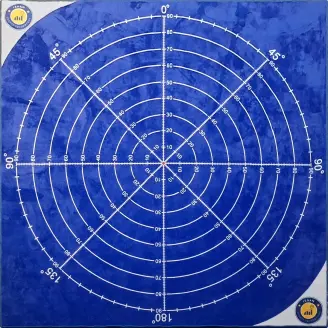
Use the SEBT when you have no kit, when you want all eight directions, or when a large group has to be screened quickly. In one study the floor test took about 6 minutes per athlete against about 8.5 for the kit, so more athletes could be screened in the same session.3 Our free Star Excursion Balance Test diagram shows how to tape out the eight lines. If you would rather not tape, our anti-slip rubber backed nylon and soft velvet carpet SEBT mats have the eight lines printed on, with distance rings every 10 cm.
Use the Y-Balance Test when several testers share the job, when you want to compare with published Y-Balance norms, or when results will be tracked over a season. The indicator stays where the reach ended, so the reading does not depend on the tester spotting a toe touch, and testers in the founding study got near identical readings (ICC 0.97 to 1.00).4 Our YBT Y-Balance Test Kit has a printed centimetre scale on each pole, and the same kit runs the upper body version of the test, done from a push-up position.10 Its two angled poles can also be turned to other angles for a layout closer to the SEBT, but published Y-Balance figures come from the standard Y layout, so keep that layout for any test you will compare with them.
Whichever you choose, stay with it. Both tests are reliable when repeated the same way,5 but a squad tested on the floor in pre-season and on a kit at mid-season will show changes in anterior reach that come from the equipment, not the athletes.
Can I use SEBT cut-offs for Y-Balance Test scores?
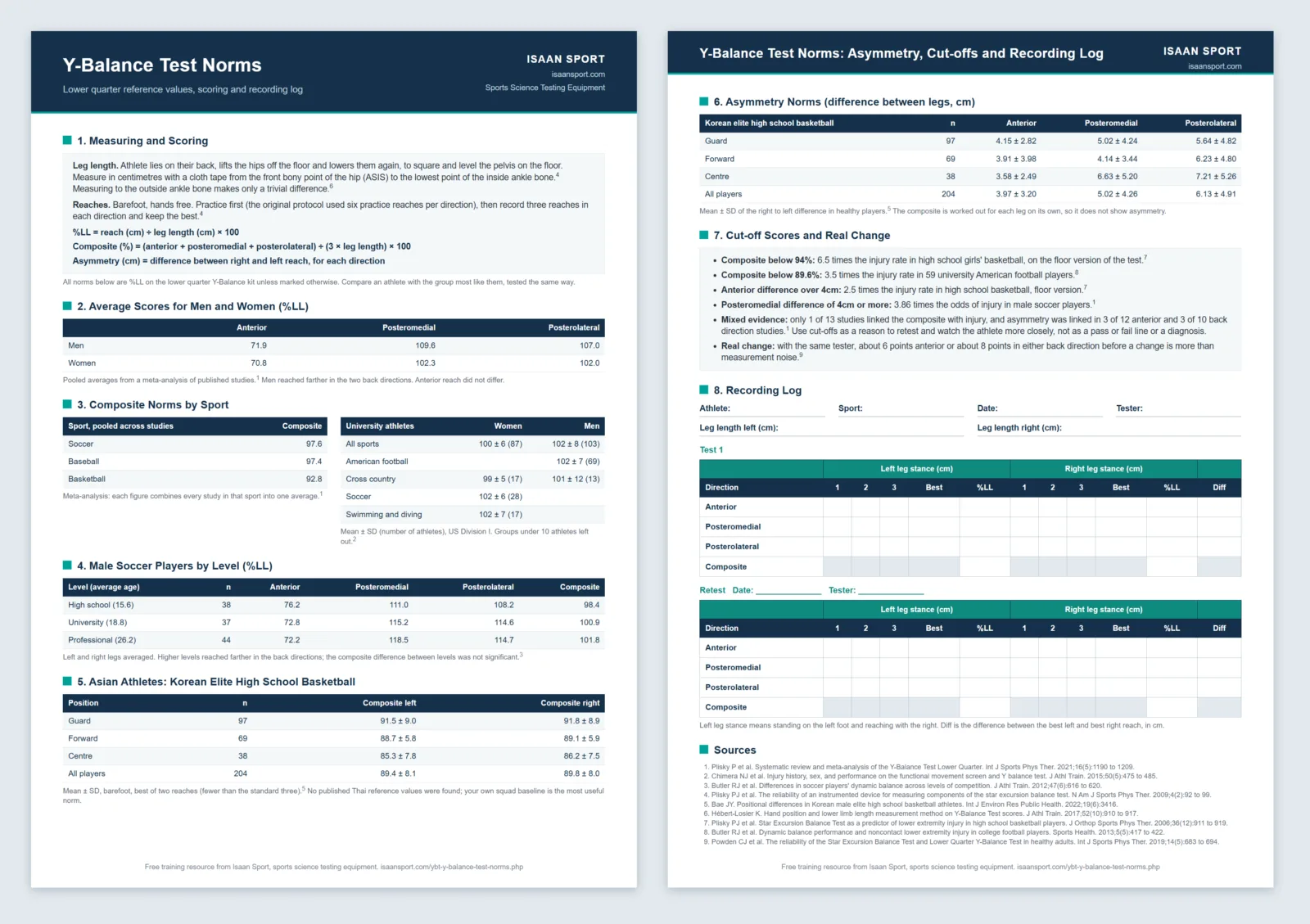
With care. The widely quoted 4 cm anterior difference and 94% composite cut-offs came from a study using the floor SEBT.8 A later study on the Y-Balance kit also found 4 cm useful for anterior difference,9 but the composite cut-offs have not held up well across studies. See our YBT norms article for the evidence.
How do I score either test?
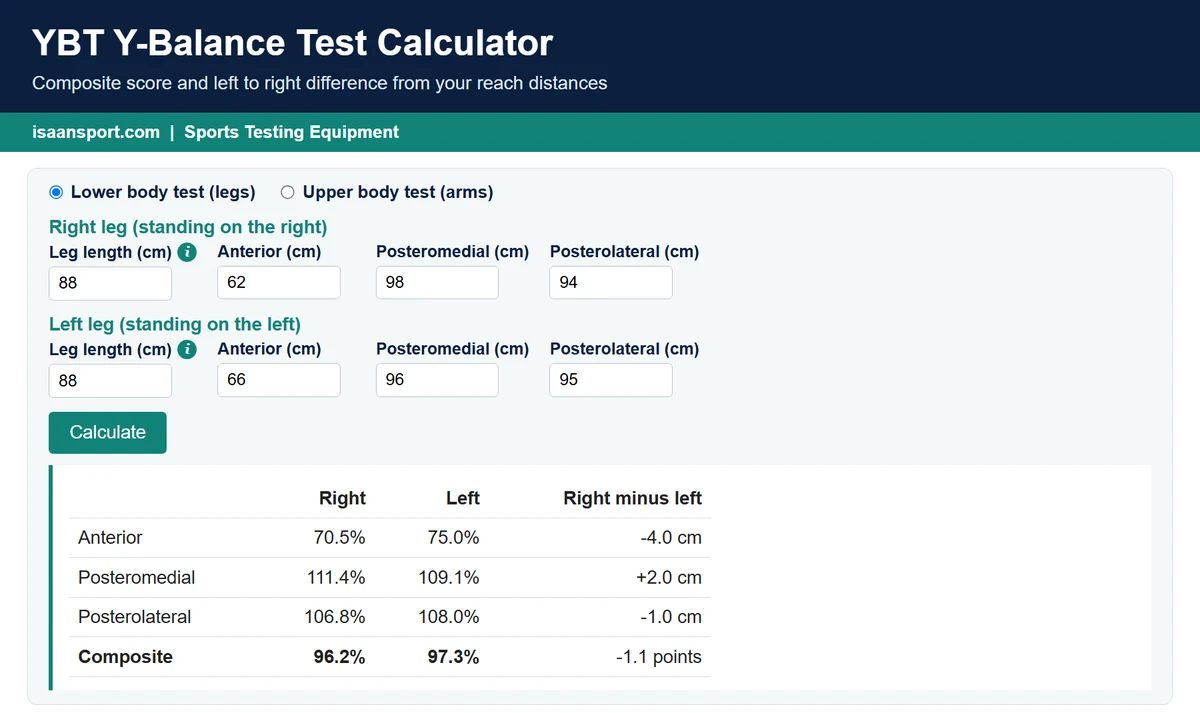
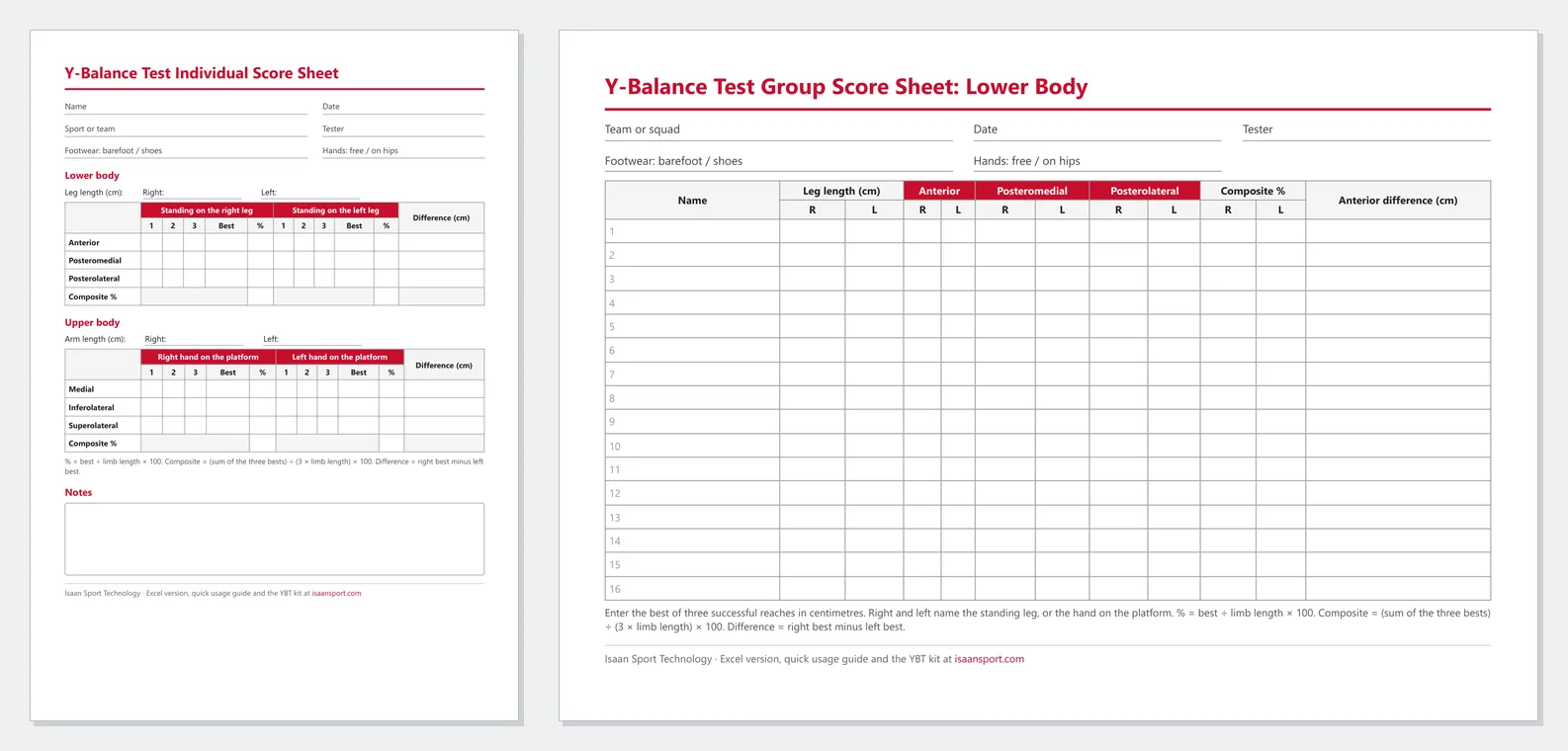
The same way. Divide each reach by leg length and multiply by 100, and average the three directions for the composite. Our YBT Y-Balance Test calculator does it for both legs and shows the right minus left difference. Our free Y-Balance Test score sheets have boxes for every reach; for all eight floor directions, use the SEBT score sheets.
Related Reading
- YBT Y-Balance Test calculator, for the composite score and the left to right difference.
- Y-Balance Test score sheets, free printables for one athlete or a squad, with a one page quick reference.
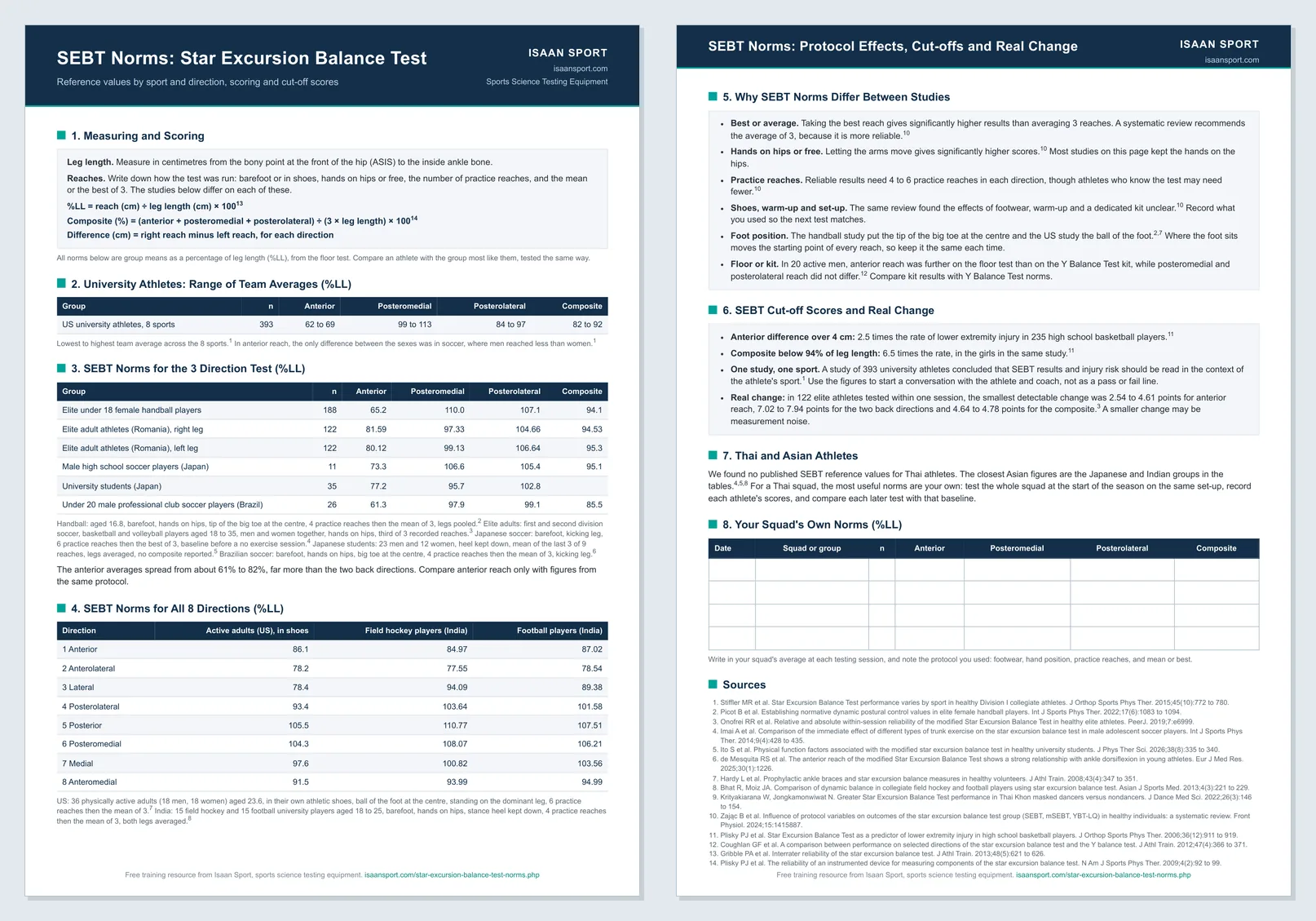
- SEBT score sheets, free printable and Excel sheets for one athlete or a squad, with all 8 directions.
- YBT norms, average scores by sport, level, sex and age.
- SEBT norms, published reach scores by sport and direction.
- Star Excursion Balance Test diagram, a free printable for the floor test.
- YBT Y-Balance Test Kit, the stance platform, poles and reach indicators.
References
- Gribble PA, Hertel J, Plisky P. Using the Star Excursion Balance Test to assess dynamic postural-control deficits and outcomes in lower extremity injury: a literature and systematic review. Journal of Athletic Training. 2012;47(3):339 to 357. doi:10.4085/1062-6050-47.3.08
- Coughlan GF, Fullam K, Delahunt E, Gissane C, Caulfield BM. A comparison between performance on selected directions of the star excursion balance test and the Y balance test. Journal of Athletic Training. 2012;47(4):366 to 371. doi:10.4085/1062-6050-47.4.03
- Gabriel EH, Powden CJ, Hoch MC. Comparison of the Y-Balance Test and Star Excursion Balance Test: utilization of a discrete event simulation. Journal of Sport Rehabilitation. 2021;30(2):214 to 219. PubMed 32325427
- Plisky PJ, Gorman PP, Butler RJ, Kiesel KB, Underwood FB, Elkins B. The reliability of an instrumented device for measuring components of the star excursion balance test. North American Journal of Sports Physical Therapy. 2009;4(2):92 to 99. PubMed 21509114
- Powden CJ, Dodds TK, Gabriel EH. The reliability of the Star Excursion Balance Test and Lower Quarter Y-Balance Test in healthy adults: a systematic review. International Journal of Sports Physical Therapy. 2019;14(5):683 to 694. PubMed 31598406
- Hertel J, Braham RA, Hale SA, Olmsted-Kramer LC. Simplifying the star excursion balance test: analyses of subjects with and without chronic ankle instability. Journal of Orthopaedic and Sports Physical Therapy. 2006;36(3):131 to 137. doi:10.2519/jospt.2006.36.3.131
- Fullam K, Caulfield B, Coughlan GF, Delahunt E. Kinematic analysis of selected reach directions of the Star Excursion Balance Test compared with the Y-Balance Test. Journal of Sport Rehabilitation. 2014;23(1):27 to 35. doi:10.1123/jsr.2012-0114
- Plisky PJ, Rauh MJ, Kaminski TW, Underwood FB. Star Excursion Balance Test as a predictor of lower extremity injury in high school basketball players. Journal of Orthopaedic and Sports Physical Therapy. 2006;36(12):911 to 919. doi:10.2519/jospt.2006.2244
- Smith CA, Chimera NJ, Warren M. Association of Y balance test reach asymmetry and injury in division I athletes. Medicine and Science in Sports and Exercise. 2015;47(1):136 to 141. doi:10.1249/MSS.0000000000000380
- Westrick RB, Miller JM, Carow SD, Gerber JP. Exploration of the Y-balance test for assessment of upper quarter closed kinetic chain performance. International Journal of Sports Physical Therapy. 2012;7(2):139 to 147. PubMed 22530188
Dr Wannaporn Sumranpat Brady is a physiotherapist with a PhD, not a medical doctor, and a lecturer in the Department of Health Science and Sports at Mahasarakham University's Faculty of Education. Her research is on patellofemoral pain (PFP). She holds a PhD in Exercise and Sport Science from Mahasarakham University, an MSc in Physical Therapy from Khon Kaen University and a BSc in Physical Therapy from Naresuan University, and has also published on athletic injury rehabilitation, sports biomechanics and physical training programme design. She co-founded Isaan Sport Technology and writes its sports science articles, which take their figures from journal studies and from tests on the equipment the store sells.