Cite this article
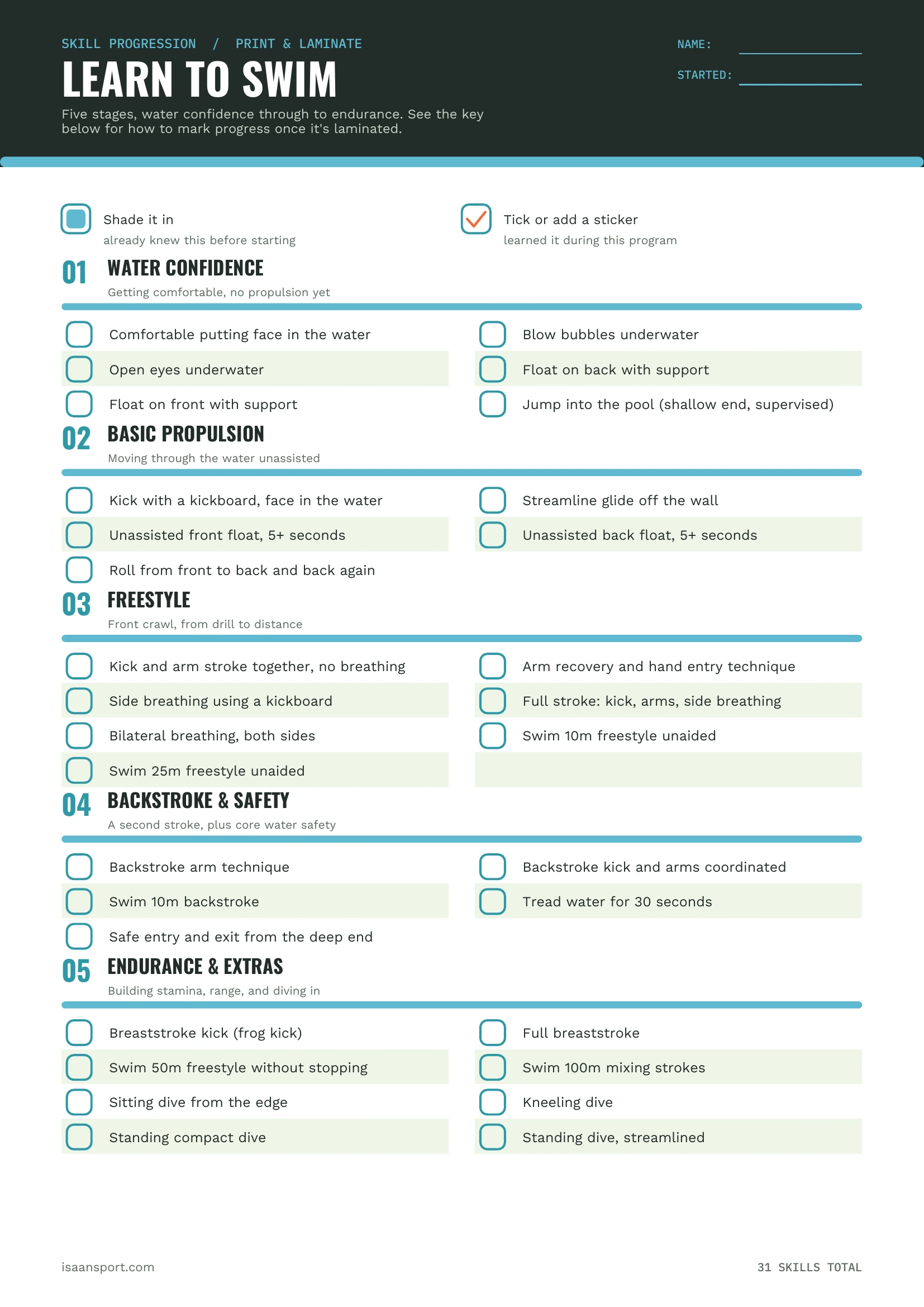
If you're teaching your child to swim, maybe they've already made some solid progress (congratulations!), but you're running out of ideas on what to teach next. Using this printable checklist, you'll be able to track their progress and have a clear guide of what to teach next. From first getting comfortable in the water through to swimming multiple strokes with confidence. Print it, laminate it, and mark off each skill as it's learned (using stickers may provide further motivation to the child).
Download the Printable PDF
How to Use It
Print the poster and laminate it so it can be reused across sessions, and not become water damaged. Once laminated, mark progress with a marker or stickers. When you look at the checklist in a few months time, you may want to remember what point the child started at, so a good method could be the following:- Shade it in - the swimmer already knew this skill before starting
- Tick it or add a sticker - the swimmer learned it during the program
01. Water Confidence
Getting comfortable, no propulsion yet.- Comfortable putting face in the water
- Blow bubbles underwater
- Open eyes underwater
- Float on back with support
- Float on front with support
- Jump into the pool (shallow end, supervised)
02. Basic Propulsion
Moving through the water unassisted.- Kick with a kickboard, face in the water
- Streamline glide off the wall
- Unassisted front float, 5+ seconds
- Unassisted back float, 5+ seconds
- Roll from front to back and back again
03. Freestyle
Front crawl, from drill to distance.- Kick and arm stroke together, no breathing
- Arm recovery and hand entry technique
- Side breathing using a kickboard
- Full stroke: kick, arms, side breathing
- Bilateral breathing, both sides
- Swim 10m freestyle unaided
- Swim 25m freestyle unaided
04. Backstroke & Safety
A second stroke, plus core water safety.- Backstroke arm technique
- Backstroke kick and arms coordinated
- Swim 10m backstroke
- Tread water for 30 seconds
- Safe entry and exit from the deep end
05. Endurance & Extras
Building stamina, range, and diving in.- Breaststroke kick (frog kick)
- Full breaststroke
- Swim 50m freestyle without stopping
- Swim 100m mixing strokes
- Sitting dive from the edge
- Kneeling dive
- Standing compact dive
- Standing dive, streamlined
What the Research Says About Lessons
Formal swimming lessons are linked to a lower drowning risk in young children, which is the reason to start working through a list like this one rather than wait until the child is older. A case-control study in the United States interviewed the families of 88 children who had drowned and 213 matched controls. Among the 61 children aged 1 to 4 who drowned, 2 had taken formal swimming lessons, against 35 of 134 matched controls, an adjusted odds ratio of 0.12.1 That is an 88 per cent lower risk, but the numbers behind it are small and the confidence interval ran from a 3 per cent reduction to a 99 per cent one. In the 5 to 19 age group the association was weaker and was not statistically significant.Read that as a good reason to book lessons, not as proof that a trained child is safe alone near water. Lessons sit alongside the other layers: a fence or a lid on anything holding water, an adult watching who is not also on a phone, and someone present who can get the child out.
The Four Survival Skills
Stroke technique and staying alive in the water are not the same thing. Drowning prevention programmes built on World Health Organization guidance teach school-aged children four survival skills rather than four strokes: swim 25 metres, float or tread water for 30 seconds, and carry out a reach rescue and a throw rescue from the bank.2,5 Two of the four are already on the poster, and the two rescue skills are not, so add them yourself if the child swims anywhere other than a supervised pool.The retention figures below come from rural Bangladesh, where 3,603 graduates of the SwimSafe programme were re-tested more than ten years after they were trained.2 They are the best answer available to the question every parent asks, which is whether any of this sticks.
| Survival skill | Where it sits on the poster | Still able, 10 years on |
|---|---|---|
| Swim 25 metres | 03. Freestyle | 88.4% |
| Float or tread water 30 seconds | 04. Backstroke and safety | 89.7% |
| Reach rescue | Not on the poster | 87.7% |
| Throw rescue | Not on the poster | 71.9% |
| All four together | 60.6% |
Swimming and floating held up best, and 70.3 per cent of those graduates said they rarely swam after the programme finished, so the skills survived without much practice. Throwing a rescue aid faded most, which is the one to go back over.
Drowning Risk in Thailand
About 300,000 people drown each year worldwide, and more than 90 per cent of those deaths happen in low and middle income countries.4 Thai death registration data for 2000 to 2009 put the unintentional drowning death rate at 6.3 per 100,000 population, 9.6 in males and 3.0 in females, and the highest rate of any group was in boys aged 0 to 4. Several public health areas in the northeast, the central region and the north sat above the national average.3For children under five, most fatal incidents happen in or around the home, in household water containers and in natural or artificial water bodies close by.4 In this part of the country that describes almost every house: a pond behind the property, a canal at the end of the road, a paddy field in the wet season and water jars by the door. Covering the jars and fencing the pond does more for a two year old than any lesson, and the checklist becomes the main protection later, once the child is old enough to be out of sight for a moment.
Frequently Asked Questions
At what age should swimming lessons start?
There is no single right age, and the evidence points in two directions. The case-control study that found the largest association between lessons and lower drowning risk looked at children aged 1 to 4, so early lessons are not wasted.1 Survival swimming programmes built on World Health Organization guidance teach school-aged children, and SwimSafe starts at six.2,5 Start when your child is comfortable in water and can follow an instruction.Do swimming lessons stop a child from drowning?
No, lessons lower the risk and no child becomes drown-proof. The 88 per cent risk reduction found in one to four year olds came with a confidence interval wide enough that the real effect could be small, and it was measured in children who had lessons, not children left alone near water.1 Keep the barriers, the supervision and an adult who can reach or throw a rescue.How long does it take to work through the 31 skills?
There is no fixed timeline, and the order matters far more than the pace. Progress depends on how often the child is in the water, how warm the water is and how confident they were to start with. Some children spend a month on stage 01 and then move through stages 02 and 03 quickly, while others are swimming before they will put their face under. Tick what is done and teach the next unticked line.Will the skills still be there after years out of the water?
Mostly yes, on the best evidence available. More than ten years after training, 3,603 SwimSafe graduates were re-tested: 88.4 per cent could still swim 25 metres and 89.7 per cent could still float or tread water for 30 seconds, even though 70.3 per cent said they rarely swam afterwards.2 Rescue skills held up less well, with 71.9 per cent still able to throw a rescue aid.What is the difference between survival swimming and stroke lessons?
Survival swimming teaches a child to stay alive in water, and stroke lessons teach them to move through it well. The survival version is short and blunt: get to the surface, float or tread water until help comes, and swim far enough to reach the side. Strokes, turns and breathing patterns come later and matter for swimming as a sport. The poster covers both, with the survival items in stages 02 and 04.Can I use this poster without being a qualified instructor?
Yes, it is a tracking sheet rather than a teaching syllabus. Anything in shallow water with a parent within arm's reach is ordinary family practice, and ticking off skills as they arrive is useful whoever taught them. Deep water, treading water and every dive on the list belong with a qualified instructor and a lifeguard, because those are the items where a mistake is not recoverable.Related Reading
- Beep test calculator and norms, for the aerobic side of a school fitness programme.
- Standing long jump norms by age, if you want benchmarks for children in other tests.
- Broad jump recording sheet, another free printable set up the same way.
- Free video analysis with Kinovea, which works from the pool deck as well as the track.
References
- Brenner RA, Taneja GS, Haynie DL, Trumble AC, Qian C, Klinger RM, Klebanoff MA. Association between swimming lessons and drowning in childhood: a case-control study. Archives of Pediatrics and Adolescent Medicine. 2009;163(3):203 to 210. doi:10.1001/archpediatrics.2008.563
- Rahman A, Ashraf L, Rahman AF, Bhuiyan MA, Shafkat Hossain M, Alam Z, Talab A, Li Q, Bachani A. Retention of survival swimming skills among SwimSafe graduates in rural communities of Bangladesh. Injury Prevention. 2025;31(6):580 to 585. doi:10.1136/ip-2024-045309
- Prameprart M, Lim A, Tongkumchum P. Modeling unintentional drowning mortality rates in Thailand, 2000 to 2009. Asia-Pacific Journal of Public Health. 2015;27(2):NP2471 to NP2479. doi:10.1177/1010539513488796
- Kawee L, Napatpittayatorn P, Ponrachom C. Promoting drowning preventive behaviors among caregivers of children under 5 years through a health belief model-based educational program in Thailand. Healthcare (Basel). 2026;14(16):2619. doi:10.3390/healthcare14162619
- Mecrow T, Fortuin Abrahams J, Said M, Baker S, Bonney J, Rahman A, Peden AE. Provision of basic swimming and water safety skills in low-resource environments: barriers and facilitators of use of WHO practical guidance. Injury Prevention. 2026;32(3):452 to 458. doi:10.1136/ip-2024-045300
By the Isaan Sport Technology team with Dr Wannaporn Sumranpat Brady · 22 Aug 2026 (updated 16 Sep 2026)
Dr Wannaporn Sumranpat Brady is a physiotherapist with a PhD, not a medical doctor, and a lecturer in the Department of Health Science and Sports at Mahasarakham University's Faculty of Education. Her research is on patellofemoral pain (PFP). She holds a PhD in Exercise and Sport Science from Mahasarakham University, an MSc in Physical Therapy from Khon Kaen University and a BSc in Physical Therapy from Naresuan University, and has also published on athletic injury rehabilitation, sports biomechanics and physical training programme design. She co-founded Isaan Sport Technology and writes its sports science articles, which take their figures from journal studies and from tests on the equipment the store sells.
Dr Wannaporn Sumranpat Brady is a physiotherapist with a PhD, not a medical doctor, and a lecturer in the Department of Health Science and Sports at Mahasarakham University's Faculty of Education. Her research is on patellofemoral pain (PFP). She holds a PhD in Exercise and Sport Science from Mahasarakham University, an MSc in Physical Therapy from Khon Kaen University and a BSc in Physical Therapy from Naresuan University, and has also published on athletic injury rehabilitation, sports biomechanics and physical training programme design. She co-founded Isaan Sport Technology and writes its sports science articles, which take their figures from journal studies and from tests on the equipment the store sells.
Cite this article
Sumranpat Brady, W. (2026, August 22). Learn to Swim Skill Progression Poster (Free Printable). Isaan Sport Technology. https://www.isaansport.com/learn-to-swim-progression-printable.php