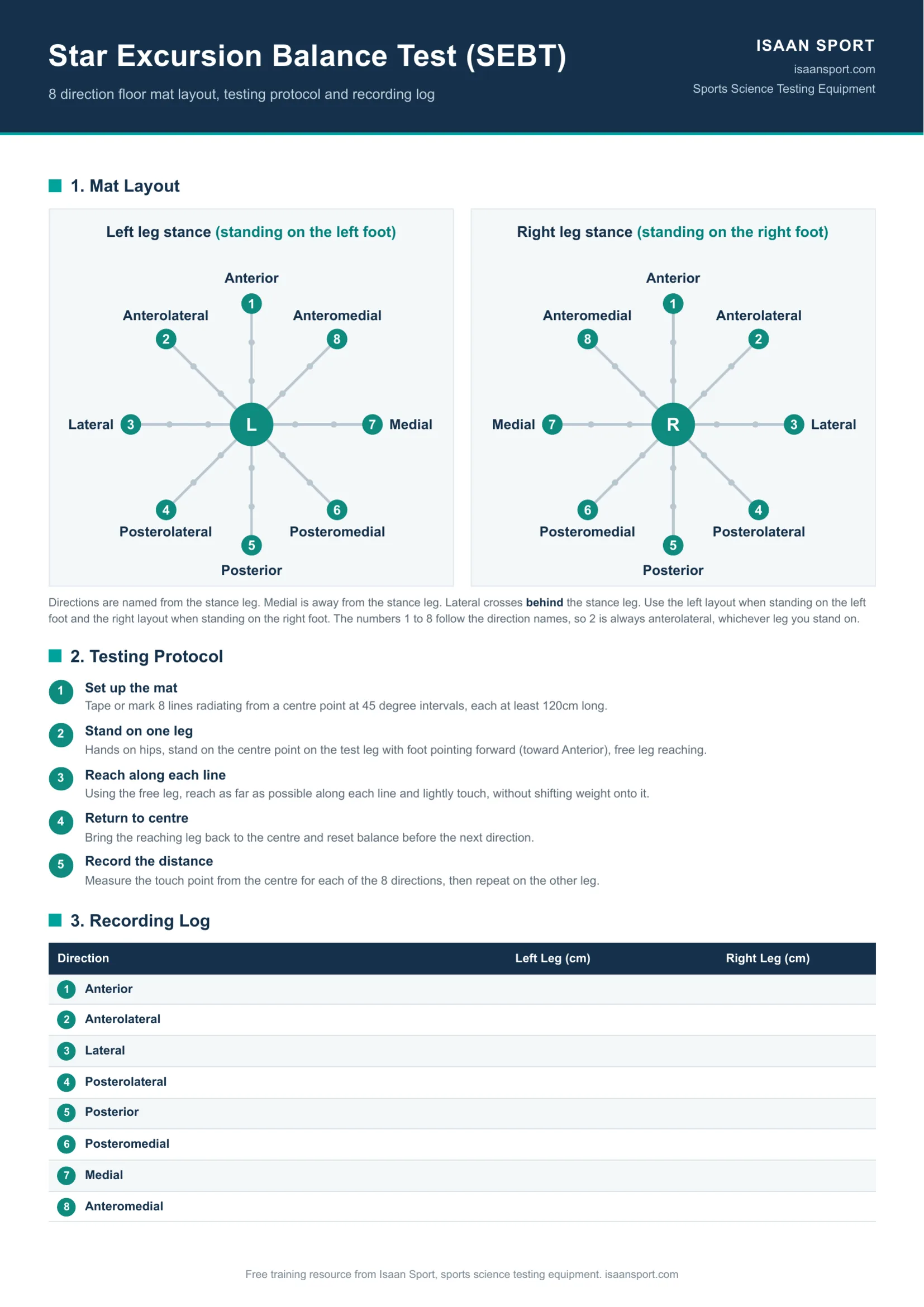
A free printable showing the 8-direction floor mat layout for the Star Excursion Balance Test, along with the testing protocol and a recording log for both legs.
Download the Printable PDF
How to Use It
Print the PDF, mark out the 8 reach lines on the floor (or use a printed mat), then follow the numbered protocol for each leg. The recording log has a row for each numbered direction and a column for each leg.Mat Layout
Eight lines radiate from a centre point at 45 degree intervals. The printable shows two layouts, one for standing on the left foot and one for standing on the right foot, because each direction is named from the stance leg. Medial is away from the stance leg. Lateral crosses behind the stance leg. The numbers 1 to 8 follow the direction names, so 2 is always anterolateral, whichever leg you stand on.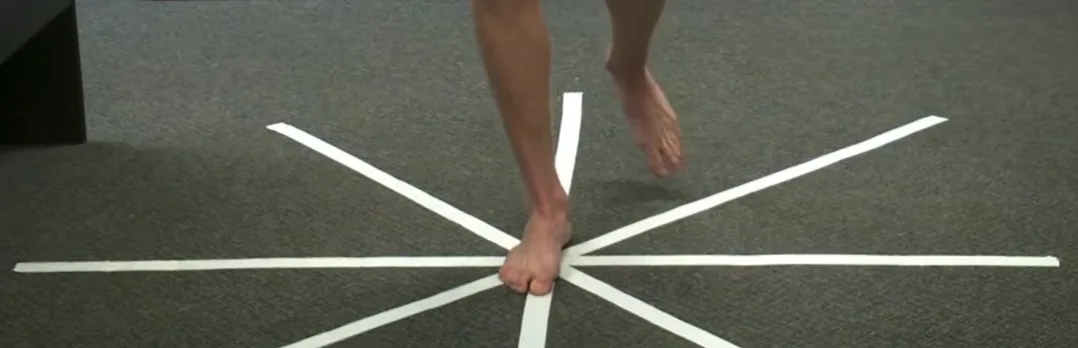
A taped 8 line grid. The stance foot sits on the centre point, pointing toward the anterior line, while the other leg reaches.
Testing Protocol
- Set up the mat. Tape or mark 8 lines radiating from a centre point at 45 degree intervals, each at least 120cm long.
- Stand on one leg. Hands on hips, stand on the centre point on the test leg with foot pointing forward (toward Anterior).
- Reach along each line. Reach as far as possible with the free leg and lightly touch, without shifting weight onto it.
- Return to centre. Bring the reaching leg back and reset your balance before the next direction.
- Record the distance. Measure each touch point from the centre, then repeat on the other leg.
Tape, Printed Mat or Y Balance Test Kit
All three set-ups measure how far the free leg reaches while you balance on the other one. They are not interchangeable, so retest each athlete on the same set-up every time.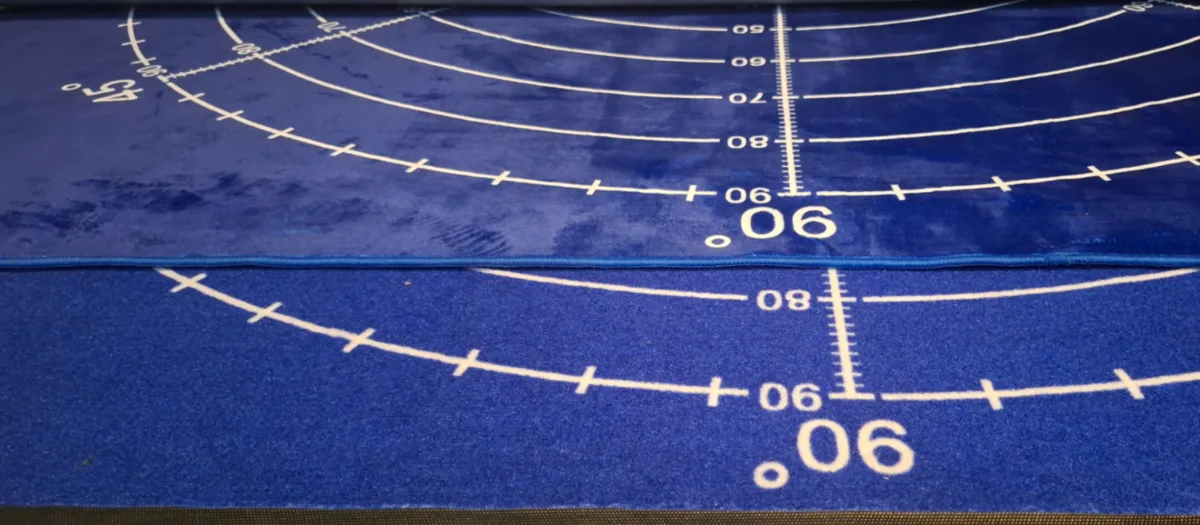
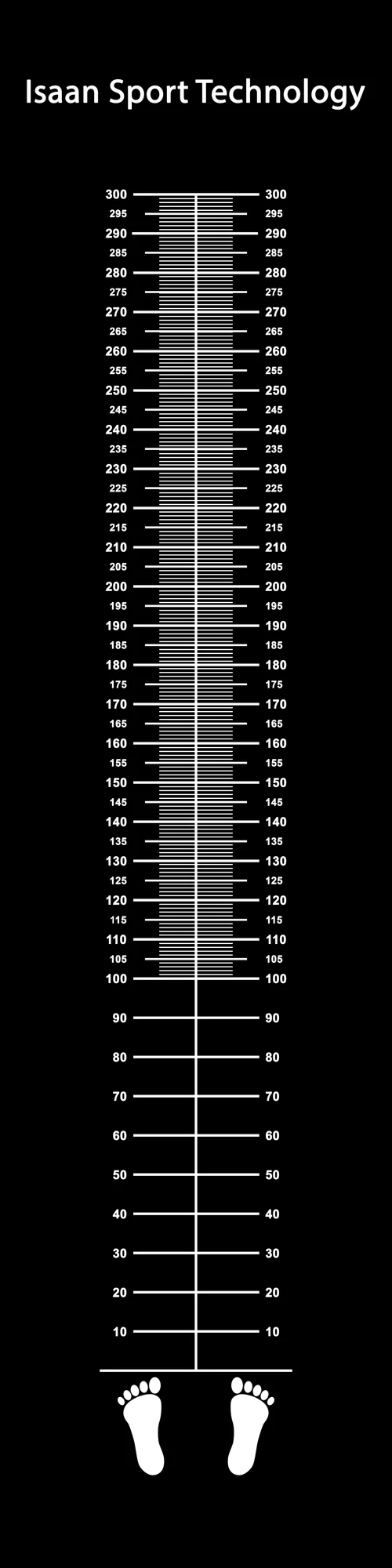
A printed mat. The lines and distance arcs are printed on, so there is nothing to tape or measure out, and it will be identical each time.
| Tape on the floor | Printed mat | Y Balance Test kit | |
|---|---|---|---|
| Directions | 8 lines at 45 degrees. | Check that it has 8 lines at 45 degrees. | 3: anterior, posteromedial and posterolateral3,4 |
| Set-up | Tape 8 lines and check the angles each session | Unroll it. The lines and angles are the same every session. | Push the poles into the stance platform and check the scale with a tape measure |
| Reading the distance | Mark where the toe touched and measure from the centre with a tape measure | Read it off the printed distance marks | The foot pushes a reach indicator along a pole with a centimetre scale. It stays at the furthest point, so you read it after the reach.3 |
| Watch for | Tape lifting or shifting on a sports floor, and the scorer missing where the toe touched | Check the printed scale against a tape measure, and make sure the mat does not slide | In 20 active men the anterior reach was shorter on the kit than on the floor test (posteromedial and posterolateral did not differ), so do not compare kit anterior scores with floor test scores4 |
Which to choose. Use tape or a printed mat when you want all 8 directions of the original test. Use a Y Balance Test kit when you test a squad often and want the same set-up and one clear reading for each reach. Whichever you pick, do not switch set-ups between tests on the same athlete.
Recording Log
A blank table with all 8 numbered directions and columns for left and right leg reach distance in centimetres.A Note on Scoring
Reach distances are often normalised to leg length (reach distance divided by leg length, multiplied by 100) so results can be compared across athletes of different heights.1,2Common Questions
How do you score the Star Excursion Balance Test?
Measure each reach in centimetres from the centre point, then divide it by leg length and multiply by 100, so the score is a percentage of leg length.1,2 Studies use either the mean or the best of 3 test trials in each direction, recorded after the practice trials.1,2 Choose one and use it every time, because the mean of 3 trials is never higher than the best one.
What are normal values for the Star Excursion Balance Test?
Published values only apply to the protocol they came from, because practice, instruction and normalising to leg length all change the result.5 The most useful comparison is the athlete's other leg and their own earlier tests on the same set-up. In 235 high school basketball players, those whose right and left anterior reach differed by more than 4cm were 2.5 times more likely to have a lower extremity injury that season.6
How many practice trials should you give?
Four practice trials in each direction is usually enough. In 20 healthy adults, reach distance levelled off within the first 4 practice trials in most directions, which supported cutting the recommended number from 6 to 4.7 After the practice trials, record 3 test trials in each direction, as recent studies of the test do.2,4
Do you need to test all 8 directions?
No, many testers now use 3 directions. In young adults with and without chronic ankle instability, posteromedial reach was the most representative of all 8, and there was considerable overlap between the directions.8 Anterior, posteromedial and posterolateral are the directions used in recent reliability studies and on the Y Balance Test kit.2,3 Use all 8 when you want the original test.
Is the Star Excursion Balance Test reliable between testers?
Yes, when the testers have been trained. With 5 raters at 2 sites testing 29 healthy adults, agreement between raters was excellent, with intraclass correlation coefficients of 0.86 to 0.92 for normalised best reach.2 Train everyone who scores the test the same way, and keep the same scorer for an athlete where you can.
What is the difference between the Star Excursion Balance Test and the Y Balance Test?
The Y Balance Test uses 3 of the 8 floor test directions on a kit with a stance platform and reach indicators.3,4 In 20 active men, anterior reach was further on the floor test than on the kit, while posteromedial and posterolateral reach did not differ.4 Compare anterior scores only with scores from the same set-up.
References
- Hardy L, Huxel K, Brucker J, Nesser T. Prophylactic ankle braces and star excursion balance measures in healthy volunteers. Journal of Athletic Training. 2008;43(4):347-351. doi:10.4085/1062-6050-43.4.347
- Gribble PA, Kelly SE, Refshauge KM, Hiller CE. Interrater reliability of the star excursion balance test. Journal of Athletic Training. 2013;48(5):621-626. doi:10.4085/1062-6050-48.3.03
- Plisky PJ, Gorman PP, Butler RJ, Kiesel KB, Underwood FB, Elkins B. The reliability of an instrumented device for measuring components of the star excursion balance test. North American Journal of Sports Physical Therapy. 2009;4(2):92-99.
- Coughlan GF, Fullam K, Delahunt E, Gissane C, Caulfield BM. A comparison between performance on selected directions of the star excursion balance test and the Y balance test. Journal of Athletic Training. 2012;47(4):366-371. doi:10.4085/1062-6050-47.4.03
- Gribble PA, Hertel J, Plisky P. Using the Star Excursion Balance Test to assess dynamic postural-control deficits and outcomes in lower extremity injury: a literature and systematic review. Journal of Athletic Training. 2012;47(3):339-357. doi:10.4085/1062-6050-47.3.08
- Plisky PJ, Rauh MJ, Kaminski TW, Underwood FB. Star Excursion Balance Test as a predictor of lower extremity injury in high school basketball players. Journal of Orthopaedic and Sports Physical Therapy. 2006;36(12):911-919. doi:10.2519/jospt.2006.2244
- Robinson RH, Gribble PA. Support for a reduction in the number of trials needed for the star excursion balance test. Archives of Physical Medicine and Rehabilitation. 2008;89(2):364-370. doi:10.1016/j.apmr.2007.08.139
- Hertel J, Braham RA, Hale SA, Olmsted-Kramer LC. Simplifying the star excursion balance test: analyses of subjects with and without chronic ankle instability. Journal of Orthopaedic and Sports Physical Therapy. 2006;36(3):131-137. doi:10.2519/jospt.2006.36.3.131
Dr Wannaporn Sumranpat Brady is a physiotherapist with a PhD, not a medical doctor, and a lecturer in the Department of Health Science and Sports at Mahasarakham University's Faculty of Education. Her research is on patellofemoral pain (PFP). She holds a PhD in Exercise and Sport Science from Mahasarakham University, an MSc in Physical Therapy from Khon Kaen University and a BSc in Physical Therapy from Naresuan University, and has also published on athletic injury rehabilitation, sports biomechanics and physical training programme design. She co-founded Isaan Sport Technology and writes its sports science articles, which take their figures from journal studies and from tests on the equipment the store sells.